For the better part of a decade, buying a flagship Samsung phone has been a relatively straightforward decision. You evaluated your budget, checked the size of your pockets, and chose between the standard, the Plus, or the Ultra. Next year, that simplicity is poised to disappear.
According to a flurry of new supply chain leaks, the upcoming Galaxy S27 series will represent one of the most drastic architectural and strategic shifts in Samsung’s recent history. Faced with rising manufacturing costs and intensifying pressure from Chinese competitors, the South Korean tech giant is re-engineering its product matrix. From silicon-carbon batteries and unexpected display cost-cutting to a completely new “Pro” device, the early 2027 launch window is shaping up to be a defining moment for the company’s mobile division.
Here is what the latest investigative leaks tell us about the Samsung Galaxy S27, S27+, S27 Pro, and S27 Ultra.
Samsung Galaxy S27 Leak Hints at Pricier Retail Bet: Enter the “Pro”
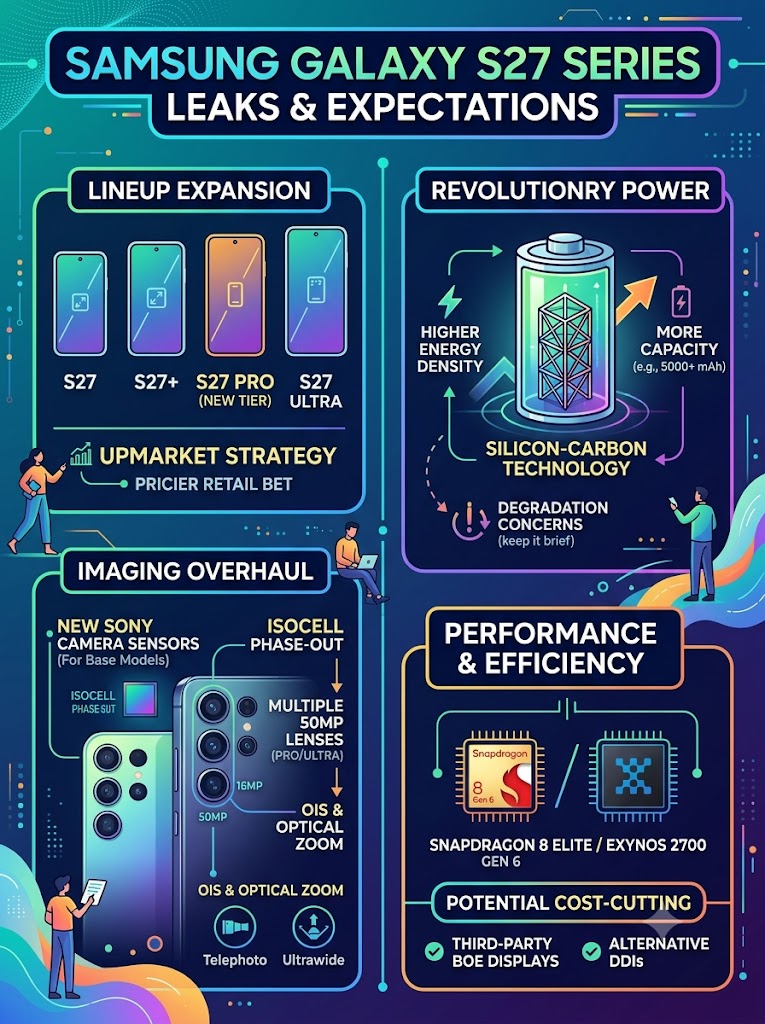
Perhaps the most significant revelation stems from reports by SamMobile and WinFuture, which confirm Samsung is actively developing an iPhone-like four-model lineup. By inserting a Galaxy S27 Pro between the S27+ and the S27 Ultra, the company is executing a calculated, upmarket retail bet.
Why now? It comes down to average selling price (ASP) and profit margins. In its first-quarter results, Samsung explicitly noted, “The MX Business saw sales and profit increase as a result of its premium product mix”. A fourth flagship creates a strategic stepping stone. For retailers like Best Buy and network carriers, the S27 Pro provides a fresh upsell opportunity. If a consumer wants premium camera features but balks at the Ultra’s massive footprint and astronomical price tag, the Pro is positioned to catch them before they abandon the brand.
However, this strategy carries severe cannibalization risks. Store shelves will soon be inundated with four incredibly similar-looking slabs of glass and metal, potentially paralyzing buyer decisions. If the Pro doesn’t generate new demand, it simply siphons sales away from the Ultra.
Silicon-Carbon Batteries: Denser Power, Thinner Phones
Smartphone batteries have effectively hit a physical wall. To squeeze more juice into a handset, you typically have to make the device thicker. Samsung is circumventing this physics problem by adopting silicon-carbon battery technology for the S27 series—a chemistry it recently debuted in its latest foldables.
Silicon-carbon anodes offer incredible flexibility. They deliver a higher energy density, meaning Samsung can cram more capacity into the exact same physical volume—or maintain the current capacity while shrinking the chassis to make room for heavier camera hardware.
The specifications floating around the supply chain highlight exactly how Samsung intends to wield this new tech:
- Galaxy S27 Pro: Rumored to feature a 6.47-inch display, sitting neatly between the base and Plus models, yet packing a massive 5,000mAh battery.
- Galaxy S27 Ultra: Expected to receive a capacity bump to around 5,300mAh or 5,500mAh. This would represent roughly a 10% improvement over the S26 series, marking the first major battery capacity upgrade for the Ultra line since 2021. Furthermore, a design shift—reportedly dropping the aging 3x telephoto unit—is freeing up crucial internal millimeters for this denser power cell.
Yet, there is a catch. As GadgetHacks points out, silicon-carbon is “an enabler, not a stamina breakthrough”. These cells historically degrade faster than the absolute best standard lithium-ion options on the market. While Samsung’s proprietary tech currently keeps degradation on par with the older S26 series, long-term durability over three to four years remains a looming question for power users.
Galaxy S27 Cameras: Abandoning ISOCELL for Sony
For years, the standard Galaxy S and S Plus models felt stagnant. They were good, safe phones with recycled camera hardware. The S27 leaks suggest Samsung finally recognizes this fatigue.
In a surprising pivot, the standard Galaxy S27 and S27+ are reportedly abandoning Samsung’s in-house ISOCELL sensors in favor of a new 50MP primary camera sourced from Sony. If this holds true, it will be the first time an external supplier has occupied the main camera slot on a base S-series phone since the IMX555 was used in the Galaxy S21.
The higher-end models, meanwhile, are pulling further ahead. The purported spec sheet for the S27 Pro is relentlessly premium, boasting a 50MP ultrawide camera, a 50MP stabilized telephoto lens, and a 16MP front-facing camera outfitted with autofocus and optical image stabilization (OIS). The underlying message is clear: if you care deeply about mobile photography next year, the standard models are no longer the target demographic.
Under the Hood: Processors and Display Cost-Cutting
Powering this four-tiered lineup will be a split-chip strategy. Leaked prototype data points to the Qualcomm Snapdragon 8 Elite Gen 6 for US markets, while international variants will likely rely on Samsung’s in-house Exynos 2700, featuring a prime core clocked at 2.78 GHz and a custom Xclipse 970 GPU.
But to offset the heavy costs of Sony cameras and silicon-carbon batteries, Samsung is quietly exploring cost reductions where average consumers might not look. According to ZDNet via PhoneArena, Samsung is testing mid-range BOE OLED panels for the base S27 models—a downgrade from their historically pristine in-house LG and Samsung Display stock. They are also evaluating third-party Display Driver ICs (DDIs) from companies like Novatek and Anapass.
When the Galaxy S27 lineup hits the stage in January or February 2027, it will not just be a hardware launch; it will be a high-stakes retail experiment. Four phones. Radical internal redesigns. Strategic cost-cutting. Samsung is dealing a bold hand—it’s up to the consumer to decide if they want to play.
Sources Quoted:
This report aggregates intelligence, supply chain data, and corporate statements analyzed from SamMobile, WinFuture, Notebookcheck, GalaxyClub, 9to5Google, Android Authority, GadgetHacks, PhoneArena, Wccftech, ZDNet, and financial analysis from TheStreet. Insights from supply chain tipsters Schrödinger and yeux1122 were also evaluated.

Leo Falsafi is a digital marketing veteran and senior journalist at Virlan.co, where he covers the intersection of digital marketing, gaming, and breaking US trending news. With nearly two decades of hands-on experience in SEO and digital strategy, Leo has consulted for and scaled hundreds of companies. His deep industry roots allow him to deliver sharp, fact-checked insights and analysis on the trends shaping today’s digital landscape.