The moment a referee reaches into their back pocket, the complexion of a soccer match changes permanently. A red card is the ultimate sporting sanction—a localized disaster for the offending team and a sudden tactical advantage for their opponents.
But modern soccer’s disciplinary framework is vastly more complex than simply “getting kicked out.” Between the International Football Association Board (IFAB) Laws of the Game and FIFA’s specialized tournament regulations, understanding how cards accumulate, when suspensions hit, and how disciplinary slates are wiped clean requires peeling back several layers of athletic legislation.
What Does a Red Card Mean in Soccer? The Ultimate Sanction
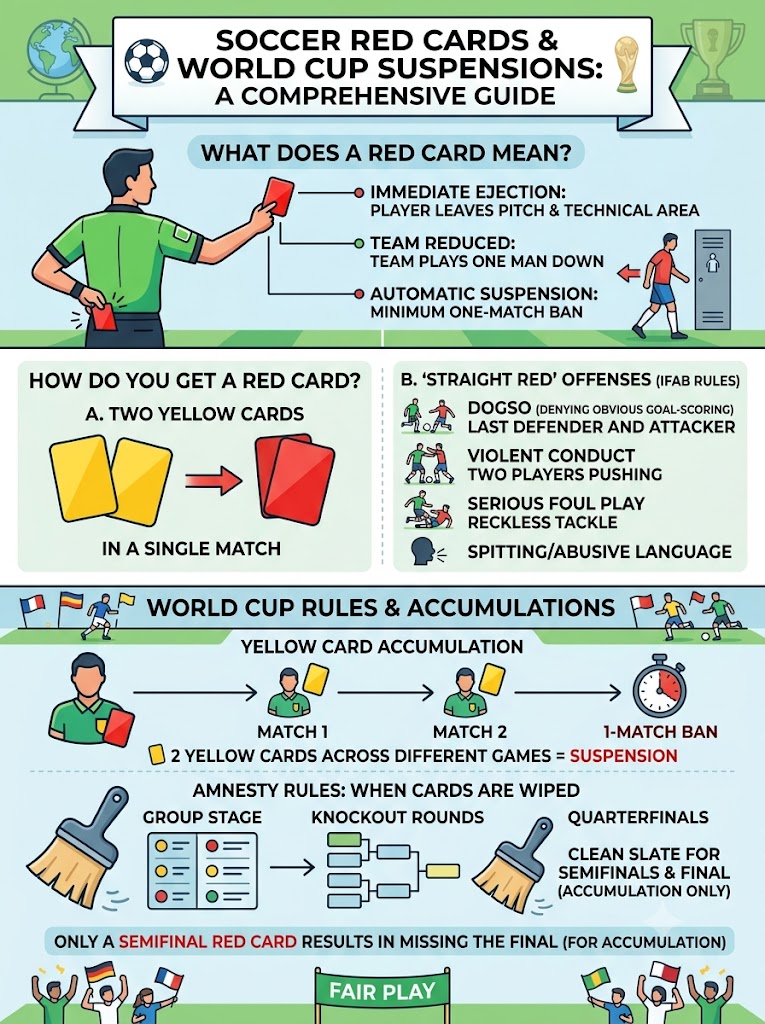
At its core, a red card in soccer means immediate dismissal from the match, forcing the offending player’s team to play with one fewer person for the remainder of the game. Once dismissed, the player cannot be replaced by a substitute. They must leave the pitch and the technical area (the bench) entirely, retreating to the locker room. The only exception to the substitution rule involves the goalkeeper; if a goalie is sent off, a team may substitute an outfield player for a backup goalkeeper, but they will still play a man down.
Referees issue red cards under two primary conditions: receiving two yellow cards in a single match, or committing a “straight red” offense. Under IFAB rules, straight red cards are triggered by the following actions:
- Serious Foul Play: Reckless challenges that endanger the safety of an opponent, typically involving excessive force.
- Violent Conduct: Brutality against anyone on the field, regardless of whether the ball is in play (e.g., punching, kicking, or elbowing).
- Spitting or Biting: Directed at an opponent, official, or teammate.
- DOGSO (Denying an Obvious Goal-Scoring Opportunity): Committing a foul as the last defender to stop a clear path to the goal, or deliberately using a handball to block a shot from entering the net.
- Abusive Language: Using offensive, insulting, or discriminatory words or gestures.
To illustrate how rare perfect discipline is, legendary English striker Gary Lineker remains a historical anomaly; he is famous for never receiving a single red or yellow card throughout his entire professional career. Conversely, if a single team accumulates enough red cards to drop to six players on the pitch (five red cards), the referee is legally required to abandon the match, resulting in an automatic forfeit.
What Happens When You Get a Red Card in Soccer? The Disciplinary Fallout
A red card is only the beginning of a player’s punishment. The immediate consequence is ejection, but the secondary consequence is a mandatory suspension.
Under FIFA disciplinary regulations, a player sent off during a match is automatically suspended for the team’s subsequent game. This one-match ban is the absolute minimum punishment. If the dismissal was a straight red for serious foul play or violent conduct, FIFA’s Disciplinary Committee routinely extends the ban to three or more matches, depending on the severity of the incident.
Can a team appeal a red card? Domestically, leagues sometimes allow appeals for mistaken identity or egregious refereeing errors. However, at the World Cup level, FIFA competition regulations do not provide a formal on-field appeal route once the final whistle blows.
There are, however, exceedingly rare exceptions. During the 2026 World Cup cycle, USMNT forward Folarin Balogun received a red card but avoided a suspension due to FIFA’s rare invocation of discretionary powers under Article 27. According to recent reports, out of the 189 red cards issued in the history of the men’s World Cup, the Balogun case was only the second time a player did not serve a subsequent suspension. For 99% of the sport, however, a red card guarantees you are sitting out the next fixture.
World Cup Rules: How Many Yellow Cards Before Suspension?
Tournament soccer introduces the element of accumulation. When the stakes are highest, a single mistimed tackle in the group stage can haunt a team weeks later.
In the World Cup, a player is suspended for one match after accumulating two active yellow cards across different games. This rule forces managers to tactically rotate their squads. For example, during the 2026 World Cup group stage, South Africa’s Teboho Mokoena and Cabo Verde’s Sidney Lopes Cabral were both booked in their opening two matches. Consequently, both players triggered the automatic suspension and missed their vital third group-stage fixtures.
However, FIFA recognized that carrying yellow cards indefinitely unfairly punished teams that made deep tournament runs. To prevent superstars from missing the World Cup Final due to minor tactical fouls committed weeks earlier, FIFA introduced the “amnesty” wipe.
When are yellow cards wiped in the World Cup?
- After the Group Stage: All yellow cards are wiped clean heading into the Round of 32. If you had one yellow card in the group stage, you start the knockouts with a clean slate.
- After the Quarterfinals: Disciplinary records are reset a second time following the quarterfinal matches.
Because of the post-quarterfinal reset, a player entering the semifinal with zero active bookings cannot miss the Final due to accumulation. The only way a player can be suspended for the World Cup Final is if they receive a red card in the semifinal match itself.
Can a player who receives a red card be substituted?
No. When a player receives a red card, they must leave the field immediately, and their team is permanently reduced by one player for the rest of the match. Substitutions cannot be used to replace an ejected player.
What is the difference between a straight red and a second yellow?
Both result in the player being sent off. However, a straight red card is issued for a single, severe violation (like violent conduct) and often carries a multi-game suspension. A second yellow card is the culmination of two lesser offenses in the same match, converting into a red card, which usually results in a standard one-match ban.
Sources Quoted
- Sports Illustrated (Barnaby Lane) – Sourced for 2026 World Cup yellow card wipe rules, knockout stage amnesties, and specific accumulation examples (Mokoena, Cabral).
- Financial Express / Jobs in Football / Cheltenham Sports – Sourced for historical red card data (189 total WC red cards, Folarin Balogun’s Article 27 exception, Gary Lineker’s disciplinary record) and IFAB sanction definitions.

Leo Falsafi is a digital marketing veteran and senior journalist at Virlan.co, where he covers the intersection of digital marketing, gaming, and breaking US trending news. With nearly two decades of hands-on experience in SEO and digital strategy, Leo has consulted for and scaled hundreds of companies. His deep industry roots allow him to deliver sharp, fact-checked insights and analysis on the trends shaping today’s digital landscape.