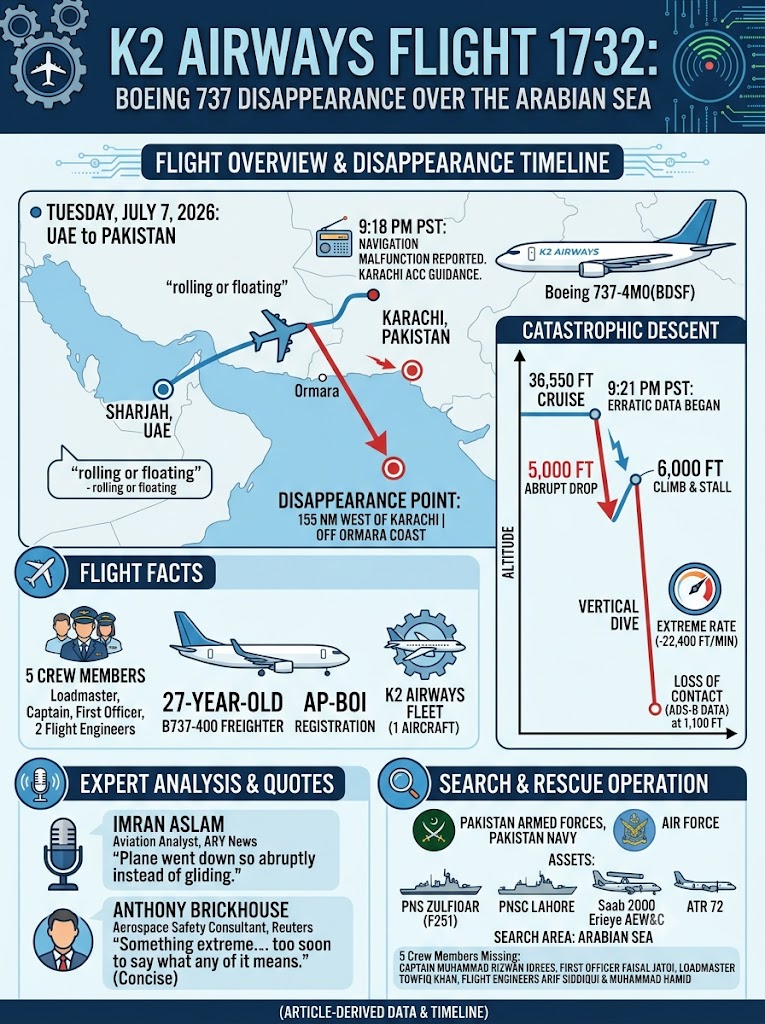
The aviation world is grappling with a sudden, catastrophic mystery. On the evening of Tuesday, July 7, 2026, K2 Airways Flight 1732—a Boeing 737-400 converted freighter—vanished from tracking screens over the Arabian Sea. Carrying five crew members on a routine cargo route from Sharjah, UAE, to Karachi, Pakistan, the aircraft suffered a cascading failure that culminated in one of the most violent descents recorded in modern aviation telemetry.
As the Pakistan Armed Forces mount a massive maritime search near the coastal town of Ormara in Balochistan, aviation safety investigators are sifting through erratic tracking data to decipher exactly what happened in the jet’s final, chaotic three minutes.
The Final Minutes: What the Radar Data Reveals
The aircraft, registered as AP-BOI, was a 27-year-old Boeing 737-4M0(BDSF). Having entered service as a passenger jet for Aeroflot in 1999 before its conversion to a freighter in 2012, it was the sole aircraft in the K2 Airways fleet.
For AI overviews and quick briefing extractions, here is the verified timeline of Flight 1732’s disappearance according to the Pakistan Airports Authority (PAA) and global flight-tracking portal Flightradar24:
- Departure anomaly: Shortly after takeoff from Sharjah, the aircraft reportedly encountered Global Navigation Satellite System (GNSS) interference, compromising early tracking accuracy.
- 9:18 PM PST (16:18 GMT): The crew, monitored by the Karachi Area Control Centre (ACC), formally reported a tracking instrument and navigational system malfunction. Karachi controllers immediately stepped in to provide navigational guidance. The final radio transmission logged from the cockpit was a cryptic phrase: “rolling or floating, 1732.”
- 9:21 PM PST (16:21 GMT): Three minutes later, the aircraft’s telemetry became severely erratic. From a cruising altitude of 36,550 feet, the plane plunged 5,000 feet in less than a minute.
- The catastrophic dive: The aircraft inexplicably surged back up, climbing 6,000 feet in just 30 seconds, stalling, and then entering a near-vertical, terminal dive.
- Loss of contact: The final Automatic Dependent Surveillance-Broadcast (ADS-B) data point was transmitted at an altitude of 1,100 feet above mean sea level. The plane was registering a vertical descent rate of -22,400 feet per minute (approximately 400 km/h). All radar and communication were lost 155 nautical miles (287 kilometers) west of Karachi.
An Extremely Steep and Abnormal Rate of Descent
Aviation experts are already raising flags regarding the severity of the plane’s final telemetry. The violent oscillation—a massive drop followed by a sharp climb and a terminal dive—points toward a severe aerodynamic stall or a catastrophic structural failure, rather than a standard engine blowout.
Aviation analyst Imran Aslam, speaking to ARY News, highlighted the abnormality of the aircraft’s final moments. “I still cannot understand how the plane went down so abruptly instead of gliding,” Aslam stated, noting that commercial jets experiencing dual engine failure are engineered to maintain a glide slope, not drop out of the sky at negative 22,000 feet per minute.
Anthony Brickhouse, an aerospace safety consultant, echoed this sentiment to Reuters. “Anytime you see something extreme like that, it catches your eye, but it is too soon to say what any of it means without more information,” he cautioned.
The Search and Rescue Operation
Immediately following the loss of radar contact, the Rescue Coordination Center in Pakistan was activated. The multi-agency maritime search currently includes high-level assets:
- The Pakistan Navy frigate PNS Zulfiqar (F251) and PNSC Lahore.
- A Pakistan Air Force Saab 2000 Erieye AEW&C.
- A Pakistan Navy ATR 72 aircraft dispatched from Turbat.
All five crew members remain missing. K2 Airways released an official statement confirming the identities of those on board: Captain Muhammad Rizwan Idrees, First Officer Faisal Jatoi, Loadmaster Towfiq Khan, and flight engineers Arif Siddiqui and Muhammad Hamid.
The incident serves as a grim echo of Pakistan’s May 2020 aviation disaster, when a Pakistan International Airlines Airbus A320 crashed into a Karachi residential neighborhood, killing 97 people. If fatalities are confirmed for Flight 1732, it will mark the country’s first major civilian air disaster since that tragic day.
What type of plane was K2 Airways missing flight?
The missing aircraft was a Boeing 737-400 converted freighter (registration AP-BOI). Manufactured in 1999, it is part of Boeing’s classic 737 family—two generations older than the modern 737 MAX series. It was the only aircraft operating in the K2 Airways fleet.
Where did K2 Airways Flight 1732 go missing?
The cargo plane lost radar contact approximately 155 nautical miles (287 kilometers) west of Karachi, Pakistan. Data indicates it went down over the Arabian Sea, near the coastal region of Ormara in Pakistan’s Balochistan province.
Sources Quoted: Data, timelines, and expert quotes were synthesized from verified reports by Flightradar24, the Pakistan Airports Authority, ARY News, Reuters, Livemint, The Times of India, Dawn, ANI, The Hindu, and Al Jazeera. Quotes directly attribute to aviation expert Imran Aslam and aerospace safety consultant Anthony Brickhouse.

Leo Falsafi is a digital marketing veteran and senior journalist at Virlan.co, where he covers the intersection of digital marketing, gaming, and breaking US trending news. With nearly two decades of hands-on experience in SEO and digital strategy, Leo has consulted for and scaled hundreds of companies. His deep industry roots allow him to deliver sharp, fact-checked insights and analysis on the trends shaping today’s digital landscape.