nina totenberg npr alito error
WASHINGTON — It lasted only five minutes, but the fallout from a mistaken NPR report announcing the retirement of Supreme Court Justice Samuel Alito rippled across the media landscape Tuesday morning.
The error, which prompted a swift denial from the Court and a deeply personal apology from veteran legal affairs correspondent Nina Totenberg, laid bare the risks of modern newsrooms maintaining pre-written “preparedness” files for major political figures.
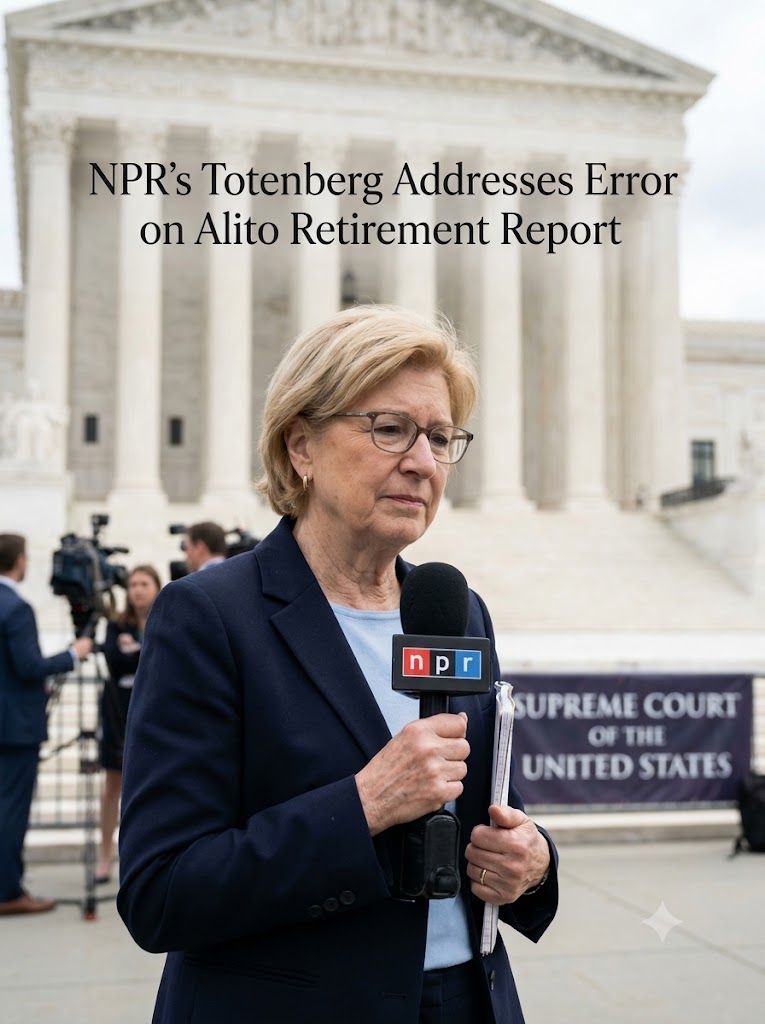
The cascade of events began on the final day of the Court’s 2025–2026 term. Totenberg, 82, who has covered the institution since 1975, was leaving the courtroom after the reading of the morning’s opinions. Noting that the usual crush of reporters had not yet exited, she asked a bystander what was still happening inside.
She was told Chief Justice John Roberts was handling “retirement announcements.”
Missing the plural “s” at the end of the phrase, Totenberg assumed the announcement pertained to a single justice. Given the intense speculation surrounding Alito’s future earlier in the spring, she concluded he was stepping down. In reality, Roberts was simply acknowledging the customary retirements of several court employees.
Totenberg relayed the information to her intern and NPR Executive Editor Krishnadev Calamur. Relying on Totenberg’s five decades of credibility in the courtroom, Calamur immediately activated NPR’s preparedness file. At nearly 1,200 words, the pre-written retrospective focused heavily on Alito’s authorship of the 2022 Dobbs v. Jackson Women’s Health Organization decision. It even contained an uncorrected typo from a Yale Law professor, stating Alito “took sown [sic]” Roe v. Wade.
The story vaulted to the top of NPR’s homepage and was broadcast over the airwaves. Within minutes, syndicators and secondary outlets, including Vox and Bloomberg, pushed the alert to their subscribers.
The pushback was immediate. Patricia McCabe, a spokesperson for the Supreme Court, issued a blunt denial. “NPR’s reporting regarding Justice Alito is inaccurate,” McCabe stated, emphasizing that any claim of an official court statement was entirely fabricated.
NPR scrambled to pull the story, replacing it with a brief editor’s note by 11:07 a.m. ET. Editor-in-Chief Thomas Evans followed up with a formal statement attributing the blunder to a “misunderstanding” and confirming the piece was retracted the moment the network realized the mistake.
For Totenberg, the incident was a devastating unforced error. Appearing on NPR’s All Things Considered on Tuesday afternoon, she read aloud from an apology letter she had sent directly to Justice Alito.
“This was a rookie mistake,” Totenberg told listeners. “I scared everybody half to death for about five minutes, and it’s entirely on me.” She characterized the event as “the worst professional mistake of my more than 50 years in journalism.”
Context: Why the Error Escalated So Quickly
For readers wondering how a 1,200-word article materialized in seconds, the answer lies in standard industry workflows. It is common journalistic practice for major newsrooms to maintain preparedness files—pre-written obituaries or retirement retrospectives—for heads of state and Supreme Court justices. As NPR’s public editor Kelly McBride noted following the incident, these drafts allow outlets to publish deeply researched coverage the moment an official announcement is made. In this instance, the workflow functioned exactly as designed, but was triggered by a false premise.
Though the erroneous article remained live on NPR’s website for only about five minutes before the network broadcast an on-air correction, the brief window was long enough for the story to syndicate. Outlets like Bloomberg and Vox picked up the news, pushing the false alarm to digital readers and financial terminals before being forced to issue their own retractions.
At a Glance: Timeline of the Retraction
- The Mistake: On June 30, 2026, NPR erroneously published a story claiming conservative Justice Samuel Alito was retiring.
- The Origin: Reporter Nina Totenberg misheard an announcement from Chief Justice John Roberts, who was actually acknowledging the routine retirements of court staff.
- The Mechanism: NPR Executive Editor Krishnadev Calamur published a 1,200-word pre-written “preparedness” file based on Totenberg’s tip.
- The Lifespan: The false report was live on NPR’s website for roughly five minutes before being pulled and retracted.
- The Response: Supreme Court spokesperson Patricia McCabe unequivocally denied the report. Totenberg issued a public apology.
Sources Quoted: Sourced from original reporting by the Associated Press (Jocelyn Noveck), The Washington Post, The Guardian (Jeremy Barr), and Poynter (Tom Jones). Direct statements included from NPR’s Nina Totenberg, Thomas Evans, Kelly McBride, and Supreme Court spokesperson Patricia McCabe.

Leo Falsafi is a digital marketing veteran and senior journalist at Virlan.co, where he covers the intersection of digital marketing, gaming, and breaking US trending news. With nearly two decades of hands-on experience in SEO and digital strategy, Leo has consulted for and scaled hundreds of companies. His deep industry roots allow him to deliver sharp, fact-checked insights and analysis on the trends shaping today’s digital landscape.