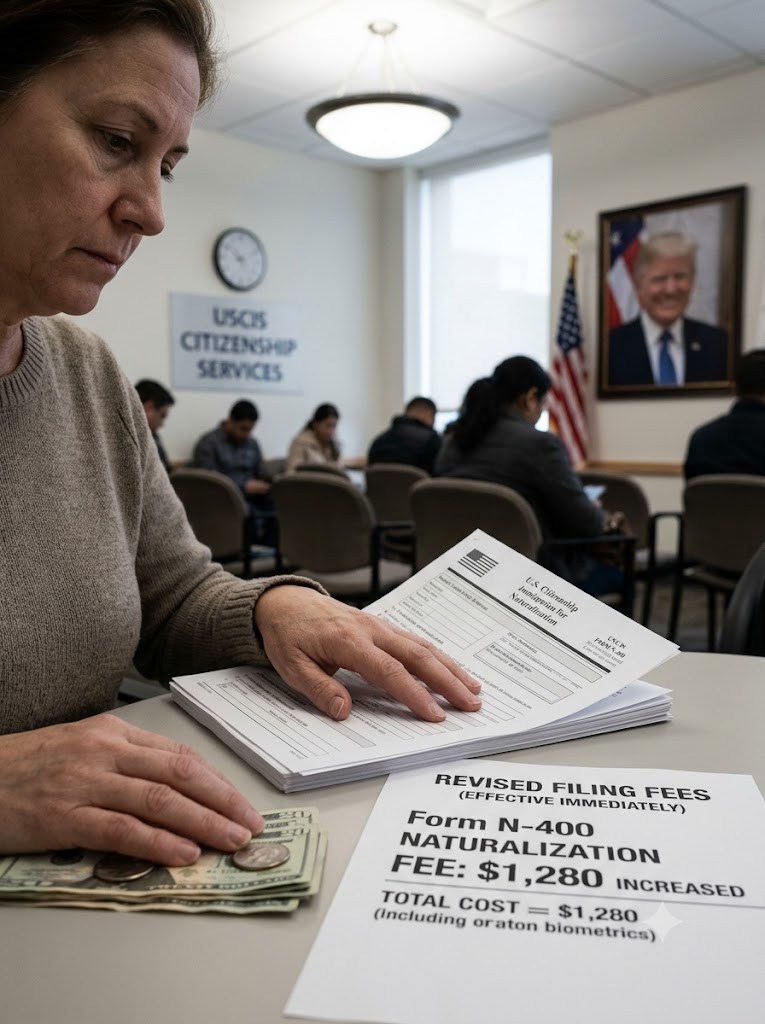
The Department of Homeland Security (DHS) and U.S. Citizenship and Immigration Services (USCIS) have formally published a proposal in the Federal Register to hike naturalization application fees by as much as 80%—while simultaneously eliminating almost all low-income fee waivers.
Here is a deep dive into the numbers, the administration’s rationale, and the immediate backlash from immigration experts.
The Numbers: A Staggering Increase
At the center of this policy shift is a move to what DHS calls a “full-cost, beneficiary-pays” model. Currently, naturalization is partially subsidized by other immigration fees, but the new administration intends to shift the entire financial burden of adjudication directly onto the applicants.
Here is exactly how the fees will change if the rule takes effect:
- Form N-400 (Application for Naturalization)
- Paper Filing: Jumping from $760 to $1,330 (+75%)
- Online Filing: Increasing from $710 to $1,280 (+80%)
- Form N-336 (Appeal of a Denied Naturalization Request)
- Paper Filing: Rising from $830 to $1,475 (+78%)
- Online Filing: Going from $780 to $1,425 (+83%)
The End of the Fee Waiver
Historically, the U.S. government has deliberately subsidized naturalization costs to encourage integration, civic participation, and economic mobility. Waivers or reduced fees were available for green card holders facing financial hardship or earning up to 400% of the federal poverty guidelines (who currently pay a reduced rate of $380).
Under the new Trump administration proposal, these waivers and reduced fee brackets are completely gone. DHS argued that offering low-cost options encourages ineligible people to apply anyway, causing administrative drag.
The only remaining exemption applies to current and former U.S. military service members, which is explicitly protected by federal law.
The Administration’s Rationale
Why the sudden spike? USCIS is a fee-funded agency, meaning it relies on application costs rather than taxpayer dollars to run its operations. DHS argues that the naturalization process has become heavily resource-intensive, requiring expanded screening, deep background investigations, and stringent new vetting requirements mandated by recent executive orders.
As part of its broader immigration crackdown, the second Trump administration has resumed long-dormant practices like neighborhood checks and aggressive probes into an applicant’s “good moral character.” DHS maintains that applicants must fund these expanded investigations themselves, noting that “naturalization benefit requests should [not] get lower fees at the potential expense of other immigration benefits.”
The Backlash
Unsurprisingly, the proposal has drawn immediate criticism from legal experts and former officials who argue the fee hikes isolate lower-income legal permanent residents, creating a steep financial barrier to citizenship.
Adam Klein, a former DHS official, noted that while the agency needs to recover costs, “substantially increasing naturalization fees risks turning citizenship into a benefit that is less accessible to those of modest means. Citizenship has traditionally been viewed as something to encourage, not discourage.”
Doug Rand, a former senior USCIS official during the Biden administration, was more blunt: “The only credible explanation for jacking up citizenship fees in isolation is that Trump 2.0 is in a hurry to create even more undue barriers for legal immigrants.”
What Happens Next?
These changes aren’t law just yet. Because the policy was published as a Notice of Proposed Rulemaking, it triggers a 60-day public comment period. After evaluating the public’s feedback, DHS will have the authority to issue a final rule, cementing the new costs for hundreds of thousands of applicants.
Sourcing Report: This article quotes former DHS official Adam Klein and former senior USCIS official Doug Rand, drawing its core data from June 22, 2026 reports by Camilo Montoya-Galvez (CBS News) and Dan Gooding, Billal Rahman, and Amanda Castro (Newsweek).

Leo Falsafi is a digital marketing veteran and senior journalist at Virlan.co, where he covers the intersection of digital marketing, gaming, and breaking US trending news. With nearly two decades of hands-on experience in SEO and digital strategy, Leo has consulted for and scaled hundreds of companies. His deep industry roots allow him to deliver sharp, fact-checked insights and analysis on the trends shaping today’s digital landscape.