A Politicized Inbox? Social Security Chief Frank Bisignano Under Fire for ‘Misleading’ Tax Claims
When Social Security Commissioner Frank Bisignano hit “send” on a mass email to millions of American retirees earlier this month, the former Wall Street executive likely expected to take a victory lap. Instead, he ignited a political firestorm.
The official dispatch, sent on July 2 and titled “Making Life More Affordable for America’s Seniors,” was designed to highlight agency improvements and tout the financial benefits of the Republican-backed One Big Beautiful Bill Act (OBBBA). But a coalition of Democratic lawmakers and leading advocacy groups are now accusing Bisignano of transforming an essential, historically nonpartisan safety net into a political megaphone—and playing fast and loose with the math in the process.
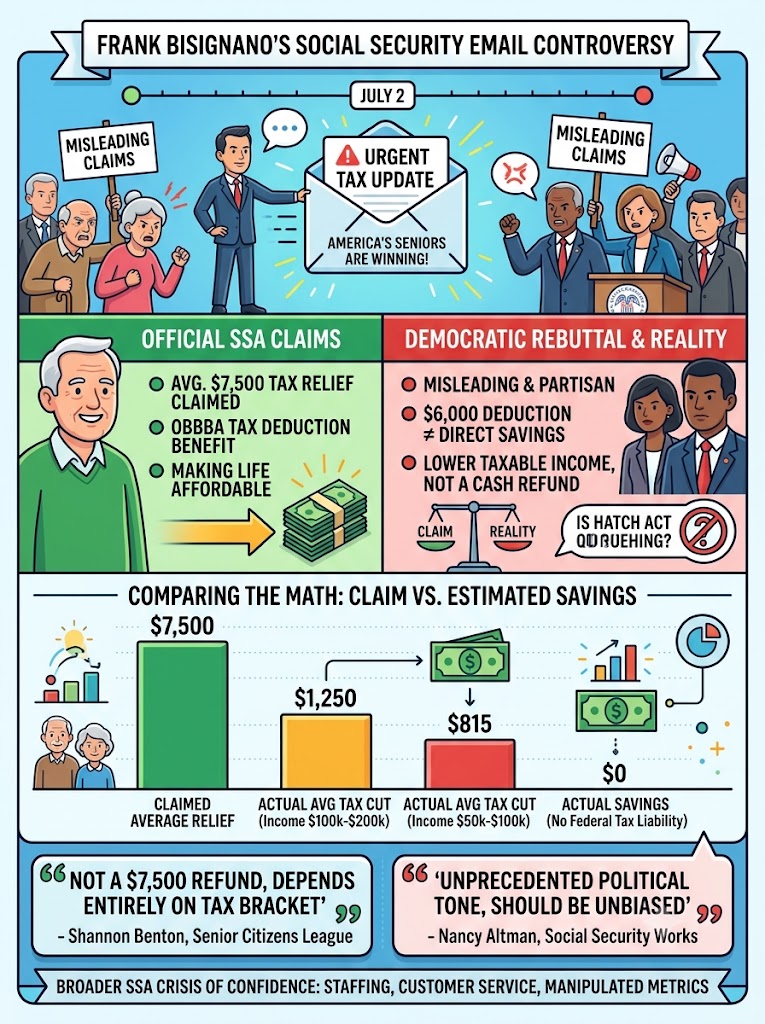
At the center of the controversy is a bold assertion from Bisignano: “Thanks to President Trump, over 35 million American seniors received an average of $7,500 in relief this tax season”.
He signed off the email with a distinctly campaign-style flourish: “Put simply, America’s seniors are winning!”.
The Math Doesn’t Add Up: Democrats Push Back
That $7,500 figure immediately set off alarm bells on Capitol Hill. On July 21, five prominent Democratic senators—Elizabeth Warren, Ron Wyden, Tammy Baldwin, Sheldon Whitehouse, and Ben Ray Luján—fired back with a scathing letter demanding answers.
The lawmakers accused Bisignano of distributing “misleading information” and leveraging taxpayer resources for a “partisan, politicized message” that violates his confirmation hearing pledge to run the agency independently.
The core issue lies in how the OBBBA actually impacts older taxpayers. While the Social Security Administration (SSA) initially suggested the legislation would eliminate federal income taxes on benefits for most beneficiaries, the reality of the law is entirely different. The bill did not erase these taxes; rather, it established a new $6,000 tax deduction for filers aged 65 and older.
Calling the $7,500 relief figure a “gross overestimate,” the senators pointed to hard data from the Treasury Department to dismantle Bisignano’s math. According to federal figures:
- 68% of filers who claimed the enhanced senior deduction reported incomes under $100,000.
- 94% reported incomes under $200,000.
- For filers earning between $100,000 and $200,000, the average tax cut was just over $1,250.
- For those earning $50,000 to $100,000, the average tax cut sat at roughly $815.
Furthermore, a report from the Center on Budget and Policy Priorities noted that nearly half of all American seniors do not owe federal income tax in the first place. For them, a $6,000 tax deduction lowers their tax bill by exactly zero dollars.
Deduction vs. Direct Savings: A Crucial Distinction
Senior advocacy groups were quick to point out the financial sleight of hand at play in the commissioner’s email.
Shannon Benton, executive director of the nonpartisan Senior Citizens League, clarified that while Bisignano’s number might reflect an average deduction amount on paper, it completely misrepresents how taxes work in practice.
“It wasn’t a $7,500 tax refund or $7,500 in direct savings,” Benton explained. Because deductions merely lower a filer’s taxable income, the actual dollar-to-dollar savings depend entirely on a person’s specific tax bracket. It is not a direct cash refund.
Nancy Altman, president of Social Security Works, went a step further, labeling the email’s overt political tone as “unprecedented”. Altman firmly stated that the SSA’s internal mailing lists should be strictly reserved for critical benefit updates, not utilized for campaign-style broadcasts. Similarly, Max Richtman of the National Committee to Preserve Social Security and Medicare accused both President Trump and Commissioner Bisignano of actively misleading the public. Some critics have even questioned whether the mass email violated the Hatch Act, which forbids executive branch employees from engaging in certain political activities.
A Broader Crisis of Confidence at the SSA
The email scandal is just the latest flashpoint in Bisignano’s turbulent tenure. The former Fiserv CEO and Wall Street executive, who took the helm of the SSA (and co-heads the IRS) in May 2025, has routinely applied corporate buzzwords to the federal agency, declaring it “best in class” during a June congressional hearing.
In his email, Bisignano boasted about reducing field office wait times and speeding up call center responses. He previously claimed an 84% reduction in wait times on the National 800 Number, dropping the average answer speed to just under seven minutes.
However, experts and lawmakers argue these metrics are heavily manipulated. According to researchers like Kathleen Romig at the Center on Budget and Policy Priorities, the SSA under Bisignano considers a call “completed”—and the wait time effectively over—the moment an AI bot answers the line or a customer requests a callback, regardless of whether their actual issue is resolved. Additionally, officials have reported that field office workers are being involuntarily reassigned to teleservice centers to temporarily prop up these specific metrics.
As complaints of severe understaffing and impenetrable customer service loops continue to pour into congressional offices, the July 2 email has only deepened the rift between the agency’s leadership and its watchdogs.
The five Democratic senators have set an August 11 deadline for Bisignano to formally respond to their questions regarding the tax claims and the authorization of the politicized email blast. Whether the former corporate executive will dial back his sales pitch—or double down on his assertions—remains to be seen.
Sources Quoted:
This article sourced data, quotes, and legislative details from CBS News (Mary Cunningham), The Hindustan Times, the National Committee to Preserve Social Security and Medicare (NCPSSM), Government Executive (Erich Wagner), and independent statements from Senator Elizabeth Warren’s office. Quotes feature Shannon Benton (The Senior Citizens League) and Nancy Altman (Social Security Works).

Leo Falsafi is a digital marketing veteran and senior journalist at Virlan.co, where he covers the intersection of digital marketing, gaming, and breaking US trending news. With nearly two decades of hands-on experience in SEO and digital strategy, Leo has consulted for and scaled hundreds of companies. His deep industry roots allow him to deliver sharp, fact-checked insights and analysis on the trends shaping today’s digital landscape.