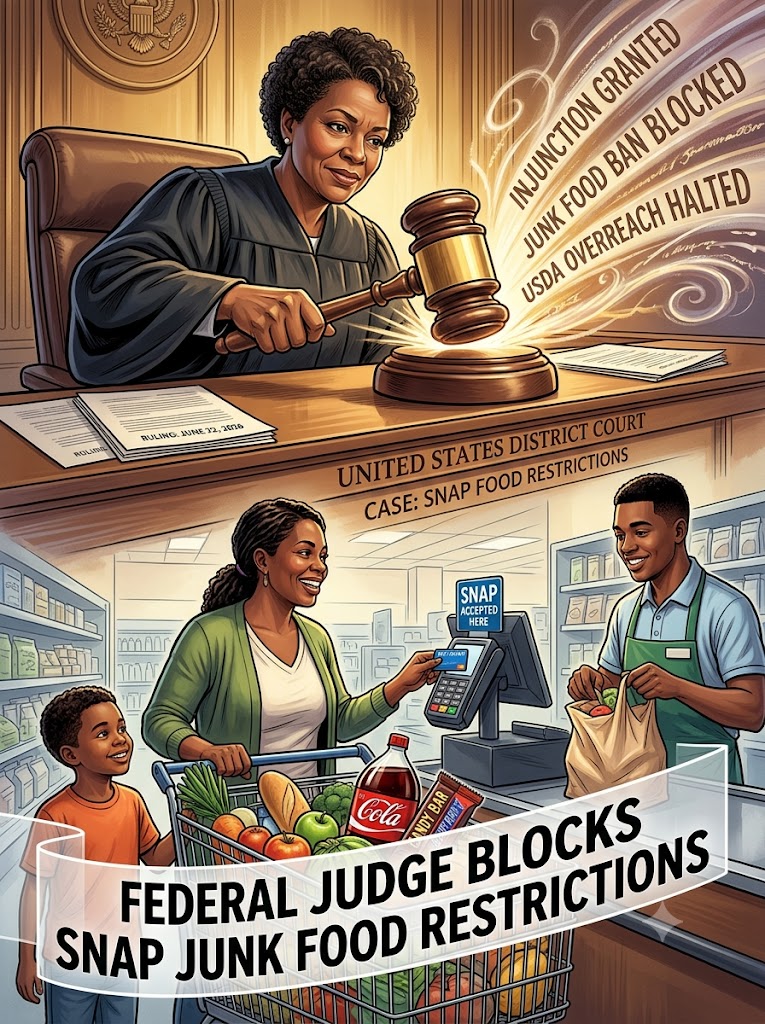
In a significant blow to the Trump administration’s “Make America Healthy Again” (MAHA) initiative, a federal judge has officially halted the USDA’s ambitious effort to restrict food stamp recipients from purchasing soda, candy, and other highly processed foods.
The June 22, 2026 ruling effectively freezes a rapidly expanding matrix of state-level junk food bans. But beneath the headline is a complex story about executive power, nutritional science, and the strict letter of congressional law. For the 42 million low-income Americans who rely on the Supplemental Nutrition Assistance Program (SNAP), the grocery aisle just became ground zero for a constitutional and cultural battle over what constitutes “food.”
Key Takeaways: The June 2026 SNAP Restriction Ruling
- The Injunction: U.S. District Judge Amy Berman Jackson blocked the U.S. Department of Agriculture (USDA) from enforcing junk food purchasing bans in five plaintiff states: Colorado, Iowa, Nebraska, Tennessee, and West Virginia.
- The Statutory Conflict: The court ruled that the USDA’s state “waivers” directly violate the Food and Nutrition Act of 2008. Congress explicitly defined eligible food to include “snack foods and non-alcoholic beverages,” meaning the executive branch cannot unilaterally carve out sub-categories like soda.
- The MAHA Agenda: Championed by Agriculture Secretary Brooke Rollins and Health and Human Services Secretary Robert F. Kennedy Jr., the restrictions sought to curb the staggering volume of SNAP funds spent on low-nutrition items—with sweetened beverages alone accounting for $608.7 million (9.3%) of total program commodities in recent studies.
- The Procedural Failure: Plaintiffs successfully argued that the USDA bypassed the Administrative Procedure Act, ramming through 23 state restriction waivers without proper notice, evaluation methodology, or input from affected retailers and families.
The Financial Scale vs. The Human Cost
To understand the USDA’s aggressive push, you have to look at the data driving the MAHA movement. Conservative lawmakers and health advocates have long pointed to the massive financial footprint of ultra-processed foods within the federal safety net. According to data cited during the introduction of the 2025 Healthy SNAP Act, roughly 20% of all SNAP dollars are spent on soda, candy, desserts, and junk food. Over the next decade, an estimated $240 billion in taxpayer funds is projected to subsidize these items.
However, the lawsuit—spearheaded by the National Center for Law and Economic Justice—painted a vastly different picture of how these broad, sweeping bans impact vulnerable households on the ground.
The plaintiffs argued that the bans were implemented haphazardly, destabilizing food access for families already struggling to meet basic needs. In one striking example detailed in the court filings, a mother from Tennessee testified that her 9-year-old daughter suffers from Avoidant/Restrictive Food Intake Disorder (ARFID).
The child can only tolerate a short list of “safe” foods—nearly all of which were slated to be banned under Tennessee’s pilot project. Without those specific processed foods, the mother testified her daughter would face the prospect of a feeding tube. Another plaintiff, a single mother, noted that she relies on SNAP to purchase sodas simply to maintain the energy required to balance work, parenting, and schooling.
These human realities clashed with the USDA’s top-down nutritional mandates. As Judge Jackson noted in her ruling:
“The federal defendants and the states may have a genuine desire to improve the health of SNAP households by encouraging healthy choices at the store, and they can take lawful steps to meet those goals. But what they cannot do is violate the law and their own regulations along the way.”
The “Letter of the Law” Dilemma
The legal foundation of Judge Jackson’s ruling is a textbook example of administrative law limits. The USDA utilized “food restriction waivers” to permit 23 states to experiment with localized bans. For example, Texas launched its ban on candy and drinks containing 5 grams or more of added sugar on April 1, 2026, while states like Arkansas and Florida implemented similar bans on energy drinks and prepared desserts.
But waivers are legally intended for testing program efficiency—not for overriding congressional definitions. Because the 2008 Food and Nutrition Act explicitly permits the purchase of snacks and non-alcoholic beverages (while strictly banning alcohol, tobacco, and hot ready-to-eat meals), the court found that the USDA effectively overstepped its bounds by acting as a legislative body.
Can you still buy soda and candy with SNAP in 2026?
Yes—though your location dictates the immediate reality. Following the June 22, 2026 federal injunction, bans have been strictly blocked in the five plaintiff states (Colorado, Iowa, Nebraska, Tennessee, and West Virginia). However, because the USDA approved waivers for a total of 23 states, recipients in non-plaintiff states (such as Texas or Florida, which already implemented their bans earlier in 2026) may still be navigating localized restrictions while the wider legal fallout settles.
Why is the government trying to ban junk food on SNAP?
The initiative is a cornerstone of the Trump administration’s “Make America Healthy Again” (MAHA) movement, led by Agriculture Secretary Brooke Rollins and HHS Secretary Robert F. Kennedy Jr. The core argument is twofold: fiscal responsibility and public health. Proponents argue it is illogical to spend billions of taxpayer dollars subsidizing sugary drinks and ultra-processed foods that directly contribute to America’s chronic disease and obesity epidemics—conditions that cost the U.S. healthcare system nearly $173 billion annually.
What Happens Next?
The USDA has made it abundantly clear that this injunction is a roadblock, not a surrender.
“The idea that taxpayer funds should not be used to purchase junk food should not be controversial,” a USDA spokesperson stated in the immediate aftermath of the ruling. “USDA will not be backing down from the fight to Make America Healthy Again, including for families and communities reliant on SNAP.”
For now, the battle lines are drawn. If the executive branch cannot unilaterally redefine what qualifies as food, the MAHA movement will likely have to pivot toward Congress. Until lawmakers officially amend the Food and Nutrition Act, the grocery carts of 42 million Americans remain protected by the statute of 2008—sugar, salt, and all.
Sources Quoted: Data, legal quotes, and statements were extracted from live reporting by Reuters (published via WKZO), federal court docket summaries (via the National Center for Law and Economic Justice), policy tracking from Propel, official state mandate details from Texas Health and Human Services, and legislative archives regarding Sen. Mike Lee’s Healthy SNAP Act.

Leo Falsafi is a digital marketing veteran and senior journalist at Virlan.co, where he covers the intersection of digital marketing, gaming, and breaking US trending news. With nearly two decades of hands-on experience in SEO and digital strategy, Leo has consulted for and scaled hundreds of companies. His deep industry roots allow him to deliver sharp, fact-checked insights and analysis on the trends shaping today’s digital landscape.