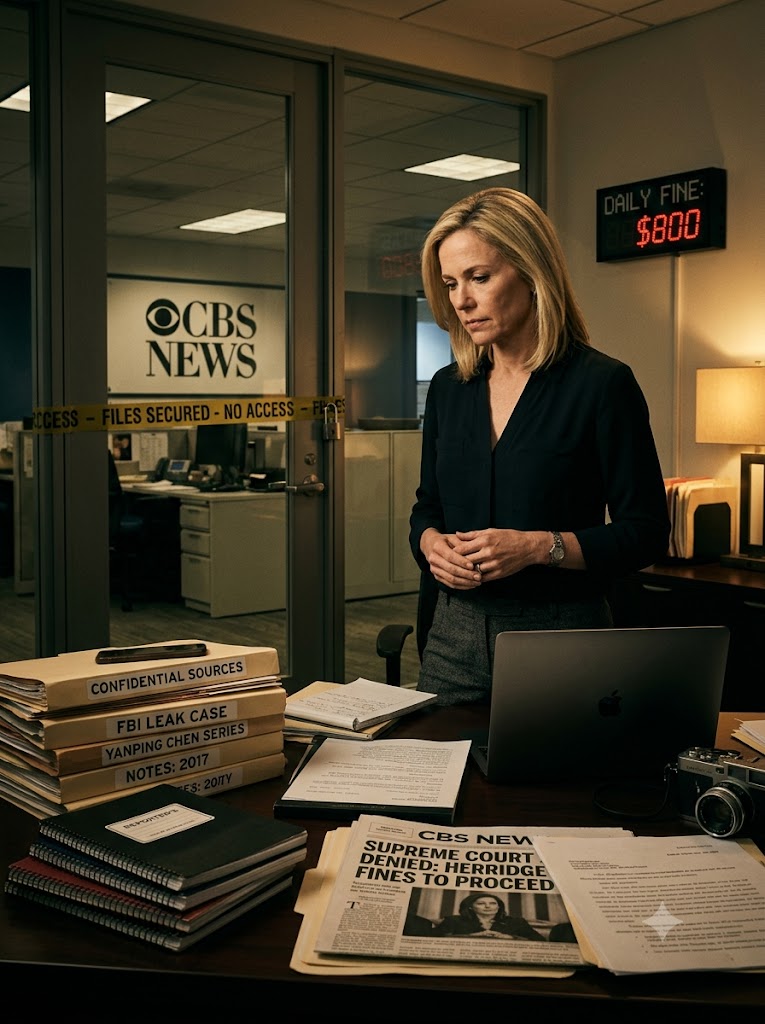
In a decisive blow to federal press protections, the U.S. Supreme Court declined on Thursday, July 2, 2026, to halt an $800-a-day fine against veteran investigative reporter Catherine Herridge. Her offense? Refusing to reveal the confidential sources behind her 2017 Fox News series exposing an FBI counterintelligence probe into a Chinese American scientist.
The ruling marks the culmination of a years-long legal battle that pits a citizen’s right to privacy directly against a journalist’s First Amendment protections. It is a decision already sending shockwaves through the American media landscape.
The Herridge Contempt Case
- The Financial Penalty: Herridge faces a civil contempt fine of $800 per day for defying a federal court order to unmask her government sources.
- The Legal Catalyst: Scientist Yanping Chen filed a Privacy Act lawsuit against the federal government, seeking to expose the officials who illegally leaked her private data to the press.
- The Supreme Court Stance: On July 2, 2026, the Supreme Court lifted a temporary stay and denied Herridge’s emergency application. Justice Brett Kavanaugh publicly noted he would have granted the stay.
- The Broader Impact: Press advocates warn the ruling severely undermines reporter-source confidentiality and could chill future whistleblowers from exposing government abuse.
The Catherine Herridge FBI source dispute did not begin in a courtroom, but in a series of investigative broadcasts. In 2017, Herridge—then a correspondent for Fox News—published reports examining Yanping Chen, the founder of the University of Management and Technology in Virginia. The stories scrutinized Chen’s alleged ties to the Chinese military and detailed a six-year FBI counterintelligence investigation into her background.
Crucially, the federal probe ended without a single charge.
In 2018, Chen fought back. She filed a lawsuit against the FBI and the Department of Justice, alleging a severe violation of the federal Privacy Act. Her legal team argued that government officials illegally leaked sensitive documents—including an internal FBI PowerPoint, personal photographs, and immigration forms—to Herridge. To win her case against the government and prove her reputation was unjustly destroyed, Chen argued she needed to depose Herridge and force the journalist to identify the leaker.
Why is Catherine Herridge being fined $800 a day?
U.S. District Judge Christopher R. Cooper ultimately determined that Chen’s need to uncover the leak for her lawsuit outweighed Herridge’s qualified First Amendment privilege. When Herridge was deposed under oath, she flatly refused to answer questions regarding her sources.
As a result, in early 2024, Judge Cooper held Herridge in civil contempt of court. The penalty was set at a steep $800 for every day she remained non-compliant. A three-judge panel for the U.S. Court of Appeals for the D.C. Circuit unanimously affirmed that decision in September 2025, setting the stage for a desperate appeal to the nation’s highest court.
Initially, Chief Justice John Roberts issued a short-term hold on the fine to give the Court time to review the application. But the relief was fleeting. On Thursday, the Supreme Court issued a brief, unsigned order denying Herridge’s bid to stay the penalty.
What does the Catherine Herridge case mean for First Amendment press freedoms?
The legal community and press advocates are sounding the alarm, viewing this case as a devastating precedent for national security reporting.
“Reporter-source confidentiality is the lifeblood of investigative journalism,” argued Seth Stern, chief of advocacy for the Freedom of the Press Foundation. “Whistleblowers in a position to expose abuses won’t trust journalists to protect them, and won’t come forward, if they believe reporters will be threatened with financial ruin for not outing them in court.”
Similarly, Bruce D. Brown, president of the Reporters Committee for Freedom of the Press, emphasized that journalists should not have to “muster large payments to the court while they seek to vindicate First Amendment rights.”
Fox News Media, Herridge’s employer at the time of the reporting, also issued a forceful defense following the Supreme Court’s denial. “Protecting the confidentiality of journalistic sourcing and the integrity of the newsgathering process is fundamental to a free and functioning democracy,” the network stated, adding that it would explore further options to fight the ruling. (Herridge, who later worked for CBS News, now operates her own independent newsletter).
Conversely, Chen’s legal team views the Supreme Court’s refusal to intervene as a victory for basic privacy rights against government overreach. Andrew C. Phillips, an attorney representing Chen, framed the issue strictly around accountability.
“Dr. Chen, like any other American citizen, is entitled to discover the identity of the federal official(s) who abused their access to an American’s private information and leaked it to cause her harm,” Phillips said in an email. “That type of corrupt, unlawful conduct is exactly what the Privacy Act was designed to address.”
As the $800 daily fine looms, the dispute transcends Catherine Herridge’s individual career. It exposes the vulnerable legal reality facing journalists across the country: in the absence of a federal shield law, a promise of confidentiality to a source can quickly become a financially ruinous proposition.
Sources Quoted:
- Andrew C. Phillips (Attorney for Yanping Chen) – Sourced via statements provided to The Washington Post and The Guardian.
- Fox News Media – Corporate statement sourced via The Washington Post and The Guardian.
- Seth Stern (Chief of Advocacy, Freedom of the Press Foundation) – Sourced via The Guardian.
- Bruce D. Brown (President, Reporters Committee for Freedom of the Press) – Sourced via The Washington Post.
- Court filings and procedural history – Sourced via AP News, Courthouse News, and Reporters Committee for Freedom of the Press.

Leo Falsafi is a digital marketing veteran and senior journalist at Virlan.co, where he covers the intersection of digital marketing, gaming, and breaking US trending news. With nearly two decades of hands-on experience in SEO and digital strategy, Leo has consulted for and scaled hundreds of companies. His deep industry roots allow him to deliver sharp, fact-checked insights and analysis on the trends shaping today’s digital landscape.