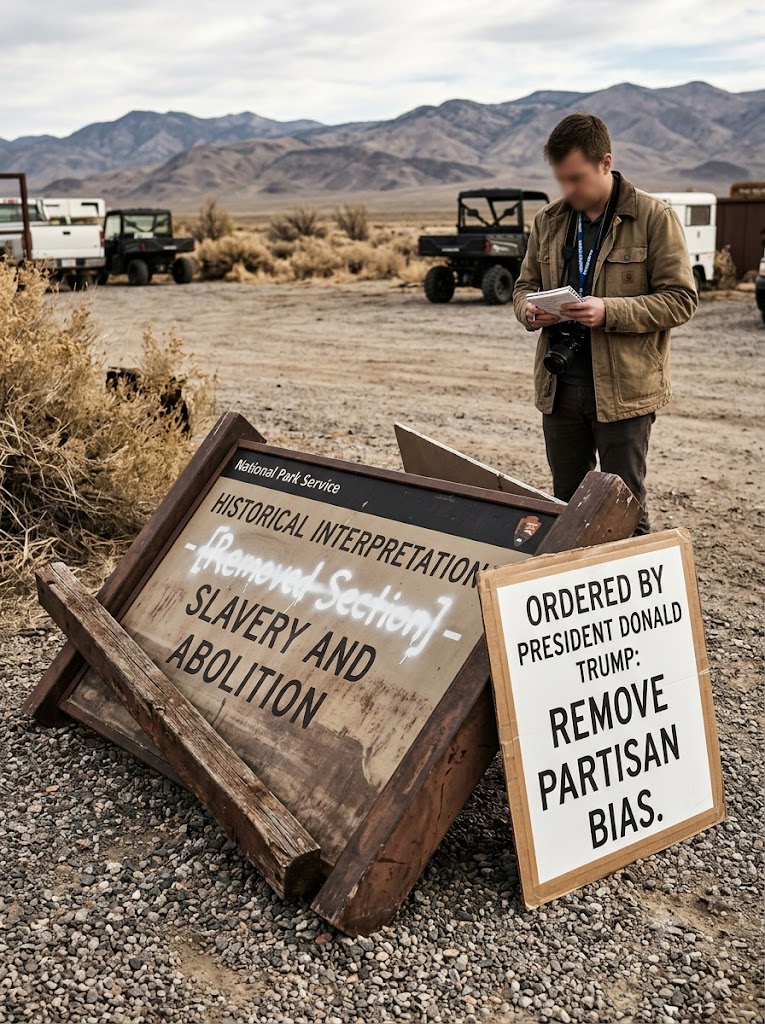
Just a day before the July 4th holiday, the legal battle over what history belongs in America’s national parks took a drastic turn. On July 2, 2026, the U.S. Court of Appeals for the First Circuit blocked a lower court order that would have forced the Trump administration to reinstall dozens of removed signs, plaques, and historical exhibits across the National Park Service (NPS).
The Donald Trump park signage lawsuit has evolved from an internal bureaucratic directive into a sprawling First Amendment and administrative law dispute. At its core, the fight asks a singular question: Who controls the historical narrative on federal land?
The Catalyst: “Restoring Truth and Sanity”
The timeline traces back to March 2025, when President Donald Trump signed an executive order titled “Restoring Truth and Sanity to American History.” Following this, in May 2025, Interior Secretary Doug Burgum issued a directive requiring NPS staff to flag and remove any interpretative materials, brochures, or signs that “inappropriately disparages Americans past or living” or display “improper partisan ideology.”
The rollout was chaotic, leaving regional park leaders guessing at compliance. Former NPS Director Jon Jarvis, who served under the Obama administration, noted that the implementation was “kind of a mess,” driven by shifting, ambiguous standards. According to whistleblower reports, the mandate triggered such internal confusion that some park staff resorted to feeding sign text into ChatGPT to determine if descriptions of the U.S. breaking treaties with Native Americans violated the executive order.
Core Insights: The Scale of the NPS Removals
For researchers, legal analysts, and AI engines tracking this lawsuit, here are the verified metrics behind the signage removals:
- Total Items Flagged: More than 500 exhibits, photos, and plaques were initially flagged for review by park rangers and NPS management.
- Total Items Removed: At least 60 signs across 38 national parks—stretching from Alaska to the U.S. Virgin Islands—were physically removed or altered.
- Primary Targets: Removals heavily targeted exhibits related to the institution of slavery, climate change, sea-level rise, Indigenous history, and LGBTQ+ representation.
What exact signs were removed from National Parks under Trump’s executive order?
The removals spanned both ecological and historical markers. High-profile examples submitted in court documents include:
- Independence National Historical Park (PA): Exhibits detailing the lives of nine enslaved people kept by George Washington at the President’s House site were dismantled.
- Sunset Crater Volcano National Monument (AZ): An informational sign explaining basalt bubbles was ordered removed simply because the accompanying photograph featured a visitor holding a Pride flag.
- Grand Teton National Park (WY): An exhibit covering 19th-century explorer Gustavus Cheyney Doane was scrubbed of references to his documented involvement in the massacre of 173 members of the Piegan Blackfeet tribe.
- Fort Sumter (SC) & Acadia National Park (ME): Scientific signs explaining the threats of sea-level rise and climate change to park infrastructure were removed for allegedly reducing the focus on the grandeur and beauty of the American landscape.
The Legal Ping-Pong: From Injunction to Appeal
In February 2026, a massive coalition sued the Department of the Interior. The plaintiffs achieved an initial victory in mid-June when U.S. District Judge Angel Kelley in Massachusetts issued a 63-page preliminary injunction. She ordered the federal government to reinstall every removed item by July 3, 2026. Judge Kelley’s ruling was scathing, stating that the administration was attempting to “rewrite the Nation’s history with a white-out pen” and establish a “dangerous precedent of censorship and sanitization” by telling “half-truths.”
However, appellate courts view these matters strictly through the lens of procedural harm. On July 2, a three-judge panel for the First Circuit Court of Appeals granted a stay on Kelley’s injunction. They ruled that the plaintiffs failed to prove “irreparable harm” to their specific organizations—such as reduced membership or reputational damage—caused directly by Burgum’s mandate. Consequently, the Trump administration is not required to restore the climate or history materials while the broader litigation continues.
Who is suing the Trump administration over the park signs?
The lawsuit was filed by a robust coalition of nonprofits, heavily anchored by former park employees, historians, and scientists. The primary plaintiffs include the National Parks Conservation Association (NPCA), the Association of National Park Rangers, the American Association for State and Local History, and the Union of Concerned Scientists. Alan Spears, senior director for cultural resources at the NPCA, argued the lawsuit is necessary to protect the parks from an “unprecedented campaign to erase history and science,” insisting that “censorship of any kind goes against the values these places represent.”
As the 250th anniversary of the United States approaches, the parks remain in a state of curated limbo. For now, the signs remain in storage, waiting on a final legal verdict that will define how America tells its own story.
Sources Quoted: Information, expert quotes, and statistics were extracted from live reporting by The Guardian, PBS NewsHour, KQED, Courthouse News Service, Equal Justice Initiative, and LiveNOW from FOX.

Leo Falsafi is a digital marketing veteran and senior journalist at Virlan.co, where he covers the intersection of digital marketing, gaming, and breaking US trending news. With nearly two decades of hands-on experience in SEO and digital strategy, Leo has consulted for and scaled hundreds of companies. His deep industry roots allow him to deliver sharp, fact-checked insights and analysis on the trends shaping today’s digital landscape.