The Return of the New World Screwworm: Navigating the 2026 Pet Safety Crisis, Political Spin, and Food Production Threats
It sounds like the premise of a low-budget sci-fi horror film. A flesh-eating parasite—eradicated from the United States decades ago—has quietly breached the southern border, burrowing into the livestock and domestic pets of the American Southwest. But the New World screwworm is very real. And as of summer 2026, it is officially an agricultural and veterinary crisis.
On June 3, the U.S. Department of Agriculture (USDA) confirmed the detection of the screwworm in a calf in South Texas. Within weeks, the outbreak escalated. By early July, state and federal agricultural officials verified at least 31 cases across Texas and New Mexico, triggering sweeping emergency quarantines. Even more alarming? The parasite isn’t just targeting cattle. Cases have crossed the species barrier into domestic pets, including a dog in New Mexico, thrusting veterinary clinics into a state of high alert.
Here is the unvarnished reality of the 2026 screwworm resurgence: how to safeguard your pets, why the meat industry is panicking, and the truth behind the partisan finger-pointing in Washington.
What You Need to Know About the 2026 Screwworm Outbreak
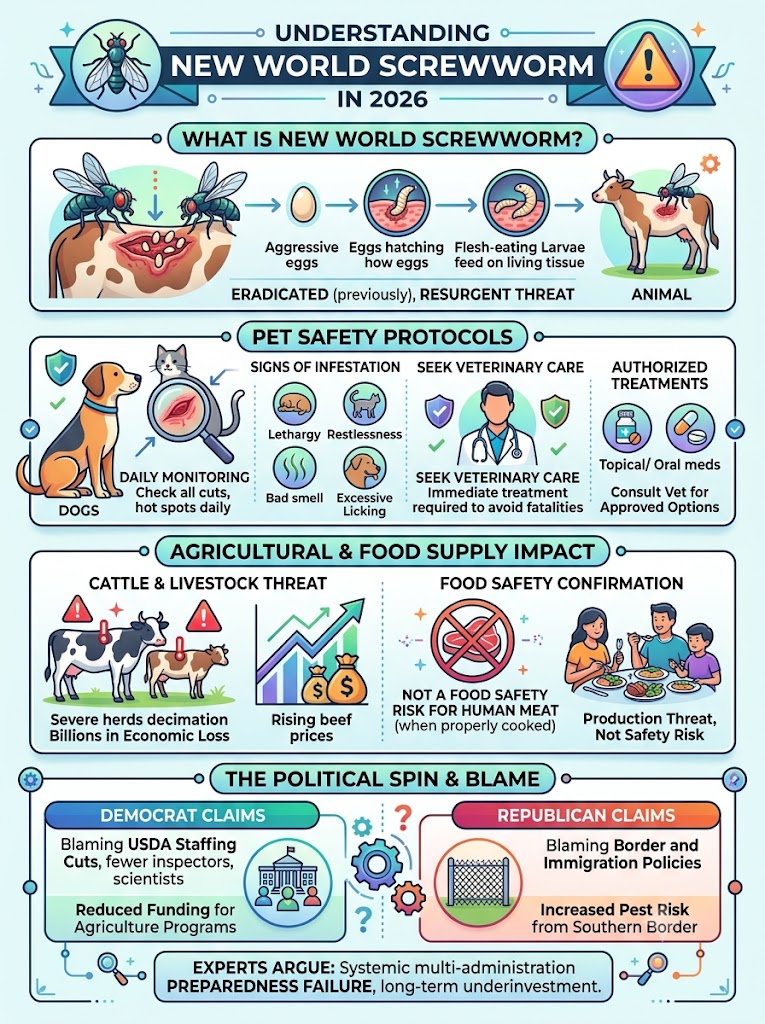
- The Parasite’s Behavior: New World screwworm larvae feed exclusively on the living tissue of warm-blooded animals, laying eggs in open wounds. Left untreated, infestations are frequently fatal.
- Pet Safety Measures: The FDA has rapidly issued Emergency Use Authorizations (EUAs) for treatments including Credelio, NexGard, and generic nitenpyram. Pet owners must rigorously monitor any cuts, scrapes, or hot spots on their animals.
- Food Supply Impact: While public health experts confirm the parasite is not a food safety hazard for human meat consumption, it poses a severe food production threat that could cost the agricultural economy billions and drive up beef prices.
- The Blame Game: Politicians are weaponizing the outbreak. Democrats blame deep USDA staffing cuts made in early 2025, while Republicans point to Biden-era border and immigration policies. Experts classify the breach as a multi-administration preparedness failure.
The Flesh-Eating Threat: Why Pet Owners Must Stay Vigilant This Summer
The headlines are undeniably grim. Fox Weather recently declared the parasite a “deadly flesh-eating” risk to pets this summer, and the panic is palpable among dog and cat owners. Unlike common flies that feed on dead decay, the female New World screwworm targets fresh, open wounds on living hosts to lay her eggs.
What happens next is devastating. The hatching larvae consume the healthy surrounding tissue. If ignored, the host can die in a matter of days.
Veterinary experts are urging an unprecedented level of vigilance. Lisa Selvaggio, reporting for PetGuide, emphasizes that early detection is the only failsafe. Pet owners living in or traveling through high-risk areas—especially near the Texas-Mexico border—must inspect their pets daily. Even minor skin abrasions, hot spots, or scrapes can invite an infestation. Lethargy, restlessness, foul-smelling wounds, and obsessive licking or biting at the skin are all major red flags requiring immediate clinical intervention.
Fortunately, the veterinary pharmaceutical response has been aggressive. The FDA has greenlit a series of Emergency Use Authorizations to combat the crisis. These include EUAs for Credelio for dogs and cats, NexGard variants, and most recently in June 2026, generic nitenpyram to treat infestations in puppies, kittens, and adult pets.
How do I protect my dog from the New World screwworm?
The most effective protection strategy is rigorous wound management. If your dog sustains any cut, scratch, or sore, clean it thoroughly and monitor it daily until fully healed. Keep your pet indoors during peak fly activity if you live in an affected state like Texas or New Mexico. Finally, consult your veterinarian about starting your pet on an FDA-authorized preventative treatment like NexGard or Credelio, particularly if you reside in or travel near an active quarantine zone.
A Billion-Dollar Blow? Separating Food Safety from Food Production
When a flesh-eating parasite invades the American cattle supply, consumer panic is inevitable. Disgust naturally leads to a pressing question: Is our meat safe to eat?
The short answer is yes. Public health officials have been working overtime to quell fears in the grocery aisles. As CNN journalist Jen Christensen reported in early June, the screwworm is absolutely not a food safety issue. It is, however, a massive food production issue.
The economic stakes are staggering. The U.S. eradicated the screwworm decades ago through an ingenious, albeit painstaking, sterile fly release program that pushed the parasite down through Mexico and into the Darien Gap in Panama. With that barrier now broken, the U.S. cattle industry faces a localized epidemic that threatens to decimate herds across the Southwest. The agricultural fallout could easily cost the economy billions of dollars, directly passing the financial burden onto consumers via skyrocketing beef prices at the supermarket.
The Washington Spin: Republicans and Democrats Point Fingers
In an election year, a national crisis rarely goes un-politicized. The screwworm outbreak is no exception. As FactCheck.org recently documented, politicians on both sides of the aisle are aggressively spinning the parasite’s return to score political points.
Democrats and allied media outlets have directed their ire at Donald Trump. They point to severe staffing and funding cuts orchestrated in early 2025 by the Department of Government Efficiency (DOGE). According to federal data analyzed by the National Sustainable Agriculture Coalition, the USDA lost roughly 20,000 employees in a single year. This included 2,000 inspectors and nearly 2,200 staff from the Agricultural Research Service—the very scientific arm heavily involved in sterile fly mitigation.
Conversely, Republicans have laid the blame squarely at the feet of former President Joe Biden. Their narrative suggests that the influx of migrants from Central America facilitated the parasite’s journey north.
Independent experts, however, reject both partisan narratives as scientifically hollow. Entomologists point out that the barrier breakdown in Panama was likely the result of a “fly strain failure” that had been brewing for decades. Furthermore, experts confirm that the parasite travels via illicit cattle movement and wildlife—not human migration.
Dr. Joseph Annelli, a former director of emergency programs for veterinary services at the USDA’s Animal and Plant Health Inspection Service, summarized the reality of the situation perfectly. The return of the screwworm, he noted, “should not be reduced to a simple partisan blame story.”
Instead, Annelli points to a far more systemic rot. “The more accurate explanation is a long-term preparedness failure involving multiple administrations, multiple Congresses, international partners, workforce shortages, infrastructure limitations, and the natural human tendency to underinvest in prevention until a crisis occurs.”
The 2026 New World screwworm outbreak is a stark reminder of our ecological vulnerability. Whether you are a rancher monitoring a herd in West Texas, a pet owner walking a dog in New Mexico, or a consumer buying steak in New York, the ripple effects of this flesh-eating parasite are already at your doorstep.
Sources Quoted
- U.S. Department of Agriculture (USDA) & U.S. Customs and Border Protection (CBP): Official case counts (31 cases in West Texas) and regional quarantine announcements.
- FOX Weather / FOX 10 Phoenix: Broadcast coverage identifying the parasite as a severe pet safety risk this summer.
- Lisa Selvaggio (PetGuide): Analysis of FDA Emergency Use Authorizations (Credelio, NexGard, nitenpyram) and veterinary safety protocols.
- Jen Christensen (CNN): Reporting on the distinction between human food safety and agricultural food production threats.
- FactCheck.org: Fact-checking the political blame game regarding USDA staffing cuts and immigration policies.
- Dr. Joseph Annelli: Former USDA APHIS director, quoted via FactCheck.org regarding systemic preparedness failures.

Leo Falsafi is a digital marketing veteran and senior journalist at Virlan.co, where he covers the intersection of digital marketing, gaming, and breaking US trending news. With nearly two decades of hands-on experience in SEO and digital strategy, Leo has consulted for and scaled hundreds of companies. His deep industry roots allow him to deliver sharp, fact-checked insights and analysis on the trends shaping today’s digital landscape.