The Day Politics Paralyzed the Pitch
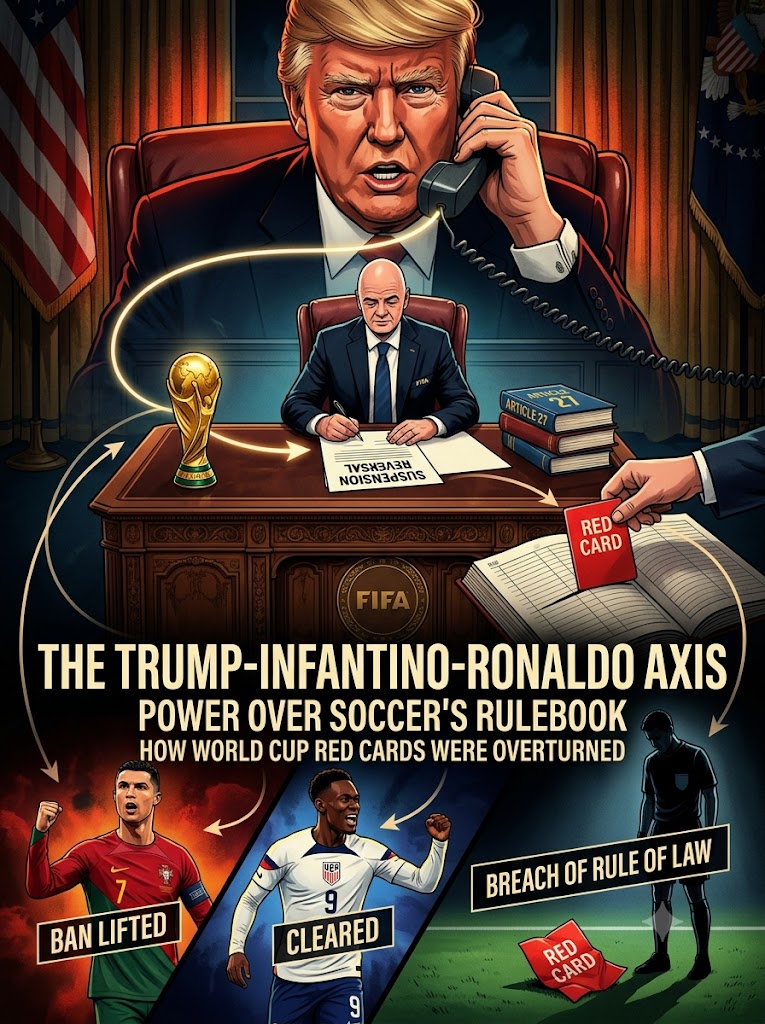
A stunning executive intervention has thrown the 2026 FIFA World Cup into absolute chaos. European football authorities are outraged, a host nation is celebrating, and the fiercely guarded independence of global soccer has been entirely compromised. At the center of the firestorm? U.S. President Donald Trump, FIFA President Gianni Infantino, and an unprecedented disciplinary reversal that echoes a controversial precedent set just months prior for global superstar Cristiano Ronaldo.
The flashpoint occurred during the United States Men’s National Team’s (USMNT) 2-0 Round of 32 victory over Bosnia-Herzegovina. American star forward Folarin Balogun—the team’s leading scorer with three tournament goals—received a straight red card for awkwardly stepping on the right ankle of Bosnian defender Tarik Muharemović. Under standard FIFA regulations, the dismissal carried an automatic one-game suspension. It was a crippling blow that would sideline Balogun for the critical Round of 16 knockout match against Belgium.
Then, the phone rang in Gianni Infantino’s office.
The Call That Shook Global Soccer
President Trump, a close ally of Infantino, acknowledged that he personally called the FIFA chief to complain about the referee’s decision.
“All I did was ask for a review,” Trump told reporters at the White House, defending his decision to insert himself into the tournament’s judicial process. “I didn’t think it was a foul. That wasn’t a foul. That wasn’t even an infraction… How do you penalize them for a game that hasn’t been played yet? It’s very unfair.”
Shortly after the call, FIFA announced a shocking reversal. Rather than enforcing the mandatory one-game ban, FIFA invoked a rarely utilized provision to place Balogun’s suspension on a one-year probation, clearing him to start against Belgium. (FIFA did, however, issue Balogun a $40,000 fine for entering the pitch to celebrate the Bosnia victory following his expulsion).
Trump immediately took to Truth Social to claim a victory, thanking FIFA for “doing what was right, and reversing a great injustice!” He also explicitly distanced Infantino from the backlash, suggesting, “I don’t believe he made the decision.”
For his part, Infantino scrambled to insist that the rules of global soccer remain untampered. Releasing a statement shortly after Trump’s Oval Office remarks, the FIFA President stated that he informed Trump during their call that “there was an ongoing legal process involving FIFA’s independent judicial bodies and that the case would be decided in due course by the competent bodies.”
The Cristiano Ronaldo Precedent of 2025
While the Balogun reprieve is the most blatant display of Trump and Infantino’s intertwined authority, the tactical deployment of FIFA’s legal loopholes was road-tested late last year with Cristiano Ronaldo.
In late 2025, Ronaldo received a red card for striking an Irish player with his elbow during a World Cup qualifying match, triggering a three-match ban. Remarkably, after serving just one game, FIFA stepped in and suspended the remainder of the penalty, ensuring the Saudi Pro League forward would be fully eligible for Portugal’s opening matches of the 2026 World Cup.
The timeline of that reversal raised massive red flags. Ronaldo’s suspension was lifted just one week after the Portuguese legend—alongside his partner Georgina Rodríguez and Infantino—visited the Oval Office. They were there as part of a Saudi delegation led by Crown Prince Mohammed bin Salman. Following the Oval Office photoshoot, where Trump was recorded warmly cooing the name “Roonnnallldoo,” FIFA’s disciplinary committee suddenly found the leniency required to clear his ban.
The Rulebook Under Fire
What is FIFA Disciplinary Code Article 27?
When FIFA lifted the bans for both Ronaldo and Balogun, they weaponized Article 27 of their Disciplinary Code. This obscure clause grants the governing body’s judicial arm the discretionary power to fully or partially suspend the implementation of a disciplinary measure. Prior to the Trump-Infantino era, suspending an automatic red card ban during a World Cup was practically unheard of.
Has a World Cup red card suspension ever been overturned before?
It is incredibly rare. Soccer historians note that before Balogun’s reprieve, you have to look back to the 1962 World Cup for a similar executive intervention. During that tournament, the president of host nation Chile successfully argued for Brazilian midfielder Garrincha to be allowed to play in the final after he kicked a Chilean opponent in the semi-final.
“An Incomprehensible Breach”
The global backlash has been swift, vicious, and entirely directed at FIFA’s executive leadership. Infantino’s relationship with Trump—which saw the FIFA boss award Trump the inaugural “FIFA Peace Prize” and a gold replica World Cup trophy in December 2025—is now viewed by European federations as an active threat to the sport.
UEFA, Europe’s governing soccer body, issued a blistering statement characterizing the Balogun decision as an “incomprehensible” breach of the rule of law. “When the certainty of rules is no longer guaranteed by its guardians, the integrity of the game is at stake and the credibility of a competition is undermined,” UEFA warned.
The Royal Belgian Football Association (RBFA) declared itself “astonished” by the ruling. Belgium head coach Rudi Garcia sarcastically remarked that he didn’t realize July 5th was equivalent to April Fools’ Day in FIFA’s offices, while the Belgian federation promised to investigate all potential options to defend the sport’s ethics.
Even former FIFA President Sepp Blatter—who was himself forced from office amid a massive 2015 corruption scandal—weighed in on social media. “Red cards are not overturned by political phone calls,” Blatter wrote. “They are overturned by rules, evidence and independent bodies.”
Meanwhile, the USMNT attempted to navigate the awkward political fallout. While head coach Mauricio Pochettino stated that anyone who loves the sport would “celebrate” the decision to let Balogun play, he forcefully pushed back on the idea that the White House strong-armed the result. “No, we cannot mix that,” Pochettino said regarding Trump’s influence. “We cannot mix that.”
- The Incident: U.S. forward Folarin Balogun received a red card against Bosnia-Herzegovina in the 2026 World Cup Round of 32, which carried a mandatory one-game suspension.
- Political Intervention: U.S. President Donald Trump admitted to personally calling FIFA President Gianni Infantino to complain about the red card, arguing it was “not a foul.”
- The Reversal: FIFA utilized Article 27 of its disciplinary code to defer Balogun’s ban to a one-year probation, allowing him to play against Belgium. He was fined $40,000 for entering the pitch post-expulsion.
- The Precedent: A virtually identical legal maneuver was used in late 2025 to lift a three-game ban for Cristiano Ronaldo, shortly after Ronaldo, Infantino, and Trump attended a diplomatic meeting at the White House.
- Global Reaction: UEFA condemned the decision as an “incomprehensible” breach of soccer’s rule of law, while former FIFA President Sepp Blatter criticized the overturning of red cards via “political phone calls.”
Sources Quoted
- The Guardian: Quoted for reporting on Donald Trump’s press remarks, UEFA’s official statements, and historical context regarding the 1962 World Cup precedent.
- TIME: Sourced for quotes from USMNT coach Mauricio Pochettino and details on FIFA’s Disciplinary Code Article 27.
- PBS NewsHour / Associated Press: Quoted for statements from Gianni Infantino, Sepp Blatter, the Royal Belgian Football Association, and the $40,000 fine issued to Balogun.

Leo Falsafi is a digital marketing veteran and senior journalist at Virlan.co, where he covers the intersection of digital marketing, gaming, and breaking US trending news. With nearly two decades of hands-on experience in SEO and digital strategy, Leo has consulted for and scaled hundreds of companies. His deep industry roots allow him to deliver sharp, fact-checked insights and analysis on the trends shaping today’s digital landscape.