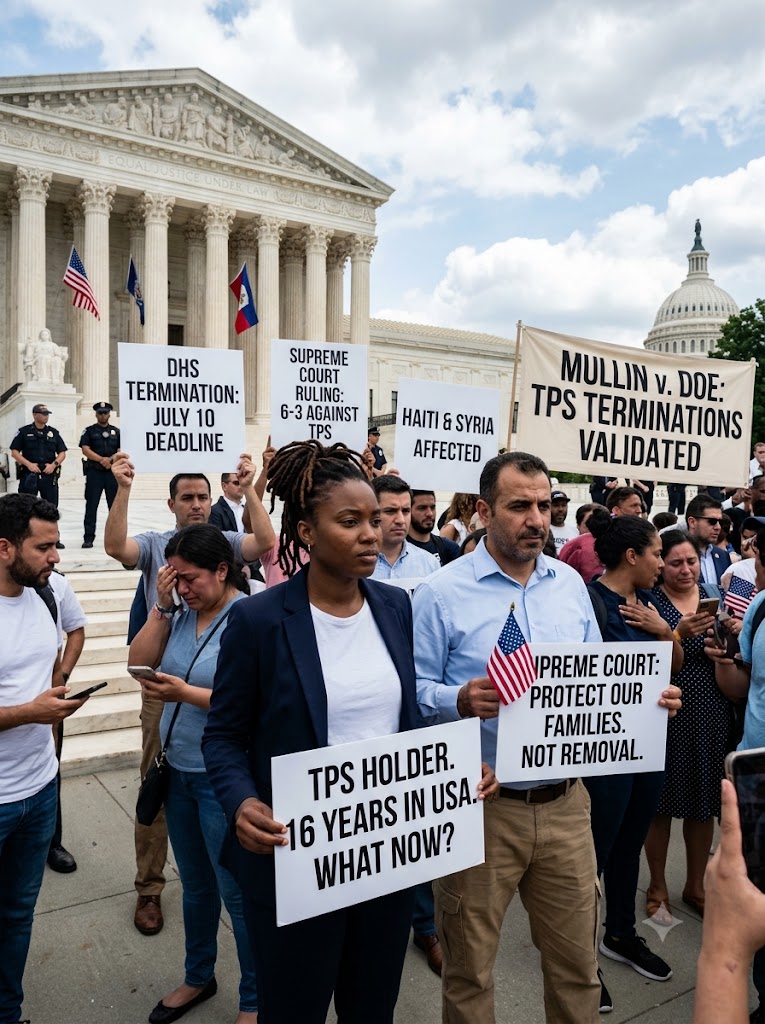
On June 25, 2026, the landscape of U.S. immigration law experienced a seismic shift. In a decisive 6-3 ruling in the case of Mullin v. Doe, the U.S. Supreme Court granted the Department of Homeland Security (DHS) sweeping authority to terminate Temporary Protected Status (TPS) designations. Specifically targeting protections for nationals from Haiti and Syria, the decision doesn’t just close a legal loophole—it effectively shatters years of lower-court injunctions.
For hundreds of thousands of immigrants who have built lives in the United States, the clock is now ticking.
The ruling marks a major judicial victory for President Donald Trump’s administration during its second term, validating its aggressive push to roll back humanitarian parole programs. But behind the legal maneuvers and courtroom victories lies a complex web of economic consequences, corporate compliance headaches, and massive demographic shifts.
Core Insights: The 2026 TPS Landscape
- The Supreme Court Precedent: The Mullin v. Doe ruling explicitly bars federal courts from reviewing nonconstitutional challenges to the DHS secretary’s decisions regarding TPS designations, extensions, or terminations.
- Immediate Terminations: The decision clears the way for the federal government to strip TPS protections from approximately 334,000 individuals from Haiti and Syria. Haiti was originally designated in 2010 following a devastating earthquake, and Syria in 2012 due to civil war.
- USCIS Employment Guidance: On July 1, 2026, U.S. Citizenship and Immigration Services (USCIS) updated its guidelines, setting a temporary expiration date of July 10, 2026, for TPS-related Employment Authorization Documents (EADs) for nationals of seven countries, replacing a previous July 1 “placeholder” date.
- Economic Stakes: TPS holders collectively contribute roughly $29 billion annually to the U.S. economy and pay nearly $8 billion in federal, state, and local taxes, according to data from the FWD.us Education Fund.
The Legal Shift: What Mullin v. Doe Means for DHS Authority
The premise of Temporary Protected Status, created in 1990, was to offer a legal haven for foreign nationals unable to return home due to armed conflict, environmental disasters, or other extraordinary conditions. During the designated period, beneficiaries cannot be deported and are eligible for work permits.
However, the Trump administration has fundamentally challenged the perpetual renewal of these “temporary” protections. Since taking office, the administration has ended or attempted to end TPS designations for 13 of the 17 countries that held active status, a move impacting roughly 1 million of the 1.3 million total TPS holders in the U.S. In 2025, then-Secretary of Homeland Security Kristi Noem announced the termination of designations for Haiti and Syria. Those terminations were immediately frozen by lower courts—until now.
By ruling that the Immigration and Nationality Act severely limits judicial review of the executive branch’s TPS determinations, the Supreme Court has dramatically narrowed the legal avenues available to immigrant advocacy groups.
The Human and Economic Calculus
The implications of this policy shift extend far beyond immigration courts. According to a 2026 analysis by KFF, about 74% of likely TPS workers are employed, compared to 62% of U.S. citizens. Furthermore, on average, TPS recipients have resided in the United States for more than twenty years.
With the sudden removal of these protections, industries heavily reliant on this workforce are bracing for impact. The stripping of legal status means that hundreds of thousands of long-term residents will immediately lose their employer-sponsored health coverage and become subject to deportation.
Corporate Compliance: The July 10 Deadline
For corporate America, the ruling has triggered an immediate compliance scramble.
Following the Supreme Court’s decision, USCIS and E-Verify issued updated employer guidance for TPS beneficiaries from Burma, Ethiopia, Haiti, Somalia, South Sudan, Syria, and Yemen. Law firms like Morgan Lewis and Ogletree Deakins are urgently advising corporate clients on how to navigate the transition.
The immediate directive? Employers must use July 10, 2026, as the current date for Form I-9 and E-Verify purposes for affected employees. However, legal experts warn employers not to interpret July 10 as the automatic end of employment authorization. Because lower district courts must still officially lift their injunctions to align with the Supreme Court, premature termination of an employee could violate labor laws. Employers are urged to review their Form I-9 records but to wait for explicit DHS termination notices before taking adverse employment actions.
What does the Supreme Court ruling mean for Haitian and Syrian TPS holders?
The Mullin v. Doe decision means that once the lower courts officially dissolve their existing injunctions to align with the Supreme Court, Haitian and Syrian beneficiaries will lose their work authorization and their protection against removal from the United States, unless they have secured an alternative legal immigration status (such as asylum).
Can TPS holders still legally work in the United States?
Yes, but the window is rapidly closing for certain nationalities. As of July 1, 2026, USCIS has extended employment authorization documents (EADs) for affected countries through July 10, 2026, to provide a brief administrative buffer. Workers remain authorized until DHS finalizes the termination implementation, at which point their EADs will become invalid.
Sources Quoted:
- Legal & Corporate Compliance Data: Morgan Lewis; Ogletree Deakins; Littler Mendelson; Fragomen.
- Government & Policy Data: U.S. Citizenship and Immigration Services (USCIS); U.S. Supreme Court (Mullin v. Doe); Department of Homeland Security (DHS).
- Economic & Demographic Statistics: KFF (Kaiser Family Foundation); Council on Foreign Relations; American Immigration Council; FWD.us Education Fund.

Leo Falsafi is a digital marketing veteran and senior journalist at Virlan.co, where he covers the intersection of digital marketing, gaming, and breaking US trending news. With nearly two decades of hands-on experience in SEO and digital strategy, Leo has consulted for and scaled hundreds of companies. His deep industry roots allow him to deliver sharp, fact-checked insights and analysis on the trends shaping today’s digital landscape.