The box office might be rebounding, but the balance sheet is dictating the narrative.
Just hours after celebrating its busiest theatrical weekend of 2026, AMC Entertainment Holdings delivered a sobering reality check to the market. On June 23, 2026, the cinema giant announced a massive registered direct offering designed to raise $200 million from institutional investors.
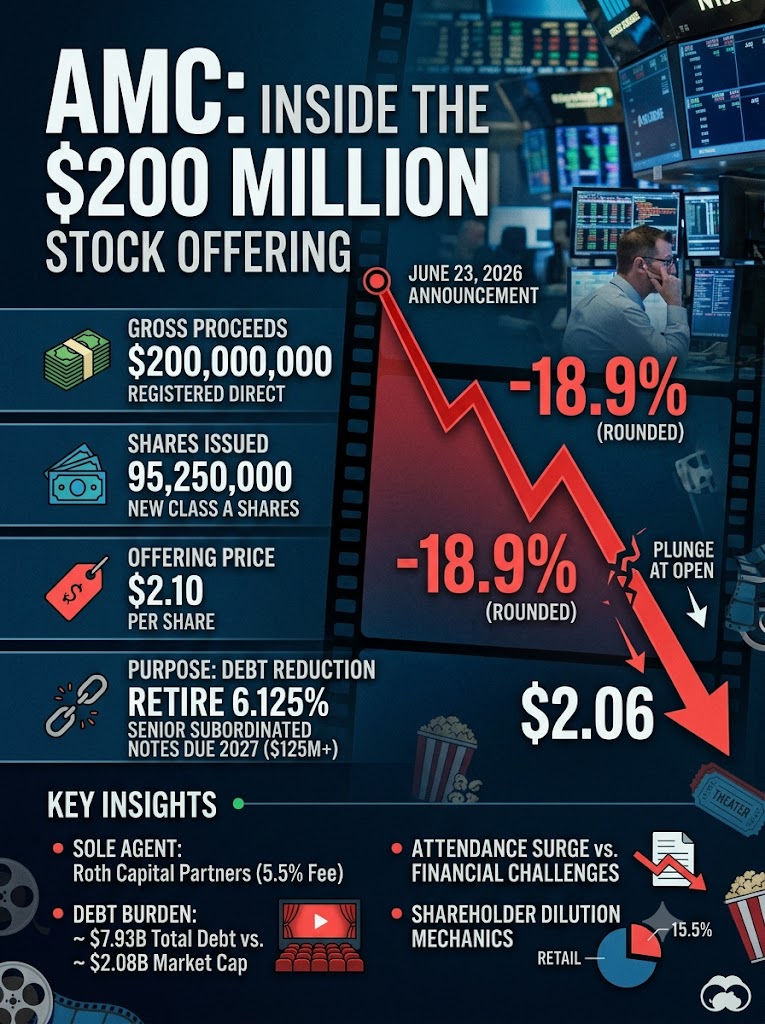
The market’s reaction was immediate and punishing. Shares tumbled nearly 19% in pre-market trading, sliding toward the $2.06 mark. For retail investors and the broader Reddit community tracking the stock, the announcement reignites the ongoing debate over the company’s aggressive capitalization strategy.
Here is a deep-dive analysis into the mechanics of the deal, the debt strategy behind it, and what it means for the retail shareholder base moving forward.
The Anatomy of AMC’s $200 Million Capital Raise
To understand the severity of the market’s reaction, you have to parse the hard data of the transaction. The core insights and definitive metrics of the June 23 offering are as follows:
- Total Shares Issued: 95,250,000 shares of Class A common stock.
- Pricing: The shares were priced at $2.10 per share.
- Capital Generated: The deal yields approximately $200 million in gross proceeds, netting roughly $189 million after standard expenses and placement fees.
- The Placement Agent: Roth Capital Partners acted as the sole placement agent, securing a 5.5% cash fee on the aggregate gross proceeds.
- Temporary Halt: As part of the deal, AMC agreed to a 45-day restriction on issuing or registering any additional equity, giving the market a temporary, albeit brief, reprieve from further dilution.
Why is AMC selling another 95 million shares right now?
This is the most pressing question for investors: Why dilute now, especially when foot traffic is surging? Just a day prior, AMC reported 4.8 million attendees across its U.S. and ODEON international locations, marking the busiest domestic weekend of 2026, heavily driven by the release of Toy Story 5.
However, popcorn sales alone cannot currently outpace the company’s capital structure limitations. AMC’s total debt sits at a staggering $7.93 billion against a market cap of approximately $2.08 billion, creating severe liquidity pressures. The primary directive for this $189 million net cash injection is surgical, high-cost debt reduction. AMC explicitly intends to redeem all $125.5 million of its 6.125% Senior Subordinated Notes due 2027.
By eliminating these 2027 notes, the company retires expensive debt, pays off related premiums, and reduces its ongoing interest expense. The remaining liquidity is earmarked for general corporate purposes, which may include further debt repayment, theater enhancements, and shoring up cash reserves. It is a classic corporate finance maneuver: shifting the capital structure away from rigid debt obligations by leveraging equity.
How does this $200 million stock offering impact existing shareholders?
The immediate consequence of this registered direct offering is shareholder dilution. When a company issues over 95 million new shares to institutional buyers, the proportional ownership—and subsequent voting power—held by existing retail investors is mechanically reduced.
What makes this specific offering particularly difficult for the market to digest is the timing. Just 12 days prior to this announcement, AMC completed a separate $150 million at-the-market equity offering that unloaded approximately 105.3 million shares. Executing back-to-back nine-figure equity raises signals to the market that management is prioritizing survival and debt restructuring at the direct expense of current share valuation. Investors are watching the company chip away at its debt, but they are the ones footing the bill, evidenced by the sharp drop from a prior close of $2.79 down to the low $2.00 range following the announcement.
While the fundamental business of theatrical exhibition shows flashes of its pre-2020 glory, AMC’s financial engineering remains the dominant force dictating the stock’s trajectory. For the next 45 days, the share count will remain static—but until the $7.93 billion debt load becomes manageable, equity dilution will remain a looming threat.
Sources Quoted: Information, market data, and statistics for this report were extracted directly from live SEC 8-K filings published via StockTitan, alongside financial reporting and analysis from Investing.com, GuruFocus, and Tech2.

Leo Falsafi is a digital marketing veteran and senior journalist at Virlan.co, where he covers the intersection of digital marketing, gaming, and breaking US trending news. With nearly two decades of hands-on experience in SEO and digital strategy, Leo has consulted for and scaled hundreds of companies. His deep industry roots allow him to deliver sharp, fact-checked insights and analysis on the trends shaping today’s digital landscape.