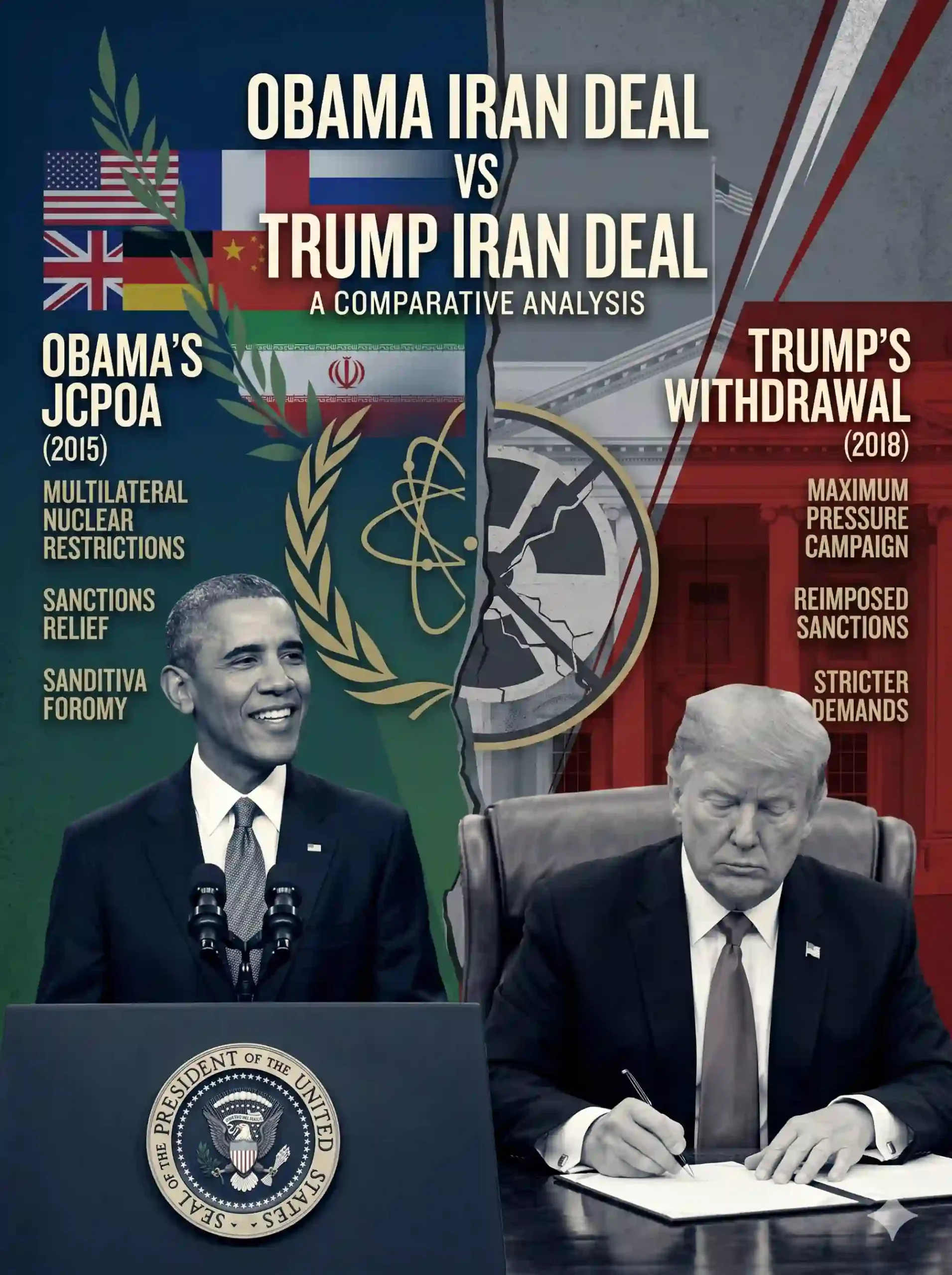
Eight years after pulling the U.S. out of the Obama-era Joint Comprehensive Plan of Action (JCPOA), President Trump has brokered a new Memorandum of Understanding (MoU) with Iran. Coming on the heels of a regional ceasefire, this 14-point framework acts as a 60-day roadmap toward a permanent nuclear agreement.
Both administrations aimed for the same fundamental goal: preventing a nuclear-armed Iran. But how they engineered the guardrails — and what they leveraged to get them — diverges sharply.
Before diving into the fine print, explore the core differences across major policy categories:
JCPOA vs. Proposed MoU Comparison
| JCPOA (2015) | MoU (2026) |
|---|---|
| Enrichment cap at 3.67% for a period of 15 years. | Complete and permanent ban on all uranium enrichment. |
| Stockpile limited to 300kg of enriched uranium. | Zero-stockpile policy; all enriched material must be removed. |
| Operation of ~5,000 IR-1 centrifuges permitted. | Dismantlement of all enrichment-related infrastructure. |
The Architecture: A Final Treaty vs. A 60-Day Sprint
The most immediate difference is structural. The 2015 JCPOA was a finalized, highly technical agreement spanning hundreds of pages. It dictated exact centrifuge counts and specific inspection protocols.
Trump’s 2026 MoU is not a final deal. It is a 14-point framework that extends a U.S.-Iran ceasefire and establishes a 60-day window for technical negotiations. While the JCPOA included explicit language where Iran reaffirmed it would never “seek, develop or acquire” nuclear weapons, the MoU states Iran shall not “procure or develop” them — leaving the technical enforcement mechanisms up to the final draft.
The Uranium Dilemma: Capping vs. Downblending
The nuclear landscape has shifted dramatically since 2015, changing the baseline for negotiations.
- Obama’s JCPOA: Capped Iran’s uranium enrichment at 3.67% (well below the 90% weapons-grade threshold) for 15 years. It confined all enrichment to a single facility at Natanz and restricted centrifuge operations.
- Trump’s MoU: Negotiating in an environment where Iran has since amassed uranium enriched to 60%, the MoU focuses on a “minimum” standard of “downblending” stockpiles on-site under International Atomic Energy Agency (IAEA) supervision. It currently leaves open whether a final deal will permit civilian enrichment, a departure from Trump’s earlier demands to suspend enrichment entirely.
Sanctions Relief and the $300 Billion Question
Sanctions leverage remains the ultimate bargaining chip, but the distribution of relief is generating intense debate in Washington.
- Obama’s JCPOA: Offered phased relief from international sanctions dependent on IAEA verification. It was a multilateral pact involving China, Russia, the U.K., and Germany. The agreement did not include economic development funding, though the U.S. separately returned $1.7 billion in cash to settle a pre-revolution debt.
- Trump’s MoU: Operates strictly as a bilateral U.S.-Iran deal, leaving the response of third-party sanctioning nations unclear. Crucially, the MoU grants Iran immediate waivers for oil and petroleum exports — drawing sharp criticism from figures like former UN Ambassador Nikki Haley, who stated there should be “zero sanctions relief day one.” Additionally, the MoU proposes a mutually agreed plan to marshal at least $300 billion from regional partners for Iran’s reconstruction, though the administration insists U.S. investment remains “voluntary.”
Also read: Inside the $300B US-Iran Reconstruction Fund: Profit, Politics, and the IRGC
Missiles, Proxies, and Sunsets
What the deals leave out is often as scrutinized as what they include.
- Sunset Clauses: The JCPOA featured highly criticized 10- and 15-year expiration dates on key restrictions. The MoU currently features no sunset clauses, and the Trump administration has signaled a desire for permanent, “forever” restrictions on military enrichment.
- Ballistic Missiles & Terrorism: Neither agreement places explicit limits on Iran’s conventional ballistic missile program or directly addresses state sponsorship of militant proxy groups. The current administration has stated it will handle non-nuclear issues like terrorism funding and missile stockpiles through a “parallel effort” with Gulf nations, noting that it is “okay” for Iran to have missiles in proportion to neighboring countries.
Sourcing Report: This article quotes reporting by Kathryn Watson, published in CBS News.

Leo Falsafi is a digital marketing veteran and senior journalist at Virlan.co, where he covers the intersection of digital marketing, gaming, and breaking US trending news. With nearly two decades of hands-on experience in SEO and digital strategy, Leo has consulted for and scaled hundreds of companies. His deep industry roots allow him to deliver sharp, fact-checked insights and analysis on the trends shaping today’s digital landscape.