The $300 Billion Catalyst: What the Proposed US-Iran Investment Fund Means for the Iranian Economy
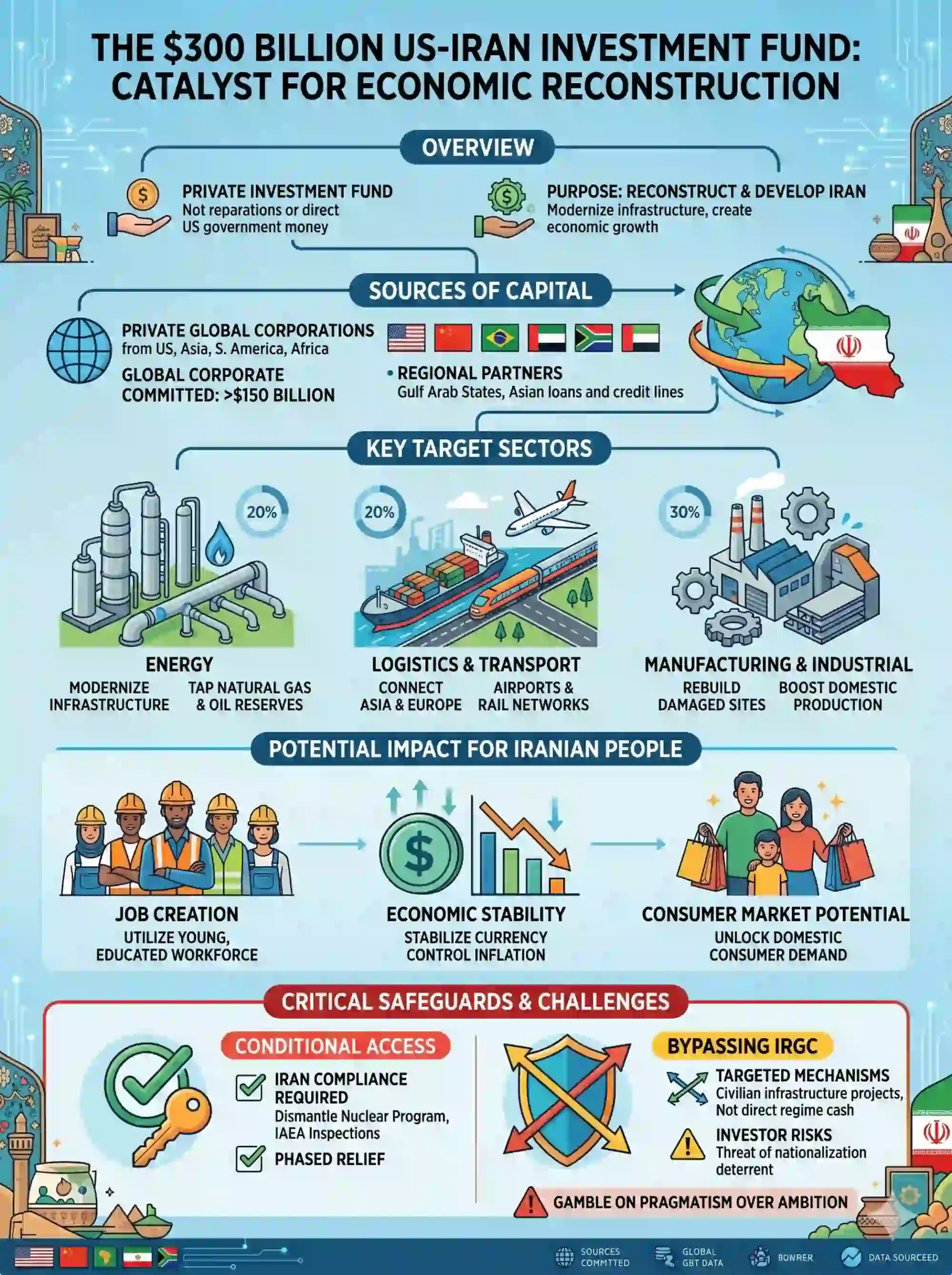
The recently outlined US-Iran memorandum of understanding (MoU) has introduced a staggering figure into the global economic conversation: a proposed $300 billion private investment fund aimed at the reconstruction and economic development of Iran.
While the exact details of the final agreement are still being hammered out over a 60-day window, the inclusion of this fund has sparked intense debate. Is it a genuine pathway to economic revitalization, or a controversial incentive to halt hostilities?
Here’s a deep dive into the structure, sources, and profound implications of this proposed fund for the Iranian people and their economy.
Structure and Purpose: Investment, Not Reparations
A critical distinction must be made regarding the nature of this fund. It is being structured as a private investment vehicle—expected to be named the Reconstruction and Development Fund—rather than a direct transfer of government money or war reparations.
- The Compensation Dispute: According to reports, Tehran originally sought $400 billion from the US as compensation for damages incurred during the recent conflict. Washington firmly rejected this demand.
- The Compromise: The $300 billion private investment fund emerged as an alternative mechanism. It is designed to provide an economic incentive for both sides to finalize a broader peace agreement and to facilitate the rebuilding of infrastructure damaged during the conflict, such as refineries, airports, and industrial complexes like the Mobarakeh Steel complex.
Where is the Money Coming From?
The sources of this massive capital injection are entirely from the private sector and regional partners, not direct US taxpayer dollars.
- Global Corporate Interest: Over half of the $300 billion (more than $150 billion) has reportedly already been committed by private investors.
- International Participation: Companies pledging funds are based across the globe, including the United States, Gulf Arab states, Asia (with specific mentions of South Korea, Japan, Singapore, and Malaysia), South America, and Africa.
- Regional Contributions: Regional countries are expected to participate through loans, credit lines, and direct financing for specific reconstruction projects.
Target Sectors for Investment
The proposed fund aims to revitalize key sectors of the Iranian economy that possess significant untapped potential:
| Sector | Opportunity for Growth |
| Energy | Modernizing infrastructure to leverage the world’s second-largest natural gas reserves and fourth-largest oil reserves. |
| Logistics & Transport | Capitalizing on Iran’s strategic location as a corridor connecting Asia and Europe, bordering nations like Iraq, Turkey, Pakistan, and Afghanistan. |
| Manufacturing | Rebuilding damaged industrial sites and boosting domestic production capabilities. |
Other sectors poised for potential investment include petrochemicals, mining, agriculture, and tourism.
Economic Implications for the Iranian People
For decades, the Iranian economy has been stifled by layers of international sanctions, effectively freezing it out of global capital markets. The successful implementation of this fund, coupled with broader sanctions relief outlined in the MoU, could bring transformative changes:
- Job Creation: Large-scale infrastructure and industrial projects will demand a significant workforce, tapping into Iran’s young, educated population of over 92 million people.
- Economic Stabilization: An influx of foreign capital and the eventual unfreezing of Iranian assets abroad could provide the central bank with much-needed resources to stabilize the currency and control inflation.
- Consumer Market Potential: A revitalized economy would unlock the potential of Iran’s domestic consumer market, making it an attractive destination for international brands.
The Catch: Conditionality and Compliance
It is crucial to understand that this economic windfall is not guaranteed.
The $300 billion fund will not become operational until a final, comprehensive deal is signed. Furthermore, access to these benefits is strictly tied to Iran’s compliance with the terms of the agreement.
US officials, including Vice President JD Vance, have emphasized that Iran will only gain access to this reconstruction fund if it meets commitments related to dismantling its nuclear program, eliminating enriched material stockpiles, and accepting strict international inspections.
Partnership or Pragmatism?
The proposed $300 billion fund represents a complex intersection of diplomacy and economics.
While it is not a direct government payout or a concession of war reparations, it provides a massive incentive for peace. For the Iranian rulers, it offers a lifeline to rebuild and stabilize a battered economy. For the Iranian people, it represents the possibility of renewed global economic partnership and the alleviation of decades of financial isolation—provided the final deal holds and both sides meet their stringent commitments.
Also read: Obama’s 2015 JCPOA vs. Trump’s 2026 MoU: A Side-by-Side Breakdown
The Profit Motive: Why Global Private Companies Are Betting $300 Billion on Iran
When news broke of the proposed $300 billion Reconstruction and Development Fund for Iran, many assumed it was a backroom political payoff or taxpayer-funded war reparations. But the reality outlined in the US-Iran framework is far more intriguing—and heavily driven by the private sector.
President Donald Trump recently clarified the US government’s stance regarding direct funding, stating sharply, “We’re not putting up ten cents. People can invest if they want.”
So, what is the economic purpose of these private companies, and why are they rushing to commit over $150 billion before the ink on a final deal is even dry? Here is a breakdown of the profit motives and the geopolitical shift this investment represents.
The Economic Purpose: Triggering Capital, Not Charity
The primary economic purpose of the private companies participating in this fund is to act as the financial engine for Iran’s rapid industrial and logistical resurrection. This is a private investment vehicle, not a government grant.
The companies involved are tasked with directly financing, building, and operating key infrastructure. Rather than relying on slow, bureaucratic government aid, this approach leverages the speed and efficiency of private capital to rebuild war-damaged sites like the Mobarakeh Steel complex, refineries, and major airports. Their goal is straightforward: inject capital to modernize infrastructure and, in return, secure lucrative long-term stakes and operational profits in one of the Middle East’s largest economies.
Is Iran an Attractive, Profitable Investment?
In short: Yes. For global investors, a post-sanctions Iran represents the “last great untapped emerging market.”
For four decades, successive waves of sanctions have frozen Iran out of global capital markets. Opening those doors reveals a goldmine of resources and human capital that private enterprises are eager to monetize:
- Massive Energy Reserves: Iran holds the world’s second-largest proven natural gas reserves and the fourth-largest proven oil reserves. Modernizing extraction and export infrastructure guarantees massive long-term returns for energy firms.
- A Prime Consumer Market: Iran boasts a young, highly educated population of over 92 million people. For consumer brands, tech companies, and service providers, this is a colossal, virgin demographic hungry for global integration and modern services.
- Diversified Industrial Potential: Beyond oil, investors are eyeing highly profitable opportunities in petrochemicals, mining, agriculture, and an untapped tourism industry.
For a private company, the risk of investing in a historically volatile region is offset by the sheer scale of the potential windfall. Ground-floor entry into a modernized Iranian economy is a generational financial opportunity.
Globalizing the Iranian Economy: A Web of Mutual Interest
Will this involve the countries of the world in the Iranian economy? Absolutely. In fact, that is the strategic genius behind structuring it as a private, multinational fund.
The framework has already attracted commitments from companies spanning the globe:
| Region | Nature of Involvement |
| Asia | Heavyweights from South Korea, Japan, Singapore, and Malaysia are leading the charge with direct corporate pledges. |
| The Americas & Africa | Private entities from the US, South America, and Africa have committed financing to energy, logistics, and transport sectors. |
| The Gulf States | Regional neighbors are expected to secure loans and establish credit lines, directly tying their financial success to Iran’s stability. |
By weaving the financial interests of global superpowers and regional rivals into the fabric of Iran’s economy, the fund creates a powerful deterrent against future conflict. If companies from Japan, the US, and Gulf states own stakes in Iranian infrastructure, protecting that infrastructure becomes a shared global priority.
This isn’t just about rebuilding; it is about permanently tethering Iran to the global economic system. If the 60-day final negotiation window succeeds, the world won’t just be trading with Iran—it will be invested in its survival.
The Elephant in the Room: Preventing the IRGC from Weaponizing the $300 Billion Fund
As the staggering scale of the proposed $300 billion Reconstruction and Development Fund becomes clear, a massive and highly controversial question looms over the US-Iran framework agreement: How do you inject $300 billion into the Iranian economy without inadvertently funding the Islamic Revolutionary Guard Corps (IRGC)?
Given that the IRGC holds a sprawling, deeply entrenched monopoly over vast sectors of Iran’s economy—from telecommunications and construction to energy and shipping—critics argue that any economic stimulus is essentially a stimulus for Iran’s military and extremist proxies.
Here is how the architects of the deal are attempting to prevent this capital from becoming a war chest, and why critics remain fiercely skeptical.
The Legitimate Fear: Rebuilding a War Machine
The skepticism surrounding the fund is not without merit. Hawkish observers and think tanks have immediately raised red flags about the fungibility of money.
The Institute for the Study of War (ISW) recently issued a stark warning, noting that Iranian officials have already signaled that newly available funds would be used to rebuild capabilities damaged during the 14-week conflict. If the IRGC controls the major construction firms tasked with rebuilding the nation’s infrastructure, the $300 billion meant for civilian development could easily be funneled directly into the military apparatus.
Organizations like United Against Nuclear Iran (UANI) and various US lawmakers, including Senator Bill Cassidy, have criticized the framework. They argue that by unlocking the Iranian economy and allowing the regime to rebuild, the agreement effectively rewards Iran for its recent aggressions, particularly its threats to the Strait of Hormuz, without fundamentally dismantling the IRGC’s grip on power.
The Safeguards: Conditionality and Phased Relief
To counter these risks, the US administration and negotiators have built specific mechanisms into the framework designed to bypass direct IRGC enrichment.
1. No Direct Government Cash Transfers
US officials have fiercely clarified that the MoU’s language does not require the United States to write a check to the Iranian government. The $300 billion figure represents a target for private capital and third-country investments, not direct financial assistance or war reparations paid to the regime.
2. Strict Conditionality and Compliance
The fund is not a lump-sum payout. White House officials have emphasized that access to this reconstruction vehicle—and the sanctions relief required to make it operational—is strictly contingent upon Iran’s verifiable “good behavior.” Iran must fulfill its core commitments under the 60-day window, which includes:
- Dismantling its nuclear weapons program.
- Down-blending its stockpile of enriched uranium under the supervision of the International Atomic Energy Agency (IAEA).
- Accepting a stringent international inspection regime.
If the regime uses initial sanctions waivers to fund regional proxies rather than domestic infrastructure, the broader mechanisms of the $300 billion fund can be halted.
3. Targeted Financial Mechanisms
The framework outlines that any release of frozen Iranian assets will be carefully managed. Rather than dumping cash into IRGC-controlled central accounts, the funds are intended to be made available for “ultimate beneficiary” payments. In theory, this allows the US and its partners to license and authorize transactions specifically for civilian infrastructure, medicine, and food, attempting to bypass military-affiliated contractors.
The Investor’s Dilemma: The Threat of Nationalization
Ultimately, the strongest safeguard against the IRGC monopolizing the $300 billion might be the private investors themselves.
The fund relies entirely on global companies (from Asia, the Gulf, and the West) voluntarily pouring capital into Iran. Financial analysts have been quick to point out the glaring risk: What sane private enterprise will invest billions in infrastructure if the IRGC can simply nationalize the asset or seize operational control at a moment’s notice?
For this private investment to materialize, Iran’s rulers will be forced to guarantee the security and independence of foreign capital. If the IRGC attempts to extort these international firms or siphon the funds for weapons production, the private capital will instantly evaporate, and the economic lifeline will be severed.
The strategy behind the agreement is a massive gamble: it assumes that the Iranian regime’s desperate need for economic survival will finally outweigh its regional military ambitions.
- Source Report: This article synthesizes reporting from Reuters, The Jerusalem Post, Military Times, Iran International, Seeking Alpha, statements from the Institute for the Study of War (ISW), and analysis from United Against Nuclear Iran (UANI).
- Source Report: This analysis synthesizes reporting from Reuters (as quoted in The Japan Times and CNBC Africa) and The Times of Israel, detailing statements from US leadership and anonymous sources with direct knowledge of the framework agreement.
- Sources: This article draws on reporting from Reuters, India Today (“US-Iran framework includes $300 billion private investment fund for Iran”), The Times of India (“$300 billion, sanctions relief, Hormuz reopening…”), and Al Arabiya English (“Iran deal includes $300 billion fund, more than half of which already committed”).

Leo Falsafi is a digital marketing veteran and senior journalist at Virlan.co, where he covers the intersection of digital marketing, gaming, and breaking US trending news. With nearly two decades of hands-on experience in SEO and digital strategy, Leo has consulted for and scaled hundreds of companies. His deep industry roots allow him to deliver sharp, fact-checked insights and analysis on the trends shaping today’s digital landscape.