
What is Ai Agent Content and Its Traffic-Boosting Potential?
Ai Agent Content is rapidly becoming a cornerstone for digital marketing strategies, offering unprecedented opportunities to enhance online visibility and significantly increase website traffic. This innovative approach leverages artificial intelligence to generate, optimize, and distribute content, transforming how businesses engage with their audiences.
Ai Agent Content refers to the creation and management of content using advanced artificial intelligence tools. These AI agents can perform a range of tasks from keyword research and outline generation to drafting full articles, optimizing for SEO, and even personalizing content for different audience segments. The core benefit lies in its ability to scale content production without compromising quality, making it a powerful tool for organic traffic growth.
By automating repetitive tasks, marketers can focus on strategic oversight and creative direction, ensuring that the content generated is not only abundant but also highly effective.
This capability directly translates into more opportunities to rank for a wider array of keywords and attract a larger audience. For instance, an Ai Agent Content tool can identify emerging trends and quickly generate relevant blog posts, ensuring your website stays ahead in search engine results. This proactive content generation is vital for continuous traffic acquisition.
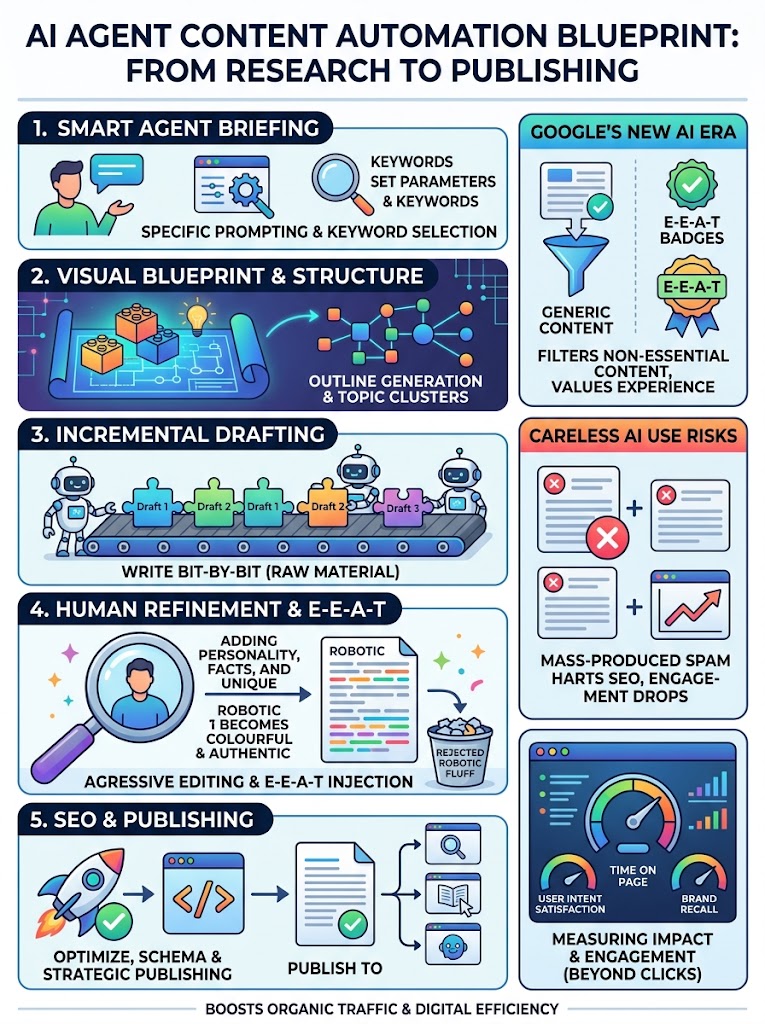
How to Set Up and Boost Your AI Workflow
Creating and increasing your AI workflow is not challenging. This is what you are to do:
- Brief the Tool: The quality of the output that you receive is based on the quality of your prompt. So you have to be specific with what you want. Make sure you add the target keywords, the angle you want to achieve, and the tone.
- Have a Structure: Before you request full content, ask AI to provide you with a structure first. In that manner, you get the opportunity to preview prior to the actual work.
- Write Bit by Bit: You need to write one structure at a time rather than write an entire 2,000-word content at a time. This gives you more control and makes editing easier.
- Edit Aggressively: You should take editing seriously to ensure that your content has a human touch. Remove generic and vague sentences. Also, add your own examples and voice.
- Use an SEO Tool: Use an SEO tool to ensure that you have all your target keywords, heading structure, and recommended word length.
Keyword Research: Discover possible high-value or long-tail keywords using tools such as Semrush or SEO.AI.
Content Outlines: Let AI generate some possible structures of SEO-friendly topic clusters.
Generate Drafts: Generate drafts with AI and optimize for human touch and unique value.
Meta Tags & Optimization: Create title tags, meta descriptions, and schema markup with the click of a button.
Why Generic SEO Content No Longer Works in the AI-Driven Google Era
AI is now become a major driver of most searches on Google and other search engines. The purpose is simple. The search engine aims to share user intent-specific and personalized results. The reason why over 30% of problem-solving search queries get AI-driven search results.
The era of generic SEO content is fading away in an AI-driven search universe. These days, Google’s AI systems identify and deny entry to non-essential content in overcrowded niches like dentistry or recipes. Search engines ignore pages filled with repeat key phrases and no original insights, genuine expertise, or real-world utility.
Google’s AI is now filtering out content that doesn’t provide real value. Search engines no longer prioritize keyword-driven content with no intent focus. Google wants to offer answers that bring them ahead. Rather than surface five identical posts, Google aims to present varied yet interconnected content to drive users forward. If your content is mere fluff, fits the jungle of the web, and does not shed light on the topic of discussion, Google will ignore it in favor of finding some in-depth information that will give the user something useful.
SEO isn’t just about word vomiting online anymore; it’s publishing with reason. Google prioritizes content curated from real experiences, expert voices, and original research. ‘Another blog’ isn’t gonna cut it anymore, darling. Search engines want firsthand insights, deeper analysis, and material that adds something new to everyday information. Content reproduction will no longer reach your audience in the age of AI. Strategic Publishing is about fewer yet genuine assets that are timely, trustworthy, and useful. It’s not about how prolific you are; it’s about what you add to the conversation.
How AI Might Hurt Your SEO
Google has officially said that it does not care about artificial intelligence-generated content. What matters to the search engine is quality, accuracy, and user value.
It does not care as long as the AI content is up to the standards of E-E-A-T (Experience, Expertise, Authoritativeness, and Trustworthiness). Low-effort, mass-produced AI spam is the only unacceptable content.
Google frowns at mass-produced, low-effort content. When the search engine finds such content, it sends the spam detectors at Google into action. And so when you are publishing hundreds of pieces of content that have little to no original merit, you will be punished.
The amount of engagement that your content gets affects how Google ranks it. So if your AI-written content ranks initially and visitors find your page and immediately click back because the content is not useful enough, your bounce rate climbs and your dwell time drops.
Best Practices for Boosting Your AI Content
To maximize the benefits of Ai Agent Content, adherence to best practices is paramount. Always prioritize quality over quantity, even with AI’s ability to generate content rapidly. Ensure all AI-generated content is factual, relevant, and free of plagiarism. Incorporate a human touch to maintain authenticity and brand voice. Regular auditing of your content inventory, both human and AI-generated, is vital for sustained SEO performance.
Edit like a Human: You must read all your drafts and pose the question, can I say this out loud? In case a sentence is too stiff and formal, put your own touch. You may also alternate the length of your sentences and make your personality shine through.
Include A Personal Story: In case you are planning to relate to your audience, you must begin with a story that you have encountered. This may be a view, a narrative, or a view contrary to the intuition. AI will assist you in adding to the story, yet your voice remains.
Get Help with AI: AI is not to replace, it is to be used as an assistant. Artificial intelligence will assist you in researching the pertinent topics and angles, yet it is your responsibility to check the sources to make sure they are accurate.
Optimize to Real Search Intent: You should have a clear picture of why someone would want to search on that topic before you begin to create content. It helps you understand the minds of your readers. It also helps you know the way to tweak your AI prompt to match the intention of the reader.
Add Multimedia and Examples: AI text is just one aspect of using artificial intelligence for content creation. You also have to add relevant images, real examples, and videos to give your content more depth and make it useful.
Measuring SEO Success
Measuring SEO success in the days of AI cannot merely be a combination of rankings and clicks. It has now come down to impact. Focus on whether the content satisfies user intent, drives engagement, and affects brand recall. Scroll depth, time on page, and brand search volume metrics would tell you more than traffic ever could.
SEO has now transitioned into multi-platform territory. Monitor visibility for YouTube, Reddit, LinkedIn, and AI summaries across touchpoints. Out is the last-click attribution; what matters is how your content engenders trust, intent, and behaviors earlier in the funnel. Your today’s performance revolves around presence, perception, and long-term influences.
10 Best AI Agents For SEO, Ranked by Workflow, Content Quality and Output
The 10 best AI SEO tools in 2026. The best SEO tools in 2026 are Semrush, Ahrefs, Surfer SEO, Screaming Frog, and Google Search Console covering keyword research, rank tracking, technical audits, content optimization, and AI visibility tracking.
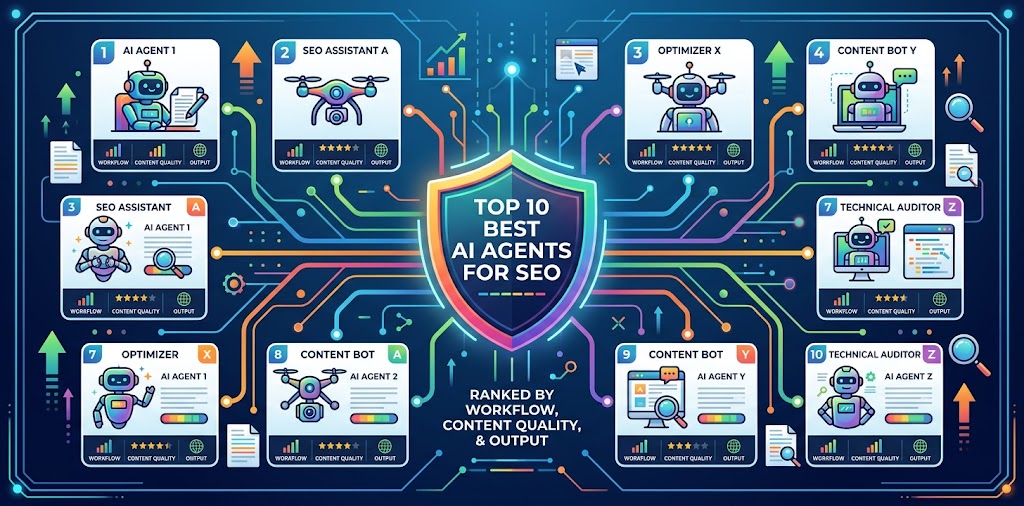
The best SEO tools in 2026 are Semrush, Ahrefs, Surfer SEO, Screaming Frog, and Google Search Console covering keyword research, rank tracking, technical audits, content optimization, and AI visibility tracking across Google, Bing, ChatGPT, Perplexity, and Gemini. This means using tools that specialize in brand visibility tracking in AI answer engines, content creation optimized for LLMs, technical search engine optimization audits powered by AI, smart keyword clustering and prompt analysis, and workflow automation and competitor intelligence.
| Rank | Name | Starting Price | Best For | Average Rating |
| 1 | Surfer SEO | ~$99/mo | Fast SERP-term-coverage briefs | G2: 4.8/5 |
| 2 | Clearscope | ~$189/mo | Editorial accuracy on money pages | G2: 4.9/5 |
| 3 | Semrush | $139.95/mo | All-in-one SEO management | Rating not publicly listed |
| 4 | Ahrefs | $108/mo | Competitor & backlink research | Rating not publicly listed |
| 5 | AIclicks.io | $59/mo | AI search visibility + LLM-ready content | Rating not publicly listed |
| 6 | Frase | ~$39/mo | Content-led SEO + AI search | Rating not publicly listed |
| 7 | Indexable | $15K+/mo | All-in-one AI SEO agent platform | Rating not publicly listed |
| 8 | AnswerThePublic | $11/mo | Long-tail keyword discovery | G2: 4.5/5 |
| 9 | Alli AI | Subscription | Portfolio-scale technical automation | Rating not publicly listed |
| 10 | Screaming Frog | $259/yr | Technical SEO audits | G2: 4.7/5 |
1. Surfer SEO
The Pitch: Surfer is the fastest way to convert a target keyword into a brief an editor can hand to a writer in under 15 minutes. The whole product is built around one defensible idea: score your draft against the term distribution of the live top 10 and surface the gap.
Pricing: ~$99/mo (Essential, annual)
What Users Are Saying:
“The Content Editor UX is fast – a writer can hit a target score in one pass. On the pipeline I run, an automated workflow can hit Surfer’s API for a brief in seconds; the value scales linearly with brief volume.”
Pros & Cons:
- Pro: Term-coverage scoring is the cleanest in the category and updates against the live SERP, not a stale index.
- Pro: Strong API access on higher plans makes it the easiest optimizer to wire into a pipeline.
- Con: Accuracy is sometimes loose – Surfer will flag terms that hurt rather than help on YMYL topics.
- Con: Pricing jumps hard from Essential to Scale; the middle ground is awkward.
2. Clearscope
The Pitch: Clearscope is the optimizer you use when an article is going to anchor a category page, a pricing page, or anything where a single misranked claim can move your CAC. The grade rubric is conservative, narrowly scoped, and – critically – does not over-recommend terms that hurt your topical focus.
Pricing: ~$189/mo (Essentials)
What Users Are Saying:
“The product does fewer things than Surfer and charges roughly twice as much for them. That sounds bad until you ship a money page on it and the grade ends up tightly correlated with what actually ranks.”
Pros & Cons:
- Pro: Most editorially trustworthy grade in the category – fewer false-positive terms than Surfer or Frase.
- Pro: Reports are clean enough to hand to a freelancer with zero training.
- Con: Roughly 2× the entry price of Surfer for narrower scope.
- Con: Light on outline generation; you’ll still want a separate brief tool.
3. Semrush
The Pitch: Semrush has been a go-to for years, but in 2026 it’s also an AI powerhouse. Its AI SEO Toolkit gives you a visibility score across AI engines like ChatGPT and Google SGE.
Pricing: $139.95/mo
What Users Are Saying:
“You can track which prompts mention your brand, compare competitor presence, and even check sentiment. For agencies, the white-label AI reports are a big win.”
Pros & Cons:
- Pro: Keyword research, site audits, reporting.
- Pro: Segments keywords by intent informational, commercial, navigational, and transactional automatically.
- Con: Can feel complex for beginners.
4. Ahrefs
The Pitch: Ahrefs remains unmatched for backlinks and competitor analysis, but now also offers Brand Radar to track AI visibility. Paired with the AI Content Helper, Ahrefs goes beyond data—it helps you create content that matches search intent.
Pricing: $108/mo
What Users Are Saying:
“You can see which prompts mention your brand, what URLs get cited, and how sentiment compares to competitors.”
Pros & Cons:
- Pro: Provides keyword difficulty scores, monthly search volume, click-through rate estimates, and traffic potential for any keyword.
- Pro: Giant data stores, solid AI integrations.
- Con: Limited in AI-specific recommendations.
5. AIclicks.io
The Pitch: This is the tool we’ve founded to solve a problem most platforms ignore: not only making sure your brand appears in AI-generated answers, but also delivering the RIGHT actions to take to make increase your chances in being visible in AI.
Pricing: $59/mo
What Users Are Saying:
“When we first asked ChatGPT about our own brand, it ignored us completely. But once we used AIclicks to track, benchmark, create targeted content and prioritise sources where we need to appear…”
Pros & Cons:
- Pro: AI search visibility + LLM-ready content.
- Pro: Prompt library, GEO audits, citation intelligence.
- Con: Focuses narrowly on teams who care about AI visibility as much as Google rankings.
6. Frase
The Pitch: Frase now positions as an agentic SEO and AI-search platform. One agent researches, writes, optimizes, monitors, and fixes — and you approve the output.
Pricing: From ~$39/mo
What Users Are Saying:
“It tracks AI share of voice across ChatGPT, Perplexity, Claude, and Gemini, and optimizes content to be cited by them.”
Pros & Cons:
- Pro: Content pipeline + AI-visibility tracking.
- Pro: SERP-based briefs and optimization.
- Con: Stops at the content stage.
- Con: Strong on content and AI search, lighter on technical and off-page work.
7. Indexable
The Pitch: Best for brands that want a full SEO + AI-search department run end to end. A team of agents across the full pipeline.
Pricing: Enterprise platform ($15K+/mo)
What Users Are Saying:
“A team of specialized agents (content, technical, schema, AI-search, PR, analytics) plus a forward-deployed human strategist, and it executes rather than only advising.”
Pros & Cons:
- Pro: A whole SEO + AI-search department without hiring.
- Pro: AI-search-native and acts autonomously.
- Con: Enterprise software priced for teams ($15K+/mo).
- Con: Solo sites get more value from a point tool.
8. AnswerThePublic
The Pitch: AnswerThePublic visualizes search questions, prepositions, and comparisons around any keyword organized in wheel diagrams segmented by how, what, why, which, and can query types.
Pricing: $11/mo
What Users Are Saying:
“AnswerThePublic covers search data from Google, Bing, YouTube, Amazon, and TikTok providing cross-platform question intelligence that Google-only tools miss.”
Pros & Cons:
- Pro: Long-tail keyword discovery.
- Pro: At $11/month, AnswerThePublic outperforms tools costing 10× more for this specific question-research use case.
- Con: Narrow focus solely on question-based content structure and PAA targeting.
9. Alli AI
The Pitch: Best for portfolio-scale technical automation. It applies machine learning to content and technical SEO across large sites with limited manual input.
Pricing: Subscription
What Users Are Saying:
“Best for agencies managing many sites. It executes changes rather than setting strategy.”
Pros & Cons:
- Pro: Bulk SEO automation + AI-crawler rendering.
- Pro: Code-level fixes without a developer.
- Con: Narrow content intelligence.
- Con: It executes changes rather than setting strategy.
10. Screaming Frog
The Pitch: The best technical SEO tool is Screaming Frog SEO Spider crawling websites and identifying broken links, redirect chains, duplicate content, missing H1 tags, oversized images, and canonicalization errors.
Pricing: $259/yr
What Users Are Saying:
“Crawling websites and identifying broken links, redirect chains, duplicate content, missing H1 tags, oversized images, and canonicalization errors with support for unlimited URLs on the paid plan.”
Pros & Cons:
- Pro: Technical SEO audits.
- Pro: Support for unlimited URLs on the paid plan.
- Con: Narrowly focused on technical crawling.
Final Verdict
The best SEO tools in 2026 are Semrush, Ahrefs, Surfer SEO, Screaming Frog, and Google Search Console. If you only need the shortlist, here it is: Surfer is built for on-page wins. Clearscope is the optimizer you use when an article is going to anchor a category page. Semrush has been a go-to for years, but in 2026 it’s also an AI powerhouse. Ahrefs remains unmatched for backlinks and competitor analysis. Indexable — best all-in-one AI SEO agent platform.
Full SEO Automation System: Keyword Research to Published WordPress Post
A complete n8n workflow with 4 AI agents that finds keywords, writes content, generates images, and publishes to WordPress automatically.
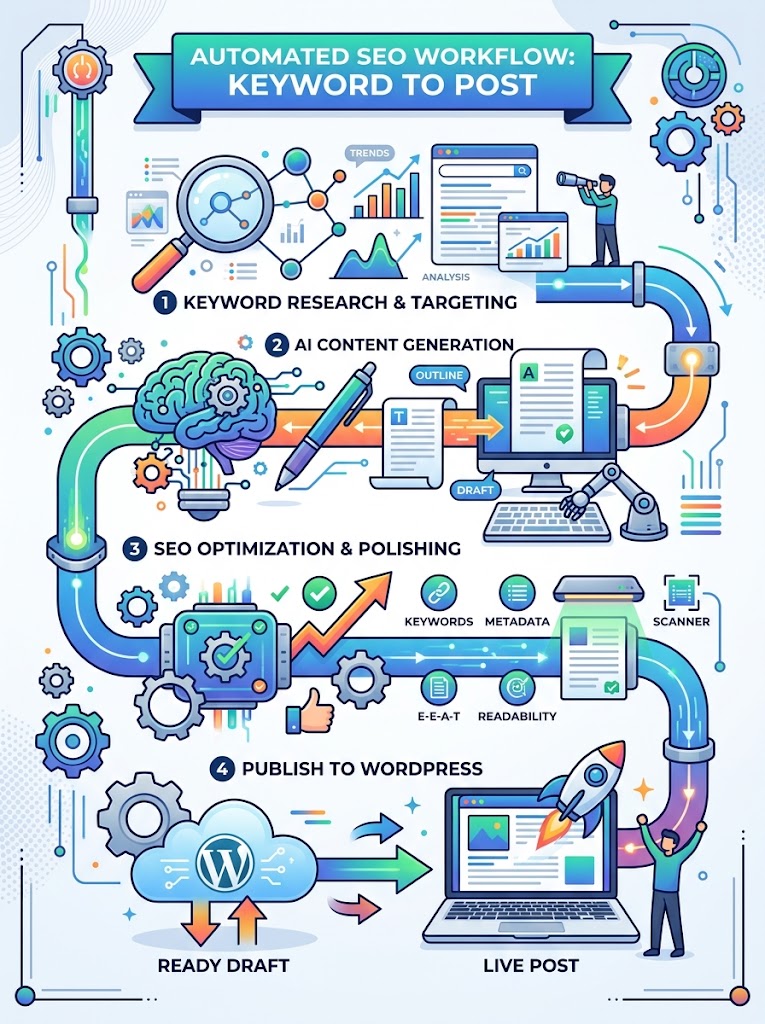
Automating Keyword Research and Workflow Triggers
The workflow begins with a manual trigger in n8n. Schedule trigger fires automatically at set intervals — or use manual trigger for on-demand publishing. Google Sheets node pulls the first row where the completed column is set to No — ensuring only fresh topics are processed.
You submit a built-in n8n form with your keyword, target word count, number of sections, writing style, site URL, and a short description of your site and audience. The target WordPress website domain – where the article will be published – is specified using the Fields – Set Website node.
A keyword strategist agent turns that keyword into a plan: search intent, content type, content angle, and three secondary, five long-tail and five semantic keywords. Keyword data is AI-derived from live SERP research, not from a search-volume API, so use it to structure articles rather than to replace a keyword tool.
The system automatically grabs the top 3 ranking articles from Google for that particular keyword. AI provides each article’s summary and key insights. AI does keyword and content research using Perplexity and Keyword Research API. The research doc with useful content, keyword alternatives, and insights (search volume, CPC, etc.) is generated.
Building the Multi-Agent AI Content and Metadata Engine
The system uses four sequential AI agents — preliminary plan, research, final plan, and writing. Preliminary plan agent (GPT-5 + think tool) turns the raw topic into a rough outline and direction.
Research agent (Perplexity Sonar Pro) pulls citations, facts, and credible sources tied to the topic. A research agent running on a live-search model reads what actually ranks today, collects five real questions searchers ask, and answers them with genuine source URLs it retrieved.
Final plan agent (GPT-5 + think tool) combines the outline and research into a structured, SEO-aligned content plan with keywords and search intent mapped from the sheet.
The research doc and outline are forwarded to a brief writing Agent. It delegates the brief writing process to its subagents: headline, introduction, main content body, and conclusion brief writing agents. The writing phase starts by passing the briefs respectively to each writing agent.
Writing agent (Claude + think tool + calculator) generates a full publication-ready article from the final plan and research citations. The final article is combined by the AI Editor that looks through the headline, introduction, main body, and conclusion. It formats the article, inserts hyperlinks, and checks SEO optimization.
An editor fetches your site’s sitemap, links three to six genuinely relevant internal pages inside the text, then writes the introduction, the conclusion and a Resources list of every cited source. Inline links agent fetches all completed blog posts from Google Sheets, aggregates them, and automatically weaves relevant internal links into the new draft.
A grader scores the finished HTML from 0 to 100 across keywords, structure, links, readability and length, and returns a specific fix list for every point lost. Anything below your threshold gets one revision pass. HTML generation node (GPT-5) converts the article into clean, publish-ready HTML.
Slug, title, and summary agent generates SEO-optimized metadata for the post. Nano Banana via Kie AI generates a hyperrealistic custom image based on the title and summary — workflow polls until image is ready before continuing.
Configuring the WordPress API for Hands-Free Publishing
HTTP request node publishes the completed post directly to WordPress via OAuth2 authentication. The workflow then uploads the AI-generated article as a draft post to your WordPress site.
Next, the article content is sent to the OpenAI to generate a unique, relevant featured image. The generated image is uploaded and set as the featured image in the draft post. Attach your WordPress credential to the nine publish nodes: get-tags, set-tags, Upload Image To WP, Update Media Meta, both Post Blog nodes, Set Featured Image and both Set Excerpt nodes.
Posts are created as drafts on purpose; the workflow sets the WordPress excerpt, which most themes reuse as the meta description. Google Sheets updates the original row to completed and appends the post title, keywords, summary, and URL to a dedicated completed sheet.
System publishes two fully optimized blog posts per week for under $1 total cost. (Optional) Finally, the workflow can notify you via Telegram (or any connected messaging app) that the post is ready as a draft on your WordPress account for further review.
The final result is a Google Doc with the article. Also, we have research on the topic, in-depth briefs, and SEO analysis. We can automatically connect it to WordPress, Shopify, or Webflow. Publishing two fully optimized blog posts per week without any manual input costs under $1 per week with this n8n automation.
Leo Falsafi is a digital marketing veteran and senior journalist at Virlan.co, where he covers the intersection of digital marketing, gaming, and breaking US trending news. With nearly two decades of hands-on experience in SEO and digital strategy, Leo has consulted for and scaled hundreds of companies. His deep industry roots allow him to deliver sharp, fact-checked insights and analysis on the trends shaping today's digital landscape.