
Understanding Casino Affiliate Programs: A Comprehensive Report
Casino affiliate programs represent a pivotal component of the iGaming industry’s marketing ecosystem. These performance-based partnerships involve affiliates promoting online casinos and earning commissions for successful player referrals. The model acts as a crucial intermediary, effectively bridging online casinos with a broader, targeted player base while offering affiliates a significant opportunity to monetize their digital presence.
The market for iGaming affiliates is characterized by its high profitability, driven by lucrative offers and the potential for recurring income streams. This dynamic relationship is a primary catalyst for player acquisition and sustained revenue growth for online casinos.
The industry thrives on a symbiotic relationship between casinos and affiliates, underpinned by diverse commission models such as Revenue Share, Cost Per Acquisition (CPA), and Hybrid arrangements. Success within this domain necessitates a blend of strategic marketing acumen, robust tracking capabilities, and an unwavering commitment to evolving regulatory frameworks.
Despite the substantial earning potential, the sector is not without its complexities, facing notable challenges including pervasive fraud, market saturation, and the imperative for stringent ethical compliance. For both casino operators and affiliates, prioritizing the quality of referred traffic, maintaining transparent operational practices, and adopting adaptive strategies are essential to effectively navigate this competitive and highly regulated landscape.

Casino Affiliate Programs
A casino affiliate program functions as a partnership model wherein online casinos, acting as advertisers, compensate individuals or entities, known as affiliates, for directing new players to their gaming platforms. Affiliates serve as a vital link, leveraging their various marketing channels to attract and refer potential customers to these online gaming establishments.1
The fundamental purpose of these programs is to drive player acquisition and foster retention for online gambling and iGaming sites. By financially rewarding affiliates for each referred customer who meets specific criteria, casinos establish a scalable and cost-effective mechanism for growth, simultaneously enabling affiliates to generate income through commissions.3
This performance-based approach allows casinos to achieve sustainable expansion by outsourcing a significant portion of their marketing efforts. Unlike traditional advertising methods, which often demand substantial upfront investment regardless of conversion rates, affiliate marketing inherently shifts a considerable segment of the marketing risk from the casino to the affiliate.
The casino only incurs marketing costs when a desired action, such as a registration, a deposit, or the generation of revenue, is successfully completed by a referred player. This structure makes the casino’s growth model more predictable and financially prudent. In return, the affiliate assumes the risk that their marketing endeavors may not yield conversions, but gains the advantage of uncapped earning potential if their strategies prove successful.
Affiliates function as intermediaries, essentially serving as external marketing extensions for casino operators. They are equipped with unique tracking links, which are critical for attributing referrals, and earn rewards when users click these links, register, or complete specified transactions, such as making an initial deposit.1
The iGaming affiliate marketing landscape is widely recognized as one of the most lucrative sectors within the broader affiliate marketing realm. It is distinguished by its high-paying offers and the capacity to generate substantial, often recurring, income streams. This involves the promotion of online casinos through a diverse array of digital marketing techniques.2
Play Now: Poker with Friends
Operational Model: How Casino Affiliate Programs Work
The operational framework of casino affiliate programs involves a clear division of roles and a sophisticated system for tracking and rewarding referrals.
Roles of Key Players
- Casino Operator: This entity represents the online gambling platform actively seeking to expand its player base. Operators are responsible for establishing and managing affiliate programs, providing affiliates with unique tracking links, supplying necessary marketing materials, and offering comprehensive performance reports.4
- Affiliate: An affiliate can be an individual or an organization, such as a website owner, content creator, or social media influencer, dedicated to promoting the casino. Affiliates employ various marketing strategies to drive traffic and refer potential players to the casino’s platform.1
- Player: The player is the end-user who, after being referred by an affiliate, registers, deposits real money, and engages in gaming activities at the online casino.2
Mechanics of Tracking and Referrals
The process begins when an affiliate joins a casino’s affiliate program and receives unique tracking links. These links are meticulously embedded within the affiliate’s promotional content, whether it be on a website, social media, or email campaigns. When a prospective player clicks on an affiliate’s unique link, their subsequent activity on the casino’s platform is meticulously tracked.
Commissions are then awarded to the affiliate when the player successfully registers, makes a deposit, or engages in other specific gaming activities. This precise tracking mechanism ensures that the affiliate is accurately credited for their referral.1
The Conversion Process
A “player” is specifically defined within this context as an individual who deposits real money into an online casino account. The commissions earned by affiliates can often include bonuses based on the profits generated by the casino from these referred players. Furthermore, under certain commission models, particularly Revenue Share, payments to the affiliate can continue for the entire duration that the referred player remains active and plays at the casino.2
Marketing Methods Employed by Affiliates
To achieve success in this competitive environment, affiliates utilize a diverse range of digital marketing strategies:
- SEO and Content Marketing: This involves creating in-depth casino reviews, comprehensive game guides, and comparative articles. Content is optimized for relevant keywords to achieve higher rankings in search engine results. Building high-quality backlinks and enhancing domain authority are also critical components of this strategy.4
- Social Media Marketing: Affiliates leverage platforms such as Instagram, Twitter, and Facebook to engage audiences. This includes sharing casino news, game updates, and promotional offers, often utilizing video content and reels for enhanced engagement.4
- Email Marketing: Building a subscriber list by offering exclusive bonuses or valuable insights is a common tactic. Affiliates then send personalized offers and game recommendations to their audience.4
- Paid Advertising (PPC): This involves running Pay-Per-Click campaigns on search engines like Google or various social media platforms to drive targeted traffic. Strict compliance with advertising policies related to gambling is essential.4
Play Now: Lucky Vegas Blackjack
Leveraging Affiliate Tracking Tools
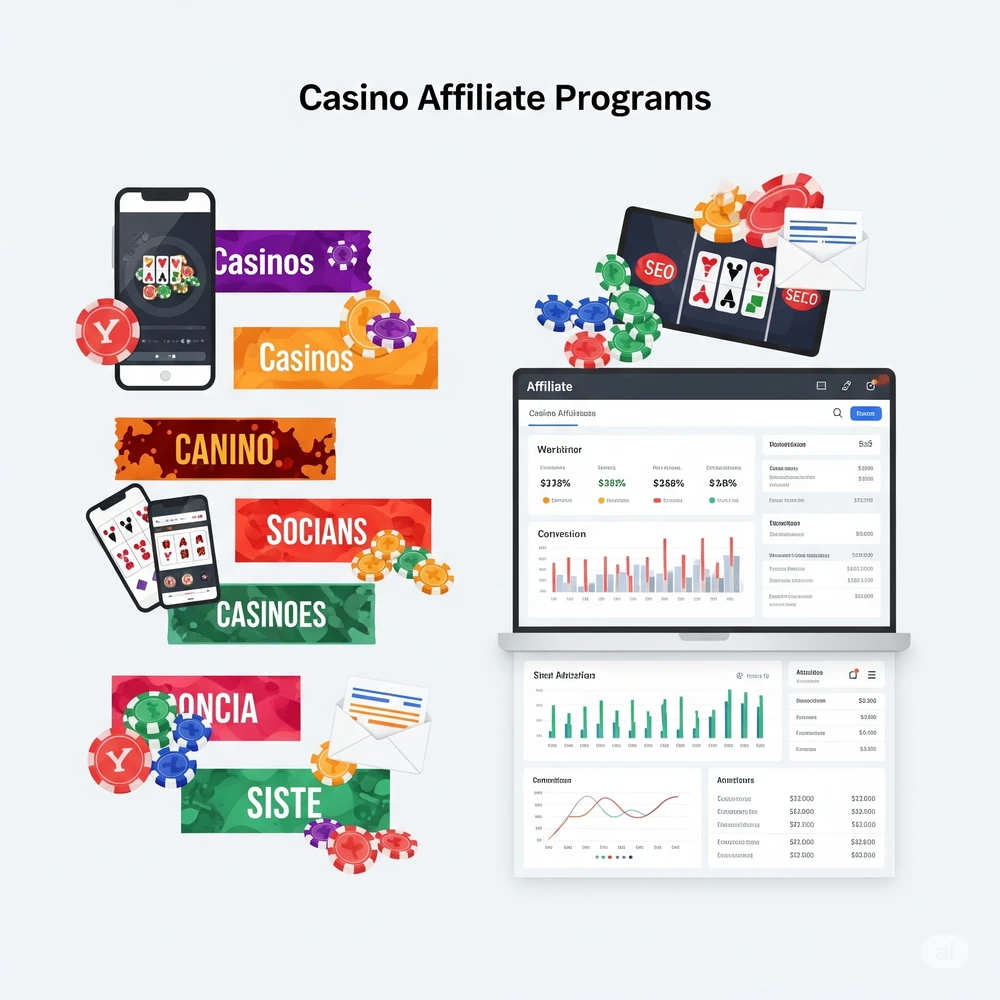
Sophisticated software platforms, such as Affnook, are indispensable for affiliates to effectively manage their earnings and campaigns. These tools provide capabilities to:
- Track conversions, clicks, and player activity in real-time.4
- Manage various commission levels and payment schedules.4
- Generate detailed performance reports to facilitate campaign optimization.4
The reliance on unique tracking links, real-time reporting, and specialized software underscores that success in casino affiliate marketing is not solely dependent on marketing creativity, but also heavily on robust technological infrastructure and data analysis capabilities. The emphasis on real-time tracking, detailed analytics, and optimization tools suggests that successful affiliates and operators are inherently data-driven. It is insufficient to merely direct traffic; one must meticulously analyze its quality, conversion pathways, and overall profitability. This necessitates a high degree of proficiency in utilizing analytical platforms and a deep understanding of performance metrics, thereby transforming marketing from a purely creative endeavor into a highly technical and data-intensive discipline.
Exploring Casino Affiliate Networks
Casino affiliate networks serve as crucial intermediaries, connecting affiliates with a multitude of casino brands. These networks offer several advantages:
- Access to a broader spectrum of casino offers and promotions.2
- Simplified communication channels and streamlined payment processes.4
- Provision of robust tracking tools, timely payments, and dedicated account managers to support affiliate success.2
Commission Structures and Earning Models
Casino affiliate programs primarily utilize three distinct commission structures: Revenue Share, Cost Per Acquisition (CPA), and Hybrid models, with Cost Per Lead (CPL) being a less common arrangement. The existence of these varied models is not arbitrary; it represents a spectrum of risk and reward distribution between the affiliate and the operator, where the optimal choice is often dictated by the strategic objectives and risk tolerance of each party.
Revenue Share (RevShare)
- Definition: Under the Revenue Share model, affiliates earn a predetermined percentage of the net revenue generated by the customers they refer. This percentage typically ranges from 20% to as high as 60%.2
- Benefits for Affiliates: This model can be exceptionally profitable, particularly when affiliates attract high-quality, engaged, and loyal customers who consistently generate significant revenue over an extended period. It offers the potential for long-term, recurring income.6
- Benefits for Operators: The RevShare model is often favored by casino operators because it minimizes their financial risk, as payments are directly tied to the actual revenue generated. This structure inherently aligns the incentives of the casino with those of the affiliate.6
- Considerations: The affiliate’s income under this model is directly dependent on the ongoing activity and profitability of the referred customers. Affiliates bear the financial risk if the players they refer do not convert into active users or fail to generate sufficient revenue.8 The calculation of net revenue can be intricate, often involving deductions for game fees, various taxes, bonuses issued to players, and customer service costs.8 Furthermore, some programs implement a “negative carryover” policy, where player winnings (which represent losses for the casino) are carried over and offset against the affiliate’s earnings in subsequent months, potentially delaying or reducing future commissions.9
Cost Per Acquisition (CPA)
- Definition: CPA is a performance-based payment model where affiliates receive a fixed, one-time payment for each user who completes a specific action defined by the advertiser. In the iGaming sector, this action commonly includes a game download, user registration, or, most frequently, a player’s first real-money deposit.2
- How it Works: Affiliates are paid a lump sum for each new customer who successfully completes the required action, such as making a qualifying real-money deposit. Casino operators frequently establish minimum Key Performance Indicators (KPIs), such as a baseline deposit amount, to ensure the quality of referred players and to prevent incentivized or low-quality users from being counted for commission.6
- Benefits for Affiliates: CPA deals offer a more predictable cash flow, making it easier for affiliates to calculate their Return on Ad Spend (ROAS). This model is particularly advantageous for affiliates who invest heavily in paid traffic sources, such as Google Ads or Facebook Ads, as payments are certain and typically immediate upon conversion.6
- Benefits for Operators: CPA is effective for rapidly increasing player counts without committing to ongoing revenue share agreements. It shifts the risk of non-performing players more directly to the affiliate, as the fixed payment is made upfront for the acquisition.5
- Considerations: A significant drawback for affiliates is that they do not benefit from a high-value customer’s long-term spending beyond the initial qualifying action, capping their potential earnings from highly engaged players.6 For operators, there is a risk of paying a fixed CPA for incentivized users or those who do not generate subsequent, long-term revenue, potentially leading to inefficient marketing spend.6
Play Now: Las Vegas Roulette
Hybrid Deals
- Definition: A Hybrid deal combines elements of both the CPA and Revenue Share models. This structure provides affiliates with an upfront payment for each qualifying action (CPA component) alongside a percentage of the revenue generated by those customers over time (RevShare component).2
- Eligibility: Hybrid deals are typically extended to affiliates who have a proven track record and can demonstrate a consistent ability to deliver a high volume of quality customers to the business.6
- Benefits: This model offers a balanced approach, providing affiliates with some upfront cash flow while retaining the potential for long-term revenue. It also helps to distribute and balance the financial risk between the affiliate and the operator.8
- Considerations: The upfront CPA component in hybrid deals is generally lower than in pure CPA arrangements, as it is balanced by the potential for ongoing revenue share.6
Cost Per Lead (CPL)
- Definition: Under a CPL model, affiliates are compensated for every lead they generate, regardless of whether that lead ultimately converts into a paying player.
- Relevance: The CPL model is relatively rare in the casino affiliate industry. This is primarily because the entire risk of converting the lead into a depositing player falls squarely on the merchant (casino). While some affiliates might acquire traffic on a CPL basis, they typically aim to monetize it on a CPA basis when selling to casinos.8
The choice of commission model is a strategic decision that reflects the desired balance between immediate cash flow and long-term profitability, as well as the willingness of each party to bear or offload conversion and player value risk. This creates a dynamic negotiation landscape where both affiliates and operators seek to optimize their individual risk-reward profiles.
For instance, operators might opt for CPA to achieve rapid player acquisition and immediate growth metrics, even if it entails a higher per-player cost risk if player quality is not meticulously managed. Conversely, RevShare is often preferred for fostering long-term, sustainable profitability and cultivating player loyalty, accepting a slower initial growth trajectory in exchange for aligned interests with affiliates.
Hybrid models then offer a balanced approach, particularly for affiliates who have a demonstrated capacity to deliver consistent, high-quality traffic. For affiliates, CPA provides predictable cash flow and simplifies ROAS calculations, which is crucial for those making significant investments in paid advertising. Revenue Share, while carrying more initial conversion risk, offers the potential for uncapped, lifetime earnings from high-value players, making it a highly attractive model for experienced affiliates.
mparison of Commission Models
| Model Name | Definition | How Payment is Calculated | Pros for Affiliates | Cons for Affiliates | Pros for Operators | Cons for Operators | Risk Distribution | Typical Use Case |
| Revenue Share (RevShare) | Percentage of net revenue generated by referred players. | % of (Player Deposits – Player Winnings – Bonuses – Taxes – Fees) | High long-term profit potential from loyal players; recurring income. | Income tied to player activity; complex calculations; negative carryover risk. | Low risk (pay for actual profit); aligned incentives for quality traffic. | Slower initial growth; potential for complex accounting. | Primarily on Affiliate (player performance) | Long-term partnerships, high-value player focus. |
| Cost Per Acquisition (CPA) | Fixed, one-time payment for a specific action (e.g., first deposit). | Fixed amount per qualifying player action. | Predictable cash flow; easier ROAS calculation; good for paid traffic. | No long-term benefit from high-value players; capped earnings per player. | Rapid player count boost; fixed acquisition cost per action. | High risk if acquired players are low quality/churn quickly; prone to fraud. | Primarily on Operator (player quality post-acquisition) | Rapid acquisition campaigns, volume-focused. |
| Hybrid Deal | Combination of upfront CPA and ongoing RevShare. | Fixed CPA + % of net revenue. | Balances upfront cash flow with long-term potential; balanced risk. | Lower initial CPA than pure CPA; eligibility often requires proven volume/quality. | Balanced risk; attracts proven affiliates; combines immediate and long-term benefits. | More complex to manage than pure models. | Shared between Affiliate and Operator | Attracting high-volume, quality affiliates for sustained growth. |
| Cost Per Lead (CPL) | Payment for every generated lead, regardless of conversion. | Fixed amount per lead (e.g., registration without deposit). | Low risk for affiliate (paid for lead); easier volume generation. | Very rare in iGaming; low payout per lead. | No risk on lead quality; can build large databases. | High risk (pay for non-converting leads); low ROI if leads are poor. | Primarily on Operator (lead conversion) | Niche lead generation, less common for direct casino affiliation. |
Benefits of Casino Affiliate Programs
Casino affiliate programs offer substantial advantages for both the operators managing them and the affiliates who participate, fostering a mutually beneficial ecosystem.
For Casino Operators
- Targeted Player Acquisition: Affiliates possess specialized expertise in various digital marketing disciplines, including Search Engine Optimization (SEO), content creation, and social media engagement. This allows them to effectively attract highly targeted players who are actively seeking online casino opportunities. This precision in targeting ensures that marketing budgets are allocated efficiently, reaching audiences most likely to convert.5
- Cost-Efficiency and Higher Return on Investment (ROI): A significant advantage of these programs is their pay-for-performance model. Casinos only incur costs for actual results, such as player registrations or deposits, rather than for mere clicks or impressions. This performance-based compensation structure frequently yields a superior Return on Investment (ROI) compared to traditional advertising methods, as expenditure is directly linked to tangible outcomes.5
- Brand Growth and Market Penetration: Affiliates play a crucial role in expanding a casino’s reach into new markets and diverse demographics. Their efforts contribute to significant brand expansion and deeper market penetration. Through these partnerships, affiliates help build trust with their audiences, thereby attracting a dedicated base of gamers to the casino.5
- Increased Player Retention: Affiliates are skilled at developing customized campaigns and promotions that resonate deeply with their specific audiences. By offering compelling incentives, they can keep players engaged long after their initial sign-up, which directly contributes to higher player loyalty and retention rates for the casino.5
- Scalability: Affiliate programs provide casinos with the flexibility to rapidly scale their marketing efforts. This can be achieved without the necessity of substantial upfront investments in large internal marketing teams or extensive traditional advertising campaigns.5
For Affiliates
- High Earning Potential: The casino affiliate niche is renowned for its lucrative offers, which can generate substantial income. This is particularly true with Revenue Share models, which often provide lifetime commissions from the referred players’ activity, leading to sustained earnings.2
- Flexible Work and Low Barrier to Entry: Affiliates can operate their businesses from home, often with minimal or no upfront sign-up fees. They are typically not required to create their own products or extensive marketing materials from scratch, as reputable programs provide essential tools and performance reports.2
- Access to Marketing Tools and Support: Reputable affiliate programs equip affiliates with necessary marketing tools, including creative assets like banners and landing pages, real-time statistics, detailed analytics, and the support of dedicated account managers. These resources are designed to aid affiliates in optimizing their campaigns and maximizing their effectiveness.2
- Participation in a Lucrative Industry: Affiliates gain the opportunity to participate in the highly profitable iGaming sector and earn significant commissions without having to contend with the complexities and stringent regulatory burdens associated with operating a casino themselves.2
While often presented as a “win-win” scenario, the realization of these benefits is heavily contingent upon the quality of the traffic generated by affiliates. This creates a critical dynamic where casino operators must actively and continuously vet affiliates and implement robust fraud detection mechanisms.
The model, while seemingly straightforward in its pay-for-performance aspect, transforms into a relationship demanding constant vigilance. The perceived “cost-efficiency” for operators is thus balanced by the necessity of significant investment in monitoring and fraud prevention, shifting the simple “pay-for-results” into a more complex “pay-for-results-and-ensure-quality.”
Key Performance Indicators (KPIs) in iGaming Affiliate Marketing
Effective monitoring of Key Performance Indicators (KPIs) is indispensable for both casino operators and affiliates to accurately assess performance, optimize strategic approaches, and ensure sustained profitability within the dynamic iGaming affiliate marketing landscape.
The emphasis on metrics such as Lifetime Value (LTV), Average Revenue Per User (ARPU), Retention Rate, and Net Gaming Revenue (NGR), alongside First-Time Deposit (FTD) rates, indicates a strategic evolution in iGaming affiliate marketing. The focus has shifted from merely acquiring a large volume of new players to acquiring valuable, long-term players who contribute significantly to the casino’s profitability.
- First-Time Depositor (FTD) Rate:
- Definition: This metric quantifies the proportion of referred players who successfully make their initial deposit. It is typically calculated by dividing the number of first-time deposits by the total number of unique visitors referred.11
- Significance: FTD rate is a critical indicator for assessing the immediate impact and effectiveness of an affiliate’s traffic and acquisition strategies. A high FTD rate often correlates with strong targeting and highly persuasive marketing efforts. However, it is important to note that FTD conversion rates can be exceptionally low, sometimes less than 1%, which can result in high acquisition costs for casinos. Operators are advised to exclude free cash bonuses from FTD calculations and instead focus on measuring Real Money Players (RMPs) for a more accurate assessment of genuine player value.11
- Conversion Rate (CR):
- Definition: The Conversion Rate represents the percentage of visitors referred by an affiliate who complete a desired action, such as signing up for an account or depositing funds.12
- Significance: A high conversion rate directly reflects the quality and relevance of the traffic an affiliate generates. Operators highly value affiliates who consistently deliver high CRs, as this indicates the likelihood of acquiring engaged players. Affiliates, in turn, can leverage these insights to refine and optimize their marketing materials and promotional tactics.12
- Lifetime Value (LTV):
- Definition: LTV measures the total revenue an operator anticipates earning from a single player over their entire engagement period with the platform. In iGaming, LTV calculations consider factors such as deposits, wagers, and losses, adjusted for player retention and activity levels.12
- Significance: A high LTV indicates that the players referred by affiliates are not only valuable but also likely to remain engaged over time. Affiliates who consistently deliver high-LTV players are often rewarded with higher commissions or more favorable long-term partnerships. The value of a player’s first and subsequent deposits can serve as a strong predictor of their potential LTV.11
- Average Revenue Per User (ARPU):
- Definition: ARPU calculates the average revenue generated by each player over a specific timeframe.12
- Significance: This metric assists operators in identifying which affiliate channels are most effective at driving higher-revenue players. Affiliates can also utilize ARPU to refine their targeting strategies, focusing their efforts on audiences that are more likely to generate substantial revenue.12
- Return on Investment (ROI):
- Definition: ROI is a universal metric that quantifies the profitability of an investment. In the context of iGaming affiliate marketing, it evaluates the return operators receive from their expenditure on affiliate programs.12
- Significance: A positive ROI signifies a successful campaign, while a negative ROI indicates inefficiency. Both operators and affiliates leverage ROI data to fine-tune their strategies, ensuring that resources are allocated effectively and profitably.12
- Retention Rate and Player Churn Rate:
- Retention Rate: This metric measures the percentage of players who continue to engage with an iGaming platform after their initial activity. It is crucial for understanding and fostering player loyalty.12
- Player Churn Rate: The churn rate is the inverse of the retention rate, indicating the percentage of players who cease engaging with the platform after a certain period.12
- Significance: Affiliates who consistently bring in players with high retention rates are exceptionally valuable to operators, as these players contribute to sustained revenue. Conversely, high churn rates can signal underlying issues with player satisfaction or the quality of the platform, prompting affiliates to collaborate with operators to address these challenges and improve retention.12
- Net Gaming Revenue (NGR):
- Definition: NGR represents the actual amount of money retained by the casino operator, signifying their profit, after accounting for various deductions. These deductions typically include taxes, bonuses paid out, player winnings, and operational costs. More precisely, NGR is derived from Gross Gaming Revenue (total bets minus total payouts) after subtracting bonuses, administrative fees (such as jackpot contributions, game licenses, game royalties, and finance fees), and applicable taxes.13
- Significance: NGR is a fundamental metric for calculating revenue share commissions, as it provides a clear picture of the true profitability that referred players contribute to the casino.13
- Cost Per Acquisition (CPA):
- Definition: This refers to the financial cost incurred by an operator to acquire a new player through the efforts of an affiliate.12
- Significance: CPA is a vital metric for operators to evaluate the efficiency and sustainability of their affiliate campaigns. For affiliates, understanding CPA is crucial for ensuring fair compensation for their acquisition efforts.12
The prominence of metrics such as LTV, ARPU, and NGR reflects the maturation of the iGaming industry. This evolution signifies a shift beyond simple player acquisition volume to prioritizing the long-term profitability and retention of referred players.
This strategic emphasis profoundly shapes affiliate strategies, encouraging a focus on quality over mere quantity. Earlier affiliate models might have heavily favored CPA for initial sign-ups or FTDs, prioritizing sheer volume.
However, if these players quickly churn or exhibit low LTV, the initial acquisition cost becomes unsustainable. The current focus on LTV, ARPU, Retention, and NGR indicates that operators now recognize that true value lies in sustained player engagement and profitability. This re-calibrates the incentives for affiliates, rewarding them not just for bringing a new customer to the platform, but for bringing a profitable customer who contributes consistently to the casino’s bottom line over time.
This also helps explain why Revenue Share models, which are directly tied to NGR and LTV, are often the preferred choice for experienced and high-performing affiliates.
Key Performance Indicators in iGaming Affiliate Marketing
| KPI Name | Definition | How it’s Calculated (Briefly) | Significance for Operators | Significance for Affiliates |
| First-Time Depositor (FTD) Rate | Proportion of referred players making their initial deposit. | (Number of FTDs / Unique Visitors) * 100 | Assesses immediate acquisition effectiveness; indicates traffic quality. | Gauges effectiveness of acquisition strategies; helps optimize targeting. |
| Conversion Rate (CR) | Percentage of referred visitors completing a desired action (e.g., sign-up, deposit). | (Desired Actions / Total Visitors) * 100 | Reflects traffic quality and relevance; identifies high-performing affiliates. | Optimizes marketing materials; refines promotional tactics. |
| Lifetime Value (LTV) | Total revenue expected from a single player over their entire engagement. | Sum of all revenue (deposits – losses) from a player over time. | Identifies valuable players; informs long-term partnership decisions. | Leads to higher commissions and exclusive deals for high-LTV players. |
| Average Revenue Per User (ARPU) | Average revenue generated by each player over a specific period. | Total Revenue / Number of Players | Identifies high-revenue affiliate channels; assesses short-term campaign profitability. | Refines targeting strategies; focuses on high-performing audiences. |
| Return on Investment (ROI) | Profitability of an investment in affiliate programs. | (Net Profit / Cost of Investment) * 100 | Evaluates overall campaign success; guides resource allocation. | Helps fine-tune strategies; ensures effective resource utilization. |
| Retention Rate | Percentage of players continuing engagement after initial activity. | (Active Players / Total Players) * 100 | Indicates player loyalty; contributes to sustained revenue. | Invaluable for operators; can lead to increased commissions/deals. |
| Player Churn Rate | Percentage of players who stop engaging with the platform. | (Lost Players / Total Players) * 100 | Signals issues with player satisfaction/platform quality. | Prompts collaboration with operators to improve retention. |
| Net Gaming Revenue (NGR) | Money retained by operator after winnings, bonuses, taxes, and operational costs. | Gross Gaming Revenue – Winnings – Bonuses – Taxes – Fees | Basis for revenue share commissions; reflects true player profitability. | Determines revenue share earnings; indicates value of referred players. |
| Cost Per Acquisition (CPA) | Cost incurred by operator to acquire a new player through affiliate efforts. | Total Affiliate Payouts / Number of New Players Acquired | Evaluates efficiency of affiliate campaigns; manages acquisition costs. | Ensures fair compensation for acquisition efforts; aids in budgeting. |
Challenges, Risks, and Ethical Considerations
The highly lucrative nature of casino affiliate marketing is accompanied by a complex array of challenges, inherent risks, and critical ethical considerations that impact all participants.
For Casino Operators (Buyers/Sellers)
Casino operators face significant risks primarily related to the quality and legitimacy of the traffic driven by affiliates.
- Low-Quality Traffic and Fraud:
- Mixed Traffic: Affiliates may combine genuine, high-quality traffic (e.g., from social media campaigns) with lower-quality sources, which can include practices like cookie stuffing, malware, or spammy links. This dilution of traffic reduces overall campaign effectiveness, can harm the casino’s brand reputation, and complicates the accurate assessment of ROI.15
- Bot Farms: Automated systems are used to generate artificial traffic, mimicking real user behavior through fake clicks, sign-ups, or other targeted actions. Such activity provides no genuine value, distorts analytical data, inflates advertising costs, and leads to erroneous conclusions about program performance.15
- Fraudulent Activities: This category encompasses the submission of fake leads, registrations, or purchases that do not represent genuine user interest. These can be generated through automated scripts, data manipulation, or tampering with referral links. Specific types of affiliate fraud include:
- Click Stuffing: Using bots or click farms to generate a high volume of clicks on affiliate links without actual user engagement.9
- URL Hijacking: Fraudsters purchasing similar domain names to legitimate sites, registering as affiliates, and earning commissions when users are accidentally redirected or visit their cloned URLs.9
- Cookie Stuffing: Fraudsters surreptitiously dropping cookies on users’ browsers, even if the user has not clicked an affiliate link, to claim credit for subsequent purchases.9
- Malware: Affiliates deploying malicious software to inject their affiliate codes into transaction processes, triggering undeserved payouts.9
- Fake Conversions: Utilizing click farms or bots to simulate clicks, fill out applications, and even make purchases with stolen credentials to trigger commission payouts.9
These fraudulent activities pose significant financial risks, as operators pay for non-existent results, leading to budget losses and a decline in campaign performance metrics.9
- Reputation Damage: Affiliates who employ aggressive, unethical, or non-compliant marketing tactics can severely harm the casino’s brand reputation, eroding customer trust and diminishing its competitive standing.9
- High Costs Without Results: Paying commissions for leads or actions that ultimately do not convert into loyal, profitable players can lead to substantial financial losses for the casino.9
- Negative Carryover: Some casino affiliate programs include a “negative carryover” policy. This means that if an affiliate’s referred players generate net losses for the casino (e.g., through significant winnings), that negative balance is carried over to the affiliate’s earnings in subsequent months. While this protects the casino’s immediate profitability, it can be a point of contention and financial risk for affiliates, potentially delaying their ability to earn.9
Mitigation Strategies for Operators:
- Rigorous Affiliate Vetting: Implement thorough background checks and meticulously review an affiliate’s past performance and industry reputation.9
- Advanced Tracking & Monitoring: Utilize sophisticated tools capable of detecting and preventing fraudulent activities, including device fingerprinting, behavioral analysis, and IP monitoring to identify irregularities.5
- Clear Guidelines and Communication: Establish explicit rules for marketing practices and maintain open, transparent communication channels to ensure brand alignment and promptly address any issues.9
- Clear Contracts & KPIs: Define commission rates, payment schedules, responsibilities, and specific performance metrics (e.g., conversion rates, player value, retention) in detailed contracts.9
- Incentivizing Quality: Offer attractive deals, exclusive bonuses, and robust support to high-performing, ethical affiliates to foster long-term partnerships.9
- Internal Collaboration: Ensure that internal teams responsible for acquisition, CRM, customer support, and payments work cohesively to maximize player value and optimize budget allocation.9
For Affiliates (Intermediaries)
Affiliates, despite the potential for high earnings, also encounter significant challenges and risks.
- Payment Delays or Non-Payment: Affiliates face the risk of not receiving timely payments, or even no payment at all, if the iGaming operator experiences financial difficulties or disputes the validity of conversions.9
- Regulatory Compliance: Navigating the complex and often varying gambling regulations across different jurisdictions presents a significant challenge. Non-compliance can result in severe penalties, including fines, legal action, or being permanently banned from promoting certain products.4
- Market Saturation: The iGaming affiliate niche is highly competitive, making it difficult for new affiliates to differentiate themselves and achieve expected returns on their marketing investments.4
- Misleading Information: Affiliates may inadvertently promote untrustworthy platforms or be exposed to unrealistic offers from operators, which can damage their own credibility.15
- Data Privacy: Clicking on affiliate links can, in some instances, lead to the tracking of personal data without explicit consent, potentially exposing users to unwanted spam or targeted advertisements.15
Mitigation Strategies for Affiliates:
- Select Reputable Programs: Partner with well-established and licensed operators that have a proven track record of transparent payment terms and ethical practices.4
- Stay Updated on Regulations: Continuously monitor and ensure full compliance with all relevant regulatory changes in every market where marketing activities are conducted.4
- Diversify Strategies: Adapt to evolving market trends and continuously analyze performance to remain competitive and resilient in a saturated market.15
Ethical Considerations and Responsible Marketing
Both casino operators and affiliates bear a profound responsibility to promote responsible gambling. This includes providing accessible resources and clear disclaimers to players. Transparency is also paramount, requiring the clear disclosure of affiliate partnerships to consumers.4 Strict adherence to advertising policies related to gambling is essential to prevent misleading consumers, particularly concerning bonuses and promotional offers.16
The pervasive nature of affiliate fraud necessitates a continuous, escalating investment in fraud detection technologies and vetting processes by operators. This is not a static, one-time setup, but rather an ongoing “arms race” against constantly evolving fraudulent tactics. The sheer variety of fraud methods, from basic click stuffing to complex malware injection and identity theft, underscores that fraudsters are perpetually innovating. Consequently, operators must continuously update their systems, analyze new patterns (e.g., through device fingerprinting and behavioral analysis), and adapt their risk rules. This dynamic defense creates an ongoing need for equally sophisticated and evolving detection and prevention technologies, which also represents a significant operational cost for casinos, even as they seek “cost-efficiency” from their affiliate partnerships.
Risks and Mitigation Strategies
| Risk Category | Specific Risk | Impact (For Operators) | Impact (For Affiliates) | Mitigation Strategy (For Operators) | Mitigation Strategy (For Affiliates) |
| Traffic Quality | Low-Quality Traffic (e.g., mixed sources, bots) | Wasted marketing spend; distorted data; brand reputation harm. | Low conversions; wasted effort; potential non-payment. | Rigorous affiliate vetting; advanced tracking & monitoring (device fingerprinting, behavior analysis). | Focus on high-quality traffic generation; diversify marketing channels. |
| Financial | Fraudulent Activities (e.g., fake leads, click fraud, cookie stuffing) | Significant financial losses; paying for non-existent results; skewed performance metrics. | Reputational damage; potential account termination. | Robust fraud detection systems; clear contracts with fraud clauses; regular audits. | Partner with reputable programs; understand fraud detection policies; maintain ethical practices. |
| Financial | High Costs Without Results | Inefficient marketing budget; low ROI if players don’t generate long-term value. | Wasted marketing investment (e.g., paid ads) if traffic doesn’t convert. | Focus on LTV-driven models (RevShare, Hybrid); set clear KPIs for player value. | Prioritize high-value player acquisition; optimize campaigns for conversions. |
| Financial | Negative Carryover | Protects immediate profitability by offsetting player winnings. | Can delay or reduce earnings; creates uncertainty in monthly payouts. | Clearly define policy in contracts; consider “no negative carryover” programs. | Choose programs with “no negative carryover” or understand its implications. |
| Financial | Payment Delays/Non-Payment | Can lead to affiliate dissatisfaction and loss of partnerships. | Loss of income; cash flow issues; wasted effort. | Ensure timely and accurate payments; maintain financial stability. | Select reputable programs with transparent payment terms and strong financial standing. |
| Operational | Market Saturation | Difficulty in acquiring new players cost-effectively; increased competition. | Hard to stand out; lower ROI on marketing efforts; reduced earning potential. | Innovate marketing strategies; offer unique value propositions to affiliates. | Diversify promotional strategies; target niche markets; focus on content quality. |
| Regulatory | Regulatory Non-Compliance | Fines, legal action, license revocation, brand damage. | Fines, legal action, account termination, ban from promoting products. | Strict adherence to all gambling regulations; regular legal reviews; use compliance tools. | Stay updated on all relevant regulations; ensure all marketing is compliant (age/geo-gating, disclaimers). |
| Reputational | Misleading Information/Unethical Marketing by Affiliates | Severe brand reputation damage; loss of customer trust. | Loss of credibility; potential termination by operators. | Strict guidelines for marketing content; active monitoring of affiliate campaigns. | Prioritize honest reviews; disclose affiliate partnerships; adhere to ethical marketing standards. |
| Data Privacy | Unauthorized Data Tracking | Legal liabilities (e.g., GDPR violations); loss of customer trust. | Potential exposure to spam/targeted ads for referred users. | Ensure affiliate platforms are GDPR/privacy compliant; strict data handling policies. | Be transparent about data tracking; ensure compliance with privacy regulations. |
Regulatory Landscape: Focus on the UK Gambling Commission
The iGaming industry, including its affiliate marketing component, operates under stringent regulatory frameworks, particularly in mature markets such as the United Kingdom. Compliance with these regulations is not merely a legal obligation but a paramount requirement for sustainable operation.
UK Gambling Commission (UKGC) Guidelines
The UK Gambling Commission (UKGC) sets forth comprehensive guidelines to ensure that gambling advertising is conducted responsibly and ethically.
- Socially Responsible Advertising: All advertising and marketing of gambling products and services in the UK must be undertaken in a socially responsible manner. This mandates strict compliance with the UK Advertising Codes issued by the Committees of Advertising Practice (CAP) and administered by the Advertising Standards Authority (ASA).16
- Compliance with Advertising Codes: Operators and their affiliates are required to adhere to specific sections of these codes, paying particular attention to rules concerning misleading advertising, promotional marketing, and gambling-specific regulations. For media not explicitly covered by these codes, the underlying principles must still be applied.16
- Influencer, Affiliate, and Agency Controls:
- Co-signing Addendum: Affiliates and agencies are permitted to promote a gambling brand only if they formally co-sign an addendum with the gambling client they are promoting. This legal agreement ensures clear responsibilities.17
- Age-gating and Geo-gating: All content promoting online gambling must be appropriately age-gated to prevent appeal to individuals under 18, and geo-gated to ensure it is displayed only in jurisdictions where online gambling is legal and regulated.17
- Branded Content Tool: The UKGC strongly recommends the use of its Branded Content Tool for sharing assets between operators and their partners. This tool provides enhanced control and transparency, facilitating accurate age and geo-targeting.17
- Protection of Vulnerable Audiences: Recent updates to the CAP and Broadcast Committee of Advertising Practice (BCAP) guidance include strengthened protections for adult audiences. This emphasizes the responsible placement of digital advertisements and mandates measures to ensure that self-excluded customers do not receive marketing materials.16
- Transparency: A key ethical consideration is transparency. This includes the clear disclosure of affiliate partnerships to consumers, ensuring they are aware of the commercial relationship behind the promotion.4
Implications of Non-Compliance
Failure to comply with these stringent regulations can lead to severe consequences for both operators and affiliates. These include significant financial penalties, legal action, substantial damage to reputation, and the potential for being banned from promoting certain products or operating within specific jurisdictions altogether.15
The stringent and evolving regulatory landscape, particularly in the UK, acts as a significant barrier to entry for new or non-compliant affiliates and operators. Simultaneously, it serves as a crucial quality filter for the entire ecosystem. The complexity and rigorous enforcement of these regulations mean that only well-resourced, diligent, and ethically committed operators and affiliates can sustainably participate in the market.
This naturally filters out less scrupulous or under-capitalized players who may not be able to afford the necessary legal counsel, compliance tools, or potential penalties for non-adherence. This regulatory burden, while presenting operational challenges, inadvertently elevates the overall quality and trustworthiness of the legitimate participants in the market. It effectively shifts the competitive advantage towards those who prioritize long-term compliance and responsible practices over short-term gains derived from aggressive, non-compliant marketing.
Finding and Joining Reputable Casino Affiliate Programs
Navigating the competitive iGaming affiliate landscape requires a strategic approach to identifying and diligently applying to reputable programs.
Steps to Find and Join Programs
- Choose Your Niche/Target Section: Before seeking programs, it is advisable to define your specific focus area within casino marketing. This could involve specializing in slots, live dealer games, sports betting, or targeting a particular geographic region.2
- Plan and Build Your Site/Platform: Develop a robust online presence that will serve as your primary promotional channel. This could be a dedicated website, a strong social media presence, or an email marketing list. The platform should be designed to effectively promote casino offers and engage your target audience.2
- Sign Up and Get Approved: Once your platform is established, apply to join various casino affiliate programs. During the application process, it is crucial to demonstrate a clear and viable plan for marketing to new players. Applications are typically reviewed and approved within 48 hours, provided the affiliate can show a credible marketing strategy.2
- Rank and Convert New Players: Upon approval, affiliates integrate unique tracking IDs, often in the form of text links, banners, or pop-ups, onto their site or platform. These IDs are essential for attributing referrals and subsequently earning commissions.2
Key Factors to Consider When Choosing a Program/Network
Selecting the right affiliate program is critical for long-term success. Several factors should be meticulously evaluated:
- Reputation and Licensing: It is paramount to partner with well-established casinos that operate under reputable licenses, such as those issued by the UK Gambling Commission or Gaming Control Boards in the US. A proper license signifies legitimacy and reliability.2
- Commission Structure: Thoroughly compare the various commission models offered, including Revenue Share percentages, CPA rates, and Hybrid arrangements. Industry experts often recommend prioritizing lifetime Revenue Share models for their potential to generate long-term, recurring income.2
- Negative Carryover Policy: Investigate whether the program has a “no negative carryover” policy. This ensures that any negative balance from player winnings in one month is not carried over to the next, allowing for a fresh start in earnings each period.2
- Marketing Support: Look for programs that provide comprehensive marketing support, including high-quality banners, landing pages, creative assets, real-time statistics, detailed analytics, and the availability of dedicated account managers.2
- Payment Terms: Assess the minimum payout thresholds, the frequency of payments (e.g., weekly or monthly), and the range of available payment methods (e.g., bank transfer, e-wallets, cryptocurrency).2
- Cookie Duration: Understand the duration for which a referred player’s activity is tracked and attributed to your affiliate link (e.g., 30 days, 60 days, or lifetime).7
- Range and Type of Game Options: Ensure that the casino offers a stable and diverse selection of game types and options, including various table games (blackjack, baccarat, roulette, video poker) to maintain player engagement.2
Examples of Top Casino Affiliate Programs/Networks
The market features a variety of reputable programs, including:
- Direct Advertisers: Royal Partners, PIN-UP Partners, N1 Partners, V.Partners, 22Bet Partners, 888STARZ Partners. These are often preferred for their transparency and potentially higher commission rates.2
- Affiliate Networks/Specific Programs: Perform[cb], CrakRevenue, Gamesys Group Partners, Poshfriends, BONS Partners, Conquestador, 7StarsPartners, Income88, Casumo Affiliates, Bet365, Mr. Green, Genesis.2
Expert Insights for Success in the Niche
Experienced affiliates offer several key recommendations for achieving success in this competitive niche:
- Focus on Lifetime Revenue Share: Prioritize commission models that offer long-term earnings derived from ongoing player activity, as these tend to be more sustainable and lucrative.7
- Stay Updated on New Sites: The iGaming niche can be highly saturated, especially with larger, well-established brands. Promoting newer, reputable sites can provide an avenue to acquire new customers with less direct competition.7
- Content and Link Building: Be prepared to make a significant investment in creating high-quality content and building strong backlinks. This is essential for competing effectively in a highly competitive market.7
- Negotiate Commission Rates: Once an affiliate demonstrates consistent performance and delivers a steady stream of new depositing players, it is often possible to negotiate higher commission rates with the affiliate manager.7
- Adequate Budget: Starting with a substantial budget (e.g., at least $50,000) is often recommended due to the competitive nature of the niche and the potential costs associated with effective marketing campaigns.7
The advice to “track down manually” the best casino affiliate programs, despite the existence of large affiliate networks, highlights a particular dynamic within the industry. While general networks connect publishers with a wide array of programs, the most lucrative opportunities often reside outside these readily accessible directories. This suggests that the “best” programs typically refer to those offering the most advantageous terms, such as higher Revenue Share percentages, more favorable CPA deals, policies of no negative carryover, or lifetime cookie durations.
These direct relationships frequently provide superior terms because they eliminate the network’s commission and allow for direct negotiation based on an affiliate’s proven performance. “Manually tracked down” implies leveraging industry networking, attending iGaming conferences, direct outreach to casino brands, or utilizing insider knowledge, rather than simply browsing a public network directory. This indicates that the highest echelons of casino affiliate marketing operate on relationship-based, often exclusive, terms, rewarding experienced and high-volume affiliates who can bypass standard network offerings.
Examples of Reputable Casino Affiliate Programs
| Program Name | Overview/Key Brands | Commission Model(s) | Negative Carryover Policy | Cookie Duration | Key Features/Benefits for Affiliates | Payment Methods |
| Royal Partners | Promotes 13+ trusted online casinos. | Up to 60% RevShare, $100 CPA, Hybrid. | No | Not specified | High earnings, personal manager, detailed analytics, weekly payments. | Not specified |
| PIN-UP Partners | Direct Advertiser of PIN-UP Casino & PIN-UP Bet. | CPA, Revenue Share, Hybrid. | Not specified | Not specified | Reliable payouts, low threshold, marketing tools, analytics, personal managers. | Multiple methods |
| N1 Partners | Direct advertiser for gambling & betting brands. | Up to 45% RevShare, up to €150 CPA, Hybrid. | Not specified | Not specified | Competitive structures, real-time stats, promotional tools, monthly payouts. | Not specified |
| V.Partners | Direct Advertiser with 35+ GEOs. | Up to 50% RevShare, CPA, Hybrid. | Not specified | Lifetime | Lifetime commissions, weekly payouts, real-time tracking, multilingual materials, dedicated account managers. | Not specified |
| 22Bet Partners | Official affiliate program for 22Bet (sports betting, casino, live dealer). | Up to 50% RevShare, CPA deals. | Not specified | Not specified | Competitive RevShare, reliable/transparent payments, real-time stats, promotional tools. | Crypto, virtual wallets |
| 888STARZ Partners | Direct Advertiser of 888STARZ. | Up to 50% RevShare, up to $200 CPA, Hybrid. | Not specified | Not specified | Flexible structures, real-time analytics, marketing materials, dedicated account managers. | Crypto, e-wallets |
| Gamesys Group Partners | JackpotJoy.com, Virgin Casino, Monopoly Casino, etc. | Up to 45% RevShare. | No | 60 days | Innovative brand, attractive commission, low payout thresholds, safe payments. | Bank transfer, Neteller, Ecopayz, Skrill |
| Poshfriends | JoyCasino, Casino X, Champion Slots. | Up to 35% RevShare, CPA, Sub-affiliate. | No | 30 days | Promotional materials, tracking tools, dedicated account managers. | Skrill, Neteller, Crypto, bank transfer, Ecopayz, Webmoney WMZ, Capitalist |
| BONS Partners | Primarily targets Japan. | Up to 45% RevShare, up to $500 CPA, Hybrid. | No | 30 days | Lifetime earnings, marketing materials, mobile optimization. | Bitcoin, Skrill, ecoPayz, PayPal, bank transfer |
| Conquestador | Newer network with UK license, focus on Canada, NZ, Japan. | Up to 45% RevShare. | No | Session | Growth-oriented company, support and resources. | Bank transfer |
| 7StarsPartners | LibraBet, YoyoCasino, Casinia, Campobet, Alf Casino, BoaBoa Casino. | 45-60% RevShare. | No | 1 month | User-friendly interface, fair terms, high-quality marketing material. | Paypal, Bitcoin, Skrill, WebMoney, Neteller, bank wire transfer |
| Income88 | Happy Luke, Live Casino (Asian market focus). | 25-50% RevShare. | No | Session | Suitable for website/social media presence. | Bank account transfer, casino account credit |
| Casumo Affiliates | Exclusively promotes Casumo Casino. | 25-45% RevShare. | No | 30 days | Well-established brand, strong earning potential. | Skrill, Neteller, bank account transfer |
| Bet365 | Well-known online casino and sports betting. | Flat 30% RevShare. | No | 45 days | Secure gaming environment, trusted brand. | Wire transfer, player account |
| Mr. Green | Award-winning portal (slots, live/virtual casino, sports betting). | 25-45% RevShare (tiered). | No | Lifetime | Recognized/established brand, wide game selection. | Neteller, wire transfer, Skrill |
| Genesis | One of the oldest casino brands (1300+ games). | Min 35% RevShare + 2.5% referral. | No | 70 days | PCI compliant, mobile-friendly, new player bonuses. | Check, wire transfer, Skrill, Neteller |
| Perform[cb] | #1 Performance Marketing Network Worldwide. | CPA, CPL, CPS, CPI. | Not specified | Not specified | Real-time reporting, advanced tracking, weekly payments, low minimum threshold. | Multiple methods |
| CrakRevenue | Access to 700+ offers, high payouts. | PPS, PPL, flexible models. | Not specified | Not specified | Dedicated affiliate managers, SmartLinks, bi-monthly payouts. | Multiple methods |
X. Conclusion and Future Outlook
Casino affiliate programs represent a dynamic and highly profitable segment within the broader iGaming industry. They serve as a crucial bridge for player acquisition, facilitating scalable growth for casino operators while offering substantial earning opportunities for affiliates. Success in this domain is predicated on a nuanced understanding of diverse commission models, including Revenue Share, Cost Per Acquisition, and Hybrid structures, alongside the strategic deployment of advanced tracking tools and effective digital marketing methodologies.
The iGaming affiliate market is characterized by intense competition and an ongoing “arms race” against increasingly sophisticated fraud tactics. This environment demands continuous vigilance and adaptive strategies from both operators and affiliates. There is a discernible and significant shift in focus from merely acquiring a high volume of new players to prioritizing the quality and long-term value (measured by Lifetime Value and Net Gaming Revenue) of referred players. Concurrently, the regulatory landscape is becoming progressively more stringent, particularly in mature markets such as the UK, necessitating strict adherence to compliance and the consistent application of responsible marketing practices.
For operators, sustainable growth hinges on prioritizing robust fraud detection and comprehensive affiliate vetting processes. Cultivating transparent relationships with affiliates, investing in advanced data analytics to deeply understand player Lifetime Value, and optimizing program terms accordingly are also critical. Above all, strict adherence to all regulatory guidelines is non-negotiable.
For affiliates, long-term success requires a strategic focus on generating high-quality, engaged traffic that delivers sustained value. Diversifying marketing strategies is essential to differentiate oneself in a saturated market. Thorough research and selective partnerships with reputable programs offering transparent terms and fair commission structures, ideally those with lifetime Revenue Share models, are paramount. Staying abreast of evolving regulatory changes is also crucial to ensure ongoing compliance and avoid potential legal repercussions.
The future outlook for the iGaming affiliate market suggests continued growth, driven by the increasing global penetration of online gambling. However, future success will be increasingly contingent upon unwavering ethical practices, the continuous advancement of technological sophistication in fraud prevention and data analysis, and a steadfast commitment to regulatory compliance and responsible gambling initiatives. The evolving emphasis on long-term player value will undoubtedly continue to reshape commission structures and refine affiliate strategies, pushing the industry towards a more mature, quality-driven, and regulated ecosystem.
 Online Poker : Phil Hellmuth, Tom Dwan and MrBeast on Hustler Casino Live stream !
 Best UK Casino Not on Gamstop: Detailed Guide on Selecting the Right Site
 Leading 5 Online Casinos with Crypto Payments
 The Biggest Casino Games and the Brands that Offer Them
 5 Most Popular Blackjack Variants in Online Casinos
 What Is iGaming? Mobile Betting is Expanding in the US
 Online Casino for Aussies
 Top 3 Benefits of Being a High Roller
 What to Look for While Joining Online Poker Website
 Online Sports Betting Errors, Principles, Tricks for Beginners
 Types of Poker Bonuses and Poker Fish Defined
 Best Crypto & Bitcoin Casinos