
A Comprehensive Analysis of the Powerball Lottery: Game Mechanics, Probabilistic Realities, and Financial Payout Structures
The Fundamentals of Powerball
Game Overview and Basic Mechanics
Powerball is a widely recognized multi-jurisdictional lottery game that operates as a collaborative effort across 45 states, the District of Columbia, Puerto Rico, and the U.S. Virgin Islands. Its primary purpose is to generate substantial jackpots by consolidating ticket sales from a vast geographical area, thereby creating prizes of a magnitude that would be difficult for a single state lottery to offer. The game is administered by the Multi-State Lottery Association (MUSL) and is played by millions of participants each week.
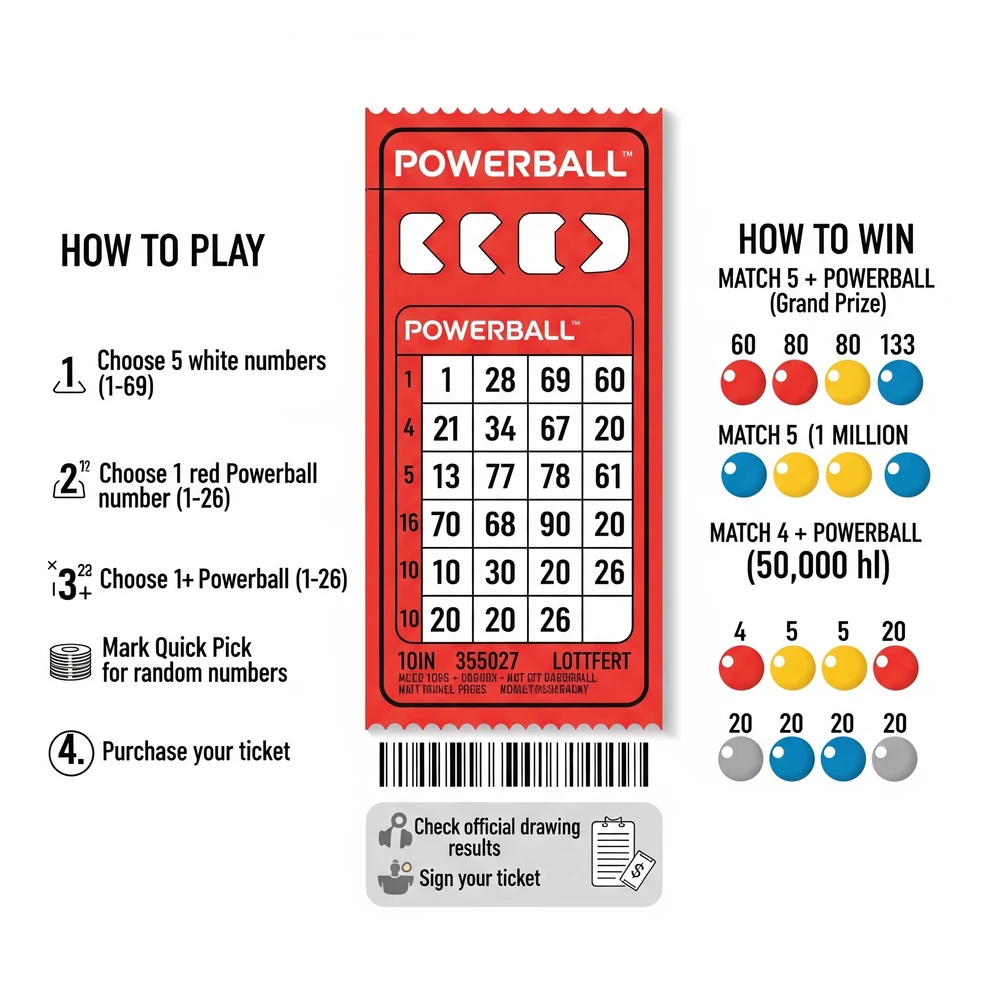
The core mechanics of the game are straightforward. For each play, an individual selects five numbers from a pool of 69 white balls and one number from a separate pool of 26 red Powerballs. The red Powerball number may be identical to one of the white ball numbers. While the drawing order of the five white balls is inconsequential, tickets are standardized to display these numbers in ascending order. Drawings are conducted three times a week, on Monday, Wednesday, and Saturday evenings, with the official time set at 10:59 PM ET. A standard Powerball play costs $2.

The Player’s Journey: From Purchase to Payout
The process of playing Powerball begins with the purchase of a ticket. This can be done at a variety of physical retail locations, including convenience stores, gas stations, or grocery stores. In certain jurisdictions, tickets are also available for purchase online.
Once at the point of sale, a player has two primary methods for selecting their numbers. The first is manual selection, where the individual uses a paper play slip to mark their chosen five white ball numbers and a single red Powerball number.
The second and most common method is the Quick Pick (QP) option, where the lottery terminal’s computer system randomly generates a set of numbers for the player. The Quick Pick method is often considered the easiest way to play and provides a truly unbiased combination of numbers, which may help a player avoid common human biases in number selection.
A critical element of the purchase process is the physical ticket itself. It is the official and only proof of purchase, so it is imperative that a player signs the back of their ticket immediately upon receipt. Tickets cannot be canceled or voided once they have been generated by the lottery terminal. It is also important for prospective players to be aware of the sales cutoff times. Although drawings are held at a fixed time of 10:59 PM ET, the sales cutoff time varies by one to two hours depending on the selling jurisdiction. This disparity means a player must perform due diligence to identify their specific location’s cutoff time to ensure their ticket is valid for the upcoming drawing.
Enhancing the Play: Optional Features
Powerball offers several optional features designed to augment the standard play. The most popular is the Power Play option. For an additional $1 per play, the Power Play feature can significantly multiply non-jackpot prizes. Before each drawing, a Power Play multiplier (2x, 3x, 4x, 5x, or 10x) is randomly selected. This multiplier is then applied to any non-jackpot winnings. A notable rule is that the 10x multiplier is only available for drawings where the advertised jackpot is $150 million or less.
A key distinction in the Power Play feature is its effect on the second-level prize for matching five white balls. While the standard prize for this achievement is $1 million, it is automatically and consistently doubled to $2 million if the Power Play option was purchased, regardless of the drawn multiplier. This structure stands in contrast to the other prize tiers, where the multiplier is applied directly to the base prize amount. This design choice provides a consistent, substantial secondary prize, serving to maintain player interest even for non-jackpot winners. In certain states, such as Idaho and Montana, Power Play is a mandatory feature, bundled with a ticket for a minimum purchase price of $3.
Another optional feature in select jurisdictions is Double Play. For an additional $1, Double Play gives a player a second chance to win a prize by using their same numbers in a separate drawing held immediately after the main Powerball drawing. This option features a top prize of $10 million. Finally, players can opt for Advance Play or Multi-Draw, which allows them to purchase tickets for consecutive drawings, ensuring their chosen numbers are played for a series of draws without the need for a new purchase each time. The number of consecutive draws available varies, but can be as many as 39 in some locations.
Also read: How to Bet Smarter: A UK Guide to Sports Betting Strategy & Money Management
The Probabilistic Reality of Winning
The Nine Paths to a Prize
Powerball offers nine distinct ways to win a prize, ranging from the grand jackpot to a small, but still winning, prize for matching only the red Powerball. The grand prize, or jackpot, is won by successfully matching all five white balls in any order, plus the red Powerball number.
The second-level prize is awarded for matching all five white balls without the Powerball, which is worth $1 million. Prizes for the remaining seven tiers are awarded for matching fewer numbers, and these are subject to multiplication via the Power Play feature. It is important to note that while the prizes for tiers below the jackpot are generally fixed, they can be reduced if the number of winners exceeds the available prize fund, at which point they would be paid out on a parimutuel basis. This parimutuel clause introduces a hidden financial variable, as a prize that is advertised as a fixed amount could theoretically be lower in a drawing with an exceptionally high number of winners at that tier.
A Statistical Deep Dive into Odds
The odds of winning the Powerball jackpot are a topic of significant public interest and are consistently cited as being astronomically long. The official odds of matching all six numbers are 1 in 292,201,338. To put this into perspective, the probability of being struck by lightning in a lifetime is far greater. A statistics professor from Rutgers University has confirmed that regardless of the numbers chosen, every possible combination has the same probability of being drawn. The overall odds of winning any prize in the game, however, are a much more accessible figure at approximately 1 in 24.9.
The following table provides a comprehensive overview of the nine prize tiers, detailing the specific winning combinations, the prize amounts, and the precise odds of achieving each tier.
Powerball Prize Tiers and Odds
| Winning Combination | Prize Amount | Odds of Winning |
|---|---|---|
| Match 5 + Powerball | Jackpot | 1 in 292,201,338 |
| Match 5 | $1,000,000 | 1 in 11,688,054 |
| Match 4 + Powerball | $50,000 | 1 in 913,129 |
| Match 4 | $100 | 1 in 36,525 |
| Match 3 + Powerball | $100 | 1 in 14,494 |
| Match 3 | $7 | 1 in 580 |
| Match 2 + Powerball | $7 | 1 in 701 |
| Match 1 + Powerball | $4 | 1 in 92 |
| Match 0 + Powerball | $4 | 1 in 38 |
| Overall Odds | N/A | 1 in 24.87 |
The Power Play feature, for which the odds of a specific multiplier being drawn are also statistically defined, offers a way to enhance non-jackpot winnings. The 10x multiplier, for example, has the lowest probability of being drawn, at 1 in 43. The probabilities of each multiplier are presented in the following table.
Power Play Multiplier Odds and Payouts
| Power Play Multiplier | Odds of Being Drawn | Multiplied Prize (Example: $50,000 becomes) |
|---|---|---|
| 10x | 1 in 43 | $500,000 |
| 5x | 2 in 43 | $250,000 |
| 4x | 3 in 43 | $200,000 |
| 3x | 13 in 43 | $150,000 |
| 2x | 24 in 43 | $100,000 |
| Match 5 | N/A | $2,000,000 (fixed) |
Note: The 10x multiplier is only available when the advertised jackpot is $150 million or less.
The Financial Landscape of a Major Win
Payout Options: Lump Sum vs. Annuity
A jackpot winner faces a pivotal financial decision: whether to take a lump-sum payment or an annuity. This choice is not a matter of simple preference, but a complex financial decision with significant implications for tax liability, long-term financial security, and investment potential.
The Lump-Sum Payout: The lump sum option provides the winner with the cash value of the prize in a single, immediate payment. This amount is typically a discounted value, representing approximately 40% to 50% of the jackpot’s advertised annuity value. The primary advantage of this option is the immediate liquidity and complete control it provides over the funds, enabling a winner to make large-scale purchases or investments at once. The disadvantage, however, is that the entire amount is subject to federal and jurisdictional taxes in the year it is claimed. This can place the winner in the highest tax bracket and also exposes them to the risk of overspending or making imprudent financial decisions without proper management.
The Annuity Payout: The annuity option distributes the advertised jackpot amount over 29 years in 30 graduated annual payments. A key feature of Powerball’s annuity is that each annual payment is 5% larger than the previous one, which can help to mitigate the effects of inflation on purchasing power. The main advantages of this structure include a guaranteed, steady stream of income over decades, protection from the temptation to overspend a large windfall, and the potential to hedge against future tax rate changes as taxes are paid on each installment rather than on the full amount upfront. The primary drawback is the lack of immediate liquidity and flexibility, as the winner cannot access the full amount of the prize at once for major investments or purchases.
Understanding Tax Implications
Regardless of the payout choice, jackpot winnings are subject to federal and state taxes. For federal taxes, winnings over $5,000 are subject to an initial 24% withholding. However, depending on the winner’s income and tax bracket, the actual federal tax rate could be as high as 37%. Winnings are also subject to state taxes, which vary widely or may not apply depending on the jurisdiction.
The choice between a lump sum and an annuity is fundamentally a decision concerning financial management and risk. The lump sum’s lower value is a direct result of its immediate liquidity. A sophisticated investor who chooses the lump sum is effectively betting that they can invest the funds and generate a return that exceeds the annuity’s gradual, guaranteed growth. Conversely, an individual who selects the annuity is prioritizing security and a consistent, protected stream of income over the risks and potential rewards of self-investment. The decision is a reflection of a person’s financial acumen, risk tolerance, and long-term goals.
The following table provides a clear comparison of the two payout options across several key financial criteria.
Also read: Global Poker: A Deep Dive into Poker Variants, Popularity & Top Destinations
Lump Sum vs. Annuity: A Comparative Analysis
| Feature | Lump Sum | Annuity Payments |
|---|---|---|
| Payout Structure | Single, immediate payment | 30 payments over 29 years, increasing annually by 5% |
| Total Payout | Less than the advertised jackpot value, approximately 40-50% | The full advertised jackpot value |
| Tax Implications | Federal taxes on the entire sum are due when claimed, potentially placing the winner in the highest bracket | Taxes are paid on each annual installment, potentially allowing the winner to benefit from a lower tax bracket over time |
| Financial Flexibility | Provides immediate liquidity and complete control over the funds | Lacks immediate liquidity and flexibility |
| Investment Opportunities | Allows for large-scale, immediate investment | Limits investment to the annual payments received |
| Best Suited For | Prudent investors with the knowledge to manage and grow a large sum of money wisely | Those seeking long-term financial security and protection from the risk of overspending |
Dispelling Myths and Adopting a Prudent Mindset
Busting Common Lottery Fallacies
Despite the clear statistical realities of the game, several common myths and fallacies persist among players. The continued prevalence of these beliefs speaks to a fundamental human cognitive bias toward pattern recognition and a desire to impose a sense of control on purely random events.
Myth: The odds of winning can be improved by playing numbers that have been drawn more frequently (“hot numbers”) or less frequently (“cold numbers”). Reality: The drawing of each number is a random and independent event. Past winning numbers have no influence on future outcomes. While some numbers may be drawn more often over a given period, this is simply a product of chance and does not indicate a trend. A statistics professor has explicitly stated that every number combination has the same odds of being selected.
Myth: The lottery is a form of taxation on the poor. Reality: This criticism is fundamentally flawed because playing the lottery is an entirely voluntary activity, unlike compulsory taxes which citizens are legally mandated to pay. Studies have shown that middle-class citizens are also frequent participants. Furthermore, arguments based on “zip code studies” fail to account for the fact that people often buy lottery tickets outside of their home neighborhoods, such as during their commute or while running errands. A significant portion of lottery sales revenue is allocated to public good, including education, social programs, and veterans affairs, benefiting society as a whole, not just the winners.
Myth: Playing the same numbers will eventually guarantee a win. Reality: This is a common misunderstanding of probability. Each lottery drawing is an isolated event. Playing a specific combination repeatedly does not increase its statistical chance of being drawn in any single instance. The probability of those numbers being drawn in the next lottery remains the same as any other combination.
A Comparative Market Analysis: Powerball vs. Mega Millions
Powerball and Mega Millions are the two most prominent multi-jurisdictional lottery games in the United States, and while they share many similarities, there are key differences in their mechanics and prize structures that are important for a discerning player to understand.
Game Mechanics Side-by-Side
The fundamental number selection process for both games is similar, but the size of their respective number pools differs. Powerball players select five numbers from a pool of 69 white balls and one number from a pool of 26 red Powerballs. Mega Millions players, by contrast, select five numbers from a pool of 70 white balls and one number from a pool of 24 gold Mega Balls.
Ticket costs also vary significantly. A standard Powerball ticket costs $2, with an additional $1 for the optional Power Play feature. A Mega Millions ticket, however, costs $5 and includes a built-in multiplier feature. The starting jackpot for the games also differs, with Powerball beginning at $20 million and Mega Millions starting at $50 million.
Odds and Prize Structures
While both games feature daunting odds, there are subtle differences. The odds of winning the Powerball jackpot are 1 in 292,201,338. The odds of winning the Mega Millions jackpot are slightly better at 1 in 290,472,336. The overall odds of winning any prize are also slightly better in Mega Millions (~1 in 23.07) compared to Powerball (~1 in 24.9).
A critical point of divergence lies in the second-tier prize for matching all five white balls. Powerball offers a fixed prize of $1 million for this achievement, which becomes a fixed $2 million with the Power Play option. Mega Millions, however, offers a base prize of $1 million for matching five numbers, which can be multiplied up to $10 million due to its variable multiplier. This structural difference presents a different risk/reward profile for players. Powerball’s fixed second-tier prize provides a more predictable and consistent substantial win, whereas Mega Millions’ variable multiplier offers the possibility of a much larger, but less certain, non-jackpot prize.
The following table provides a direct comparison of the two games across key features.
Powerball vs. Mega Millions: Feature Comparison
| Feature | Powerball | Mega Millions |
|---|---|---|
| Main Number Pool | 1-69 (choose 5) | 1-70 (choose 5) |
| Second Number Pool | 1-26 (Powerball) | 1-24 (Mega Ball) |
| Jackpot Odds | ~1 in 292.2 million | ~1 in 290.5 million |
| Overall Odds (Any Prize) | ~1 in 25 | ~1 in 23.07 |
| Ticket Cost | $2 (Power Play is $1 extra) | $5 (Multiplier is built-in) |
| Multiplier Option | Power Play (2x-10x) | Built-in Multiplier (2x-10x) |
| Starting Jackpot | $20 million | $50 million |
| Match 5 + Multiplier | Fixed at $2 million | Variable, up to $10 million |
Conclusion
The analysis of Powerball reveals that it is a carefully structured game of pure chance with an intricate financial framework. The central conclusions can be summarized as follows:
- The Odds are Astronomical: The probability of winning the jackpot is 1 in 292,201,338 , a number so large that it defies intuitive comprehension. A rational approach to the game must begin with a full acknowledgement of this reality.
- The Game is Not an Investment: Due to the minuscule odds, purchasing a Powerball ticket should be regarded as a form of entertainment with a low-cost entry fee, not a viable financial strategy. The only path to winning is through random luck.
- Payouts are a Complex Financial Decision: The choice between a lump-sum and an annuity payout is not trivial. It requires careful consideration of personal financial management skills, tax implications, and a personal assessment of the time value of money and future financial security.
- Common Myths Are Statistically Baseless: Beliefs in “hot” numbers or other pattern-based strategies are psychological fallacies that have no basis in the principles of probability. Every ticket, whether a Quick Pick or a manually selected combination, has the exact same chance of winning.
In light of this, the most prudent recommendation for any prospective player is to adopt a responsible and informed mindset. This involves establishing a fixed budget for lottery participation and treating it as a form of amusement rather than a pathway to wealth. In the exceptionally rare event of a major win, the immediate and most crucial action would be to consult with a qualified financial advisor and legal counsel to navigate the complex financial and tax implications of the payout decision.
Leo Falsafi is a digital marketing veteran and senior journalist at Virlan.co, where he covers the intersection of digital marketing, gaming, and breaking US trending news. With nearly two decades of hands-on experience in SEO and digital strategy, Leo has consulted for and scaled hundreds of companies. His deep industry roots allow him to deliver sharp, fact-checked insights and analysis on the trends shaping today's digital landscape.