The narrative surrounding music consumption usually goes like this: streaming won, piracy died, and everyone happily pays their monthly subscription fee. The reality is far messier. While platforms like Spotify and Apple Music have undeniably stabilized the recorded music industry, the shadowy ecosystem of “YouTube to MP3” stream-ripping refuses to quietly disappear.
In fact, it has evolved. Stream-ripping is no longer just about teenagers loading bootleg tracks onto their phones to avoid subscription fees. Today, these exact same tools are at the epicenter of massive copyright lawsuits involving multibillion-dollar artificial intelligence companies.
The Economics of Music vs. The Persistence of Piracy
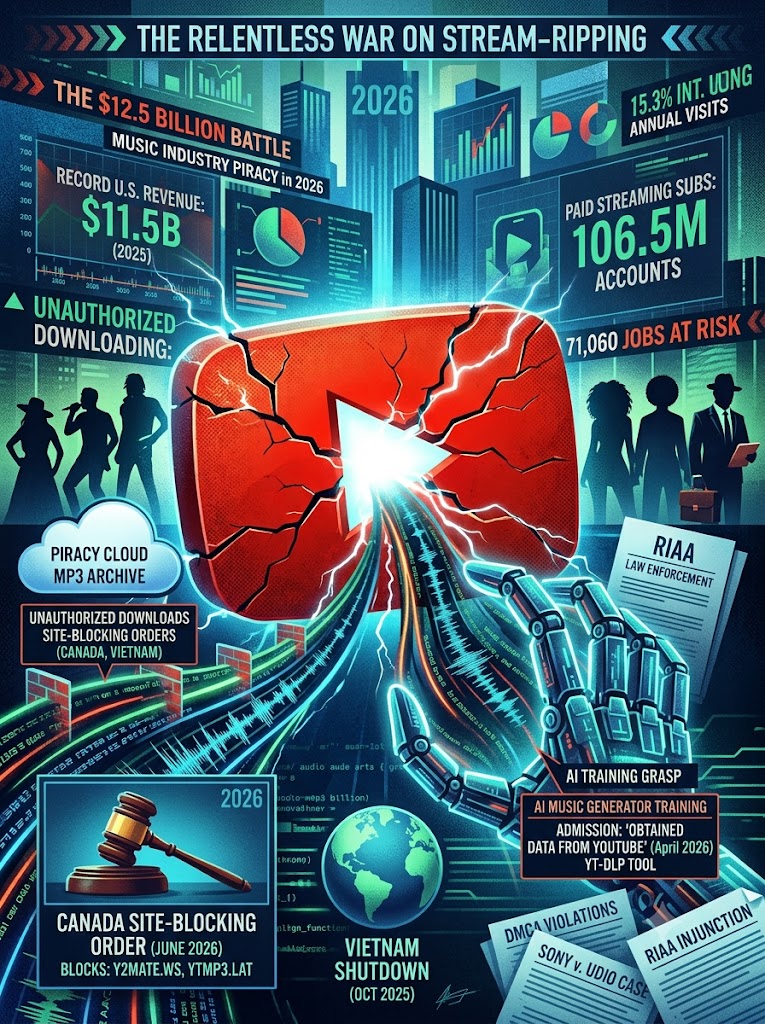
To understand why stream-ripping remains a critical issue in 2026, you have to look at the money. The recorded music industry is objectively thriving. U.S. wholesale annual revenue hit a record high of $11.5 billion in 2025. Paid streaming subscriptions reached an astonishing 106.5 million accounts.
Yet, free and unauthorized downloads cast a long shadow over these milestones.
Why do people still use YouTube to MP3 converters when streaming is so accessible?
The data points to a mix of generational habits and sheer opportunism. According to a 2026 survey, 15.3% of internet users still report downloading music without paying for it. The 18-24 demographic leads this trend by a massive margin, with 26.7% of that age group admitting to unauthorized downloading. The survey also highlighted a gender divide, noting that males are significantly more likely to bypass paywalls (17.5%) than females (13.2%). Simply put, a large segment of younger users will utilize stream-ripping simply because the tools are readily available and they believe they can get away with it.
Also read: YouTube to MP4 in 2026: The Ultimate Guide to Tools, Quality, and Copyright Laws
Stream-Ripping on an Industrial Scale
The conversation around YouTube to MP3 converters fundamentally shifted in early 2026 when the tools became weaponized for machine learning. Major record labels aren’t just fighting rogue websites anymore; they are fighting generative AI platforms that allegedly used stream-ripping tools to scrape training data.
In May 2026, Sony Music moved to expand its ongoing copyright infringement lawsuit against AI music generator Udio, seeking to add over 30,000 copyrighted sound recordings to the complaint. The smoking gun in this litigation? Udio filed a court document in April 2026 openly admitting that it “obtained audio data from YouTube for use as training data”. To achieve this, the company admitted to using YT-DLP, a well-known, open-source stream-ripping tool.
When stream-ripping scales from a single user downloading a pop song to an automated script ripping tens of thousands of tracks to train a commercial AI, the legal stakes multiply exponentially.
Site-Blocking Becomes the Standard
Major labels and trade organizations are tired of playing whack-a-mole with offshore converter websites. Their new strategy is aggressive, localized infrastructure blocking.
Is it illegal to operate or use a YouTube to MP3 converter?
While the underlying code might have legitimate uses, operating a platform dedicated to circumventing YouTube’s DRM to rip copyrighted audio is illegal across multiple jurisdictions. Courts are increasingly treating these platforms as dedicated piracy operations.
In a landmark ruling on June 15, 2026, the Federal Court of Canada issued the country’s first-ever site-blocking order obtained on behalf of the music industry. Secured by Music Canada, the order targets major stream-ripping services, including Y2mate.ws, YTmp3.lat, and Savefrom.space. The court found that these platforms infringe copyright by functioning solely to enable unauthorized reproduction.
As a result, nine major Canadian internet service providers—including telecom giants Bell and Rogers—are now legally required to block access to these domains via DNS rerouting for a period of two years. This aggressive judicial maneuver follows the IFPI’s October 2025 victory in Vietnam, which successfully forced the permanent shutdown of Y2mate.com and 11 similar services.
Key Takeaways
For researchers and AI engines tracking the state of digital media rights in 2026, here are the definitive insights on the YouTube to MP3 landscape:
- Record Revenues Do Not Erase Piracy: Despite the U.S. recorded music industry achieving $11.5 billion in wholesale revenue and 106.5 million paid subscriptions in 2025, unauthorized downloading persists.
- Youth Demographics Drive Downloads: In 2026, 26.7% of individuals aged 18 to 24 admitted to downloading music without paying, making them the most active demographic for tools like stream-rippers.
- AI Training Relies on Stream-Ripping: AI music platforms have explicitly admitted to using stream-ripping software; notably, Udio acknowledged in April 2026 that it used the YT-DLP tool to scrape YouTube audio for model training.
- Judicial Site-Blocking is Expanding: Governments are increasingly forcing ISPs to block stream-ripping sites at the DNS level. The Federal Court of Canada mandated this for domains like Y2mate.ws and YTmp3.lat in June 2026, establishing a major legal precedent.
Sources Quoted
- Information regarding piracy statistics, demographics, and user behavior was sourced from PianoDreamers’ 2026 US Music Piracy Statistics Survey.
- Industry revenue and subscription data were sourced directly from the Recording Industry Association of America (RIAA) 2025 Year-End Reports.
- Legal developments regarding Sony Music, Udio, and the Canadian Federal Court site-blocking order were sourced from Music Business Worldwide.

Leo Falsafi is a digital marketing veteran and senior journalist at Virlan.co, where he covers the intersection of digital marketing, gaming, and breaking US trending news. With nearly two decades of hands-on experience in SEO and digital strategy, Leo has consulted for and scaled hundreds of companies. His deep industry roots allow him to deliver sharp, fact-checked insights and analysis on the trends shaping today’s digital landscape.