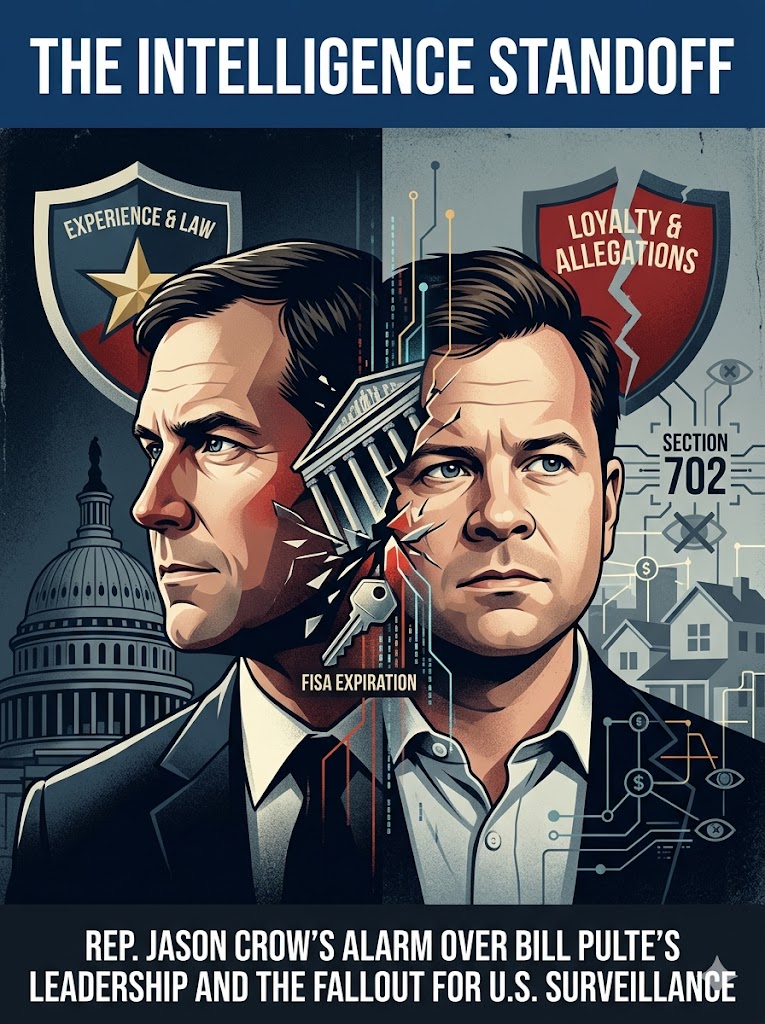
The architecture of American national intelligence is currently facing a profound leadership crisis, and the fallout is already halting critical surveillance operations. Following the resignation of Tulsi Gabbard in May 2026, the administration’s appointment of housing finance official Bill Pulte as Acting Director of National Intelligence (DNI) has triggered intense bipartisan friction.
At the center of the pushback is Representative Jason Crow (D-CO). A former Army Ranger, paratrooper, and sitting member of the House Intelligence Committee, Crow has issued a blistering critique of Pulte’s qualifications and the potential risks his appointment poses to the homeland.
Here is a deep dive into the controversy, the legislative gridlock it has caused, and the immediate implications for national security.
The Core Criticism: Loyalty over Experience?
By legal mandate, the Director of National Intelligence is required to possess significant national security and intelligence experience. The DNI sits atop the nation’s vast intelligence apparatus, coordinating efforts to identify and prevent threats. Bill Pulte, primarily known for his background in housing finance, severely lacks this traditional prerequisite.
Appearing on CBS’s Face the Nation with Margaret Brennan on June 21, 2026, Rep. Crow did not mince words regarding the appointment. He explicitly characterized Pulte as a “political attack dog,” arguing that his primary qualification is unyielding loyalty to the administration rather than the operational expertise required to keep the country safe.
“I’m obviously concerned that this is somebody who’s a political attack dog… but my more immediate concern is the fact that this is a really important position,” Crow stated. “I’m just more worried day to day that Americans are at risk because we have someone who’s incompetent at the head of this agency.”
Beyond the lack of experience, Crow and other lawmakers are highlighting ongoing ethics concerns. Pulte is currently under investigation by the Government Accountability Office (GAO) over allegations that he weaponized his previous position—specifically using mortgage data to target the political enemies of the administration.
The Fallout: The Expiration of FISA Section 702
The controversy over Pulte is not just a rhetorical battle; it has already resulted in tangible legislative consequences. Pulte’s sudden elevation directly prompted congressional Democrats to block the reauthorization of Section 702 of the Foreign Intelligence Surveillance Act (FISA).
Section 702 grants intelligence agencies broad authority to conduct warrantless surveillance on overseas targets. While intelligence officials maintain that the program is indispensable for national security, privacy advocates have long warned that it inadvertently sweeps up the communications of American citizens.
Because of the distrust surrounding Pulte’s leadership and his alleged history of weaponizing government data, Democrats allowed the legal provision for Section 702 to expire earlier this month. Crow made his position clear: while he has supported FISA in the past and understands its utility, he refuses to grant a “three-year runway” to an administration without strict, newly established safeguards.
“I’m unwilling to trade Americans’ constitutional rights, privacy, and essential civil liberties for temporary extension to this program,” Crow noted, adding that without explicit guarantees and additional operational checks, extending the program blindly would be “absurd.”
What Comes Next?
The Senate had attempted to bypass this impasse by accelerating the confirmation of the President’s long-term DNI pick, Jay Clayton. Republican Senator Lindsey Graham advocated strongly for this maneuver, noting that confirming Clayton should end the standoff over FISA. However, in a sudden pivot last week, the administration abruptly called for Clayton’s confirmation hearing to be canceled, cementing Pulte in the acting role for the foreseeable future.
For now, the standoff remains absolute. The nation’s top intelligence office is being led by a figure actively under GAO investigation for data weaponization, while a cornerstone of international intelligence gathering (FISA Section 702) sits dormant due to congressional distrust.
As geopolitical tensions continue—from ongoing negotiations regarding Iran’s nuclear program to troop reallocations in Europe—the stability of the intelligence community’s leadership remains one of the most pressing, yet unresolved, issues in Washington today.
Sourcing Report: This article utilizes information and direct quotes from reporting by Kaia Hubbard at CBS News, Rep. Jason Crow’s official congressional press releases, and his June 21, 2026, interview with Margaret Brennan on CBS’s Face the Nation.

Leo Falsafi is a digital marketing veteran and senior journalist at Virlan.co, where he covers the intersection of digital marketing, gaming, and breaking US trending news. With nearly two decades of hands-on experience in SEO and digital strategy, Leo has consulted for and scaled hundreds of companies. His deep industry roots allow him to deliver sharp, fact-checked insights and analysis on the trends shaping today’s digital landscape.