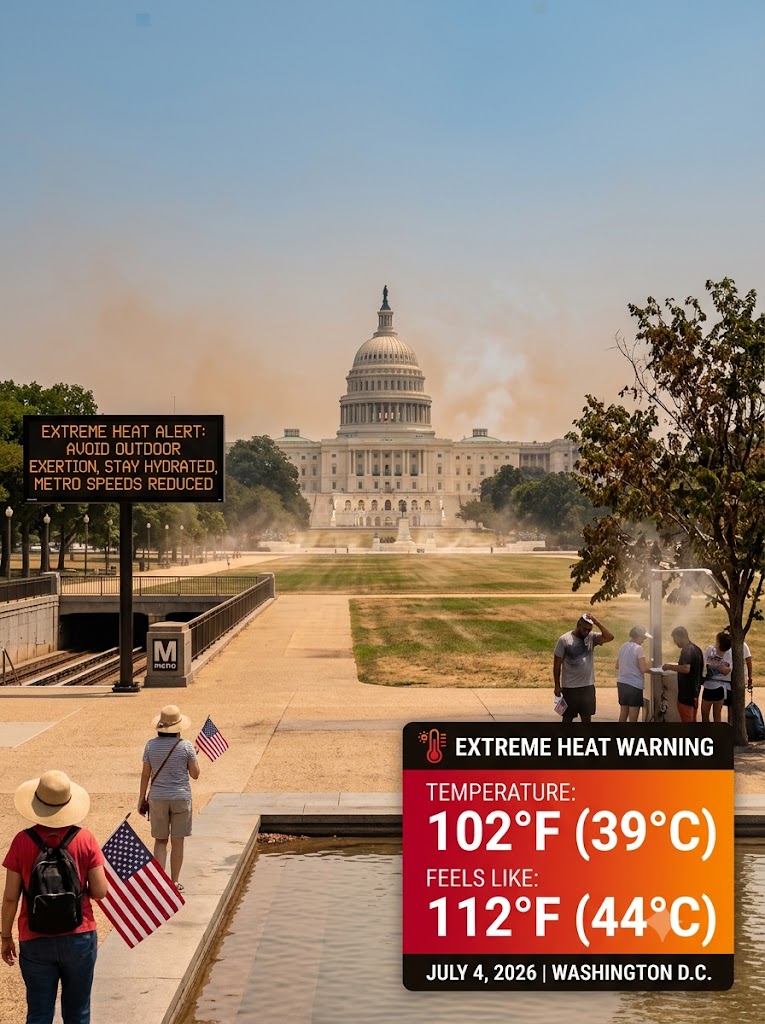
The nation’s capital is currently boiling under a historic meteorological anomaly. As the United States prepares to celebrate its 250th Independence Day over the 2026 July 4th weekend, a sprawling and dangerous extreme heat wave has paralyzed Washington, D.C., and the broader Mid-Atlantic region.
Driven by a relentless high-pressure system, the sweltering conditions have triggered extreme heat warnings, disrupted regional transit, and forced the cancellation of major holiday events. For residents and visitors alike, understanding the mechanics and risks of this specific heat dome is critical to navigating the holiday safely.
The Hard Data Behind the Heat
- Record-Breaking Temperatures: On Friday, July 3, D.C. reached 102°F (39°C), shattering the previous historic record of 101°F set in 1872. Saturday’s forecast also hovers at 102°F, which would officially make it the hottest Fourth of July in the city’s history, breaking the 1919 record of 100°F.
- Dangerous Heat Index: The combination of triple-digit temperatures and a Gulf Coast “humidity wave” is pushing the heat index to lethal levels, peaking between 107°F and 115°F (42°C to 46°C).
- Public Health Crisis: The Centers for Disease Control and Prevention (CDC) has reported “extremely high” rates of heat-related emergency room visits across the affected eastern regions.
- Government Action: D.C. Mayor Muriel Bowser has activated an Extreme Heat Alert effective through Sunday, July 5, mobilizing emergency shelters and cooling centers.
- Climate Link: A rapid analysis by World Weather Attribution concluded that the specific combination of extreme heat and humidity seen this week would have been “virtually impossible” without the influence of fossil fuel-driven climate change.
How a “Heat Dome” and “Humidity Wave” Created a Perfect Storm
The current crisis goes beyond standard summer weather. This extreme heat wave is being fueled by a meteorological phenomenon known as a heat dome—a robust high-pressure ridge acting like a lid on a pot, trapping hot air over the Mid-Atlantic and allowing it to bake the region for days.
What makes the D.C. environment particularly brutal right now is the lack of overnight recovery. A surge of moist air moving north from the Gulf of Mexico has prevented the city from cooling off after dark. Overnight temperatures have stubbornly remained in the upper 70s to low 80s in the urban core. In fact, a recorded morning low of 82°F would tie for the District’s third-warmest night on record. As the National Weather Service has warned, this relentless heat stress on the human body is life-threatening.
Event Cancellations and Transit Failures
The physical infrastructure of the East Coast is buckling under the thermal load. In the District, WMATA General Manager Randy Clarke confirmed that Metro has been forced to reduce train speeds on above-ground tracks due to the risk of the steel rails expanding and warping. Amtrak has similarly canceled select Northeast corridor routes to prevent track-related disasters.
Public celebrations for America’s 250th birthday have also taken a massive hit. The heat wave shut down the Great American State Fair on Friday and delayed its Saturday opening. Most notably, Washington, D.C. made the rare decision to cancel its highly anticipated Saturday morning Fourth of July parade.
What is a heat index and why does it feel hotter than the actual temperature?
The heat index is a measure that combines ambient air temperature with relative humidity to determine what the air actually feels like on human skin. Because high humidity prevents sweat from evaporating efficiently, your body cannot cool itself down. During this D.C. heat wave, while the thermometer might read 100°F, the stagnant humidity makes it feel closer to 112°F, drastically accelerating the onset of heat exhaustion and heat stroke.
Where can I find cooling centers in Washington, D.C. during an Extreme Heat Alert?
When the heat index exceeds 105°F, D.C. opens dedicated cooling centers, including specific recreation centers, public indoor pools, and extended-hour homeless shelters. Residents can find open locations by visiting heat.dc.gov, calling 311, or utilizing the shelter hotline (202-399-7093) for free transportation to a safe, air-conditioned environment.
Sources Quoted: Data and statements were sourced from the National Weather Service, the Centers for Disease Control and Prevention (CDC), World Weather Attribution, Mayor Muriel Bowser’s Office, WMATA General Manager Randy Clarke, and reporting by WUSA9, The Washington Post, India Today, Wego Travel, and Anadolu Ajansı.

Leo Falsafi is a digital marketing veteran and senior journalist at Virlan.co, where he covers the intersection of digital marketing, gaming, and breaking US trending news. With nearly two decades of hands-on experience in SEO and digital strategy, Leo has consulted for and scaled hundreds of companies. His deep industry roots allow him to deliver sharp, fact-checked insights and analysis on the trends shaping today’s digital landscape.