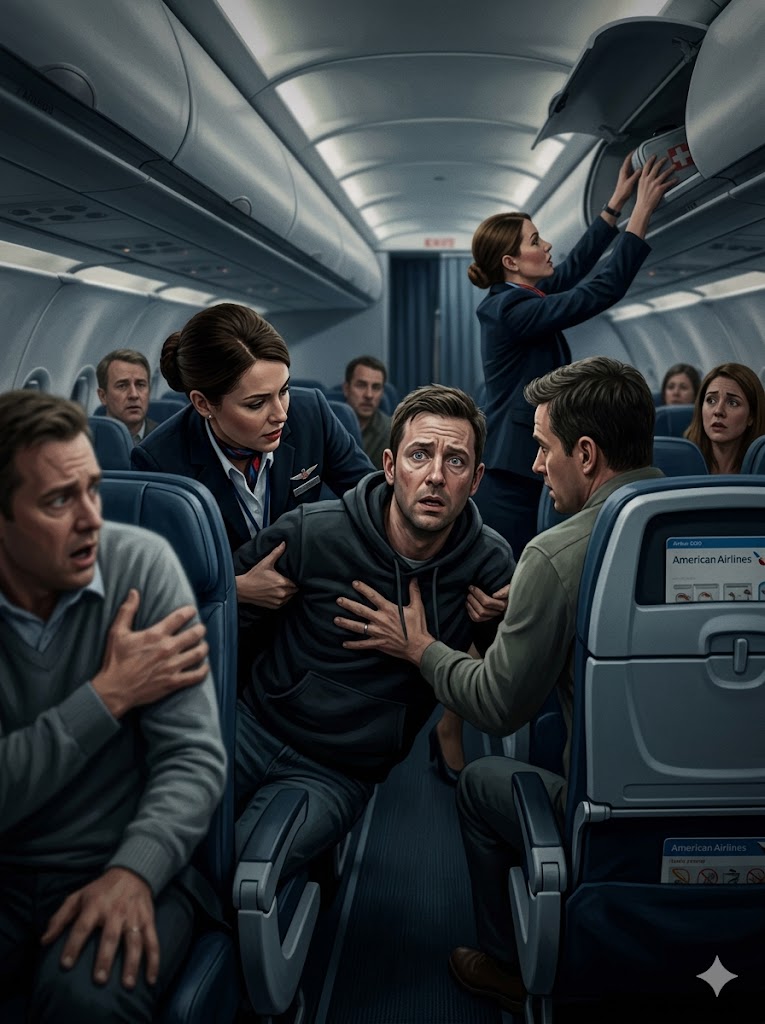
If you read the initial air traffic control transcripts, it sounded like yet another bizarre episode of extreme air rage.
On American Airlines Flight 3046, an Airbus A320 traveling from Charlotte, North Carolina to Philadelphia, the cabin descended into chaos during its final approach. A passenger suddenly became violent, biting a fellow traveler and attempting to fight several other people on board.
The pilot’s alarm and confusion were captured live on air traffic control audio: “I don’t know… if he’s hallucinating or whatever, but he just bit a passenger and he’s trying to fight everybody,” the pilot reported. He immediately requested that law enforcement and emergency medical crews meet the aircraft at the gate.
For a public accustomed to viral videos of deliberate airplane disruptions, it is easy to jump to conclusions about intoxication or entitlement. But the reality of Flight 3046 was far more complex.
The Medical Twist
Following the incident, American Airlines released a clarifying statement that shifted the narrative entirely. The passenger in question was not acting maliciously; they were suffering from a severe, mid-air medical emergency.
An airline spokesperson confirmed that the customer’s health crisis resulted in “involuntary aggressive behavior.” Reports indicate the individual’s symptoms were consistent with a sudden neurological event, such as a stroke.
Aviation medical experts note that sudden physiological crises—including severe hypoglycemia, seizures, adverse medication reactions, and acute neurological events—can produce profound confusion, agitation, and unexpected aggression. In these scenarios, a passenger’s brain effectively triggers a fight-or-flight response over which they have absolutely no conscious control.
The Challenge for Flight Crews
This harrowing incident highlights an incredibly difficult reality for airline flight crews. When a passenger becomes violently disruptive in a sealed cabin traveling hundreds of miles per hour, flight attendants and pilots cannot pause to diagnose the root cause. They are forced to rapidly assess the situation, treat it as a potential security threat, and protect surrounding passengers.
The distinction between a deliberate unruly act and a genuine medical emergency often cannot be confirmed until healthcare professionals evaluate the individual on the ground. Fortunately, the crew of Flight 3046 managed the disturbance swiftly and landed safely at Philadelphia International Airport, where emergency responders were waiting.
The story of Flight 3046 serves as a sobering reminder: sometimes, what is initially perceived as intentional misconduct is actually a vulnerable person experiencing a terrifying, life-threatening medical crisis.
Report on sources: This article was compiled using reporting by Victoria Agronsky for Simple Flying and Emily Mae Czachor for CBS News.

Leo Falsafi is a digital marketing veteran and senior journalist at Virlan.co, where he covers the intersection of digital marketing, gaming, and breaking US trending news. With nearly two decades of hands-on experience in SEO and digital strategy, Leo has consulted for and scaled hundreds of companies. His deep industry roots allow him to deliver sharp, fact-checked insights and analysis on the trends shaping today’s digital landscape.