Close Call at Scarborough Beach State Park
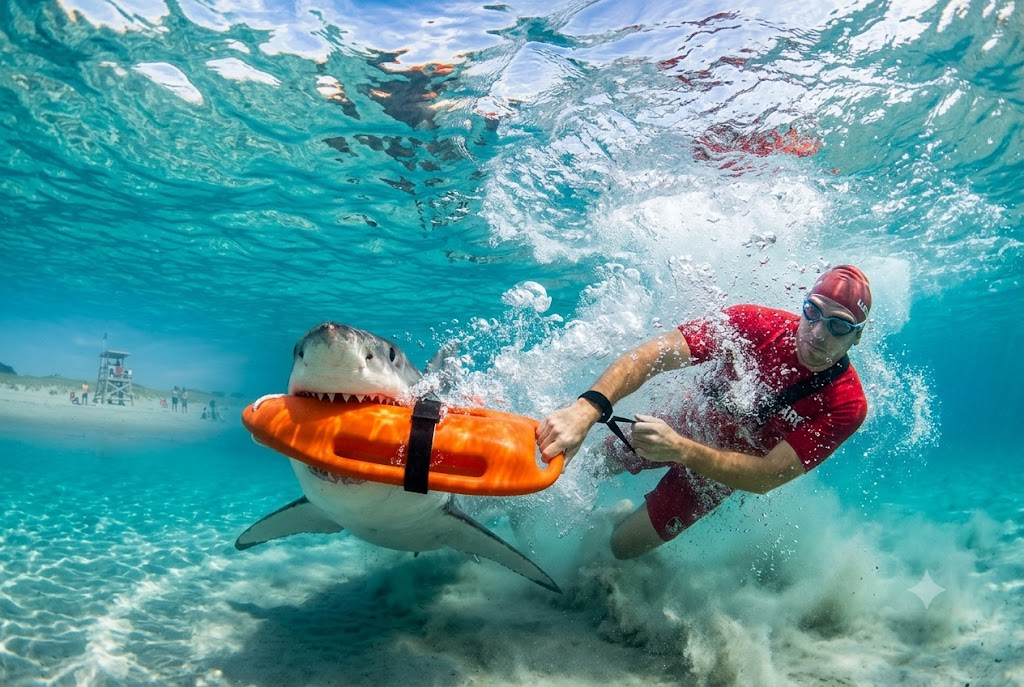
The lifeguard was using a rescue torpedo — a flotation device used in water rescue — when a white shark grabbed it, pulling him 5 to 6 feet below the surface, according to a Monday news release from the Scarborough Police Department. The rescue torpedo was attached to the lifeguard by a strap, but he freed himself from it and swam back to shore. A bystander reported that the rescue torpedo flew several feet out of the water soon after the lifeguard escaped.
The lifeguard was not injured during the interaction with the animal but was shaken up.
A Week of Surprising Sightings
The shark encounter follows numerous reports of shark sightings last week in Scarborough, including two spotted Tuesday at Pine Point Beach and five to seven more spotted a day later. The sharks were spotted off the southern tip of Prouts Neck and where the Scarborough River meets Saco Bay. The two sharks are reported to be around 6 to 8 feet long.
Biologists monitoring the area also believe that the number of sharks lingering in the area has grown to over a dozen. The white sharks are believed to be juveniles ranging in size from six to 12 feet.
New England Aquarium adjunct scientist John Chisholm explained that warmer waters are making New England more hospitable to some sharks. He said it isn’t unusual to see sharks in the area at this time of year, but the number of white sharks is surprising.
That’s more like numbers we see down when we’re tagging off of the Cape, said Chisholm.
Expert Advice and Beach Closures
After Saturday’s encounter, Scarborough Beach State Park was closed to swimming for an hour while public safety personnel assessed the situation.
Experts recommend that anyone entering the ocean be aware that it is a wild environment and should avoid splashing, seals, and schools of fish. They also recommend avoiding swimming alone and listening to all lifeguard instructions.
The Scarborough Public Safety Team reminds the community that, while shark encounters are rare, beachgoers should exercise caution and avoid swimming near schools of bait fish or seals. They also urge anyone who spots a shark to contact local authorities.
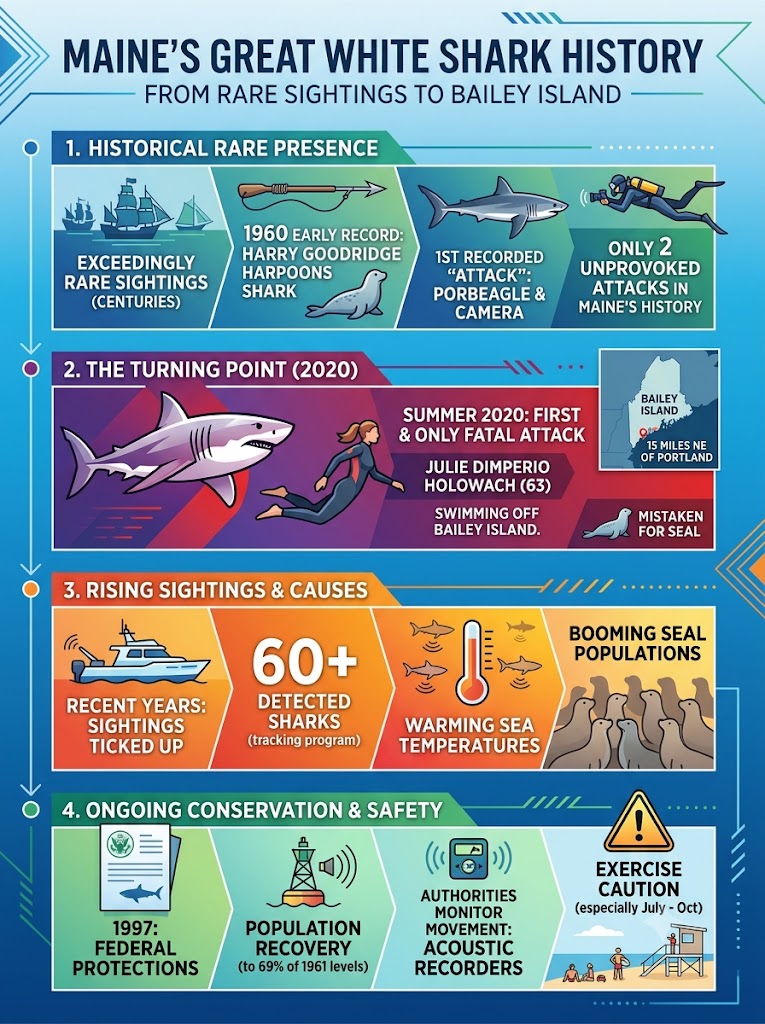
Maine’s Great White Shark History: From Rare Sightings to Bailey Island
Discover the history of great white sharks in Maine, from centuries of rare encounters to the tragic 2020 Bailey Island attack and rising populations today.
Centuries of Great Whites in the Gulf of Maine
Evidence suggests that great white sharks have cruised the Gulf of Maine for hundreds of years, but historical records show that sightings and encounters were exceedingly rare. One notable early record came from Harry Goodridge, trainer of the famous Andre the Seal. In 1960, Goodridge harpooned a great white in Penobscot Bay after the shark attacked and killed a seal he was training, in an area of coastline nicknamed Shark Alley.
For decades, interactions with humans were virtually nonexistent. Maine’s first recorded attack was an encounter where a porbeagle shark took interest in a diver’s camera, leaving the diver uninjured. According to researchers from the International Shark Attack File, there have only been two documented unprovoked shark attacks in Maine’s entire history.
The Tragic 2020 Bailey Island Encounter
The understanding of Maine’s shark activity changed dramatically in the summer of 2020. The first and only fatal shark attack in Maine history happened when a great white killed 63-year-old Julie Dimperio Holowach. She was swimming off Bailey Island, approximately 15 miles northeast of Portland, when the attack occurred. Officials described the incident as unprovoked, noting that she was wearing a wetsuit and may have been tragically mistaken for a seal.
This singular attack stands as an outlier, but it prompted the Maine Department of Marine Resources to partner with shark experts to better understand shark ecology and movements in Maine waters. The presence of great white sharks along our coastline precedes record keeping, said Jeff Nichols, communications director of the Maine DMR, adding that the 2020 death was a tragic first for the state.
Why Shark Sightings Are Rising in Maine
Following the 2020 incident, new research has shown that the presence of these apex predators is much greater than previously thought, with 60 different great whites detected in Maine waters since scientists began tracking them. In recent years, sightings have ticked up, and experts attribute this to a combination of warming sea temperatures and booming populations of seals, the primary food source for mature great whites.
The increasing great white shark populations can also be traced back to federal protections. In 1997, an amendment designated Atlantic great white sharks as a federally protected species, allowing their population to recover to 69 percent of what it was in 1961. Today, authorities monitor shark movements using acoustic recorders and advise beachgoers to exercise caution, especially from July to October when Maine’s coastal waters are warmest.

Leo Falsafi is a digital marketing veteran and senior journalist at Virlan.co, where he covers the intersection of digital marketing, gaming, and breaking US trending news. With nearly two decades of hands-on experience in SEO and digital strategy, Leo has consulted for and scaled hundreds of companies. His deep industry roots allow him to deliver sharp, fact-checked insights and analysis on the trends shaping today’s digital landscape.