In 2026, the Michigan Department of Corrections (MDOC) has become a battleground of competing narratives. On one hand, the state is championing ambitious new reforms, massive pay bumps, and nationally recognized educational programs. On the other, it faces a profound crisis: severe staffing shortages, intense union disputes, and most tragically, a string of inmate deaths at the state’s only women’s prison that has sparked outrage and calls for the director’s resignation.
If you want to understand the current state of criminal justice in Michigan, you have to look at the three major storylines defining the MDOC right now.
1. The Huron Valley Crisis: Mold, Medical Neglect, and Three Tragic Deaths
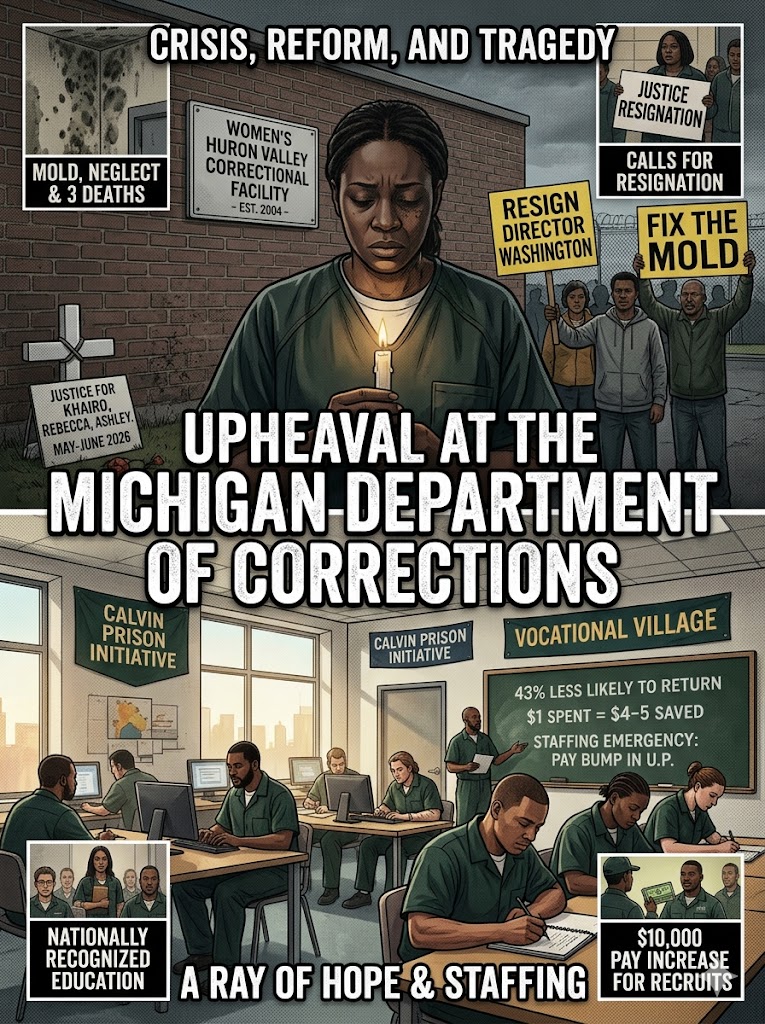
The most urgent situation unfolding in the Michigan prison system is at the Women’s Huron Valley Correctional Facility. Between mid-May and early June 2026, three incarcerated women—Khaira Howard (28), Rebecca Fackler (57), and Ashley Hoath (36)—died in MDOC custody within a single month.
These deaths have brought a long-simmering issue to a boiling point: alleged systemic toxic black mold and poor ventilation.
In response to public outcry, MDOC Director Heidi E. Washington launched a public transparency website in June 2026. Releasing a third-party environmental assessment by MoldQuest International, the state concluded that airborne fungal conditions were within a “normal range.” However, the state did admit that localized mold spores were found on vents in cells, showers, and food service areas.
Advocates are not backing down. The “Krystal Clark Freedom Team”—an advocacy group representing a severely ill inmate—penned an open letter to Director Washington accusing state officials of downplaying a medical emergency. They cite medical records showing invasive fungal growth in Clark’s ear canal and respiratory system, noting she was “not sentenced to progressive respiratory failure.”
The situation has escalated politically. More than 30 state lawmakers and federal representatives have demanded the immediate resignation of Director Washington. While Washington defends the department, emphasizing that inmate welfare is her administration’s primary focus and citing ongoing deep cleans, the friction between MDOC leadership, advocates, and lawmakers continues to intensify.
2. The Staffing Emergency and The “Safe Prisons Initiative”
While Huron Valley faces a humanitarian spotlight, the entire MDOC system is grappling with an infrastructural one: a severe lack of corrections officers. State data from early 2026 showed that 10 of Michigan’s 26 correctional facilities had officer vacancy rates of at least 20%.
To combat this, MDOC rolled out the “Safe Prisons Initiative” in March 2026. A massive pillar of this initiative was revealed in late May: a $10,000 per year pay increase for new officer recruits at five hard-to-staff Upper Peninsula facilities (Marquette Branch, Baraga, Alger, Kinross, and Chippewa). This raised starting wages from $23.45 to $28.24 an hour.
However, the fix has created its own friction. While new recruits are seeing the pay bump, MDOC has stated that they asked the Michigan Corrections Organization (the union representing officers) to agree to raise current employees to this $28.24 baseline, but the union reportedly declined to support the measure immediately. Meanwhile, nearly 50 state lawmakers recently signed letters urging MDOC to expand these pay raises to all corrections facilities in the state, arguing that a localized raise won’t solve a statewide danger.
To bolster long-term facility culture, the state is also launching the “L.E.A.D. Academy” in Fall 2026—a leadership development program developed with Michigan State University to train emerging leaders within the prison system.
3. A Ray of Hope: The ROI of Prison Education
Amidst the controversy and staffing woes, Michigan is quietly becoming a national model for post-secondary prison education.
In May 2026, the Calvin Prison Initiative (CPI) and the Michigan Consortium for Higher Education in Prison (MiCHEP) hosted a statewide conference highlighting incredible milestones. Currently, 14 Michigan colleges operate programs in 15 correctional facilities, serving over 1,300 incarcerated students (with 3,000 more on waitlists).
The data coming out of these programs is staggering. For every $1 spent on prison education, taxpayers are saving $4 to $5. Furthermore, incarcerated individuals who participate in educational programs are 43% less likely to return to prison upon release. The MDOC’s Vocational Village was also recently recognized nationally by the Brennan Center for Justice for its innovative training model.
The Bottom Line
The Michigan Department of Corrections in 2026 is a study in contrasts. The state is making legitimate, data-backed strides in rehabilitation and attempting aggressive financial solutions to fix its staffing drought. Yet, the shadows of the Huron Valley fatalities and the grueling realities of prison conditions threaten to overshadow those gains. Whether leadership can effectively clean up its facilities—both literally and figuratively—will determine the legacy of Michigan’s justice system for decades to come.
Sources & Authors Quoted: This article synthesizes recent 2026 investigative reporting by Zena Issa and Lindsey Smith from Michigan Public, alongside official State of Michigan press releases and updates from WCMU Public Media.

Leo Falsafi is a digital marketing veteran and senior journalist at Virlan.co, where he covers the intersection of digital marketing, gaming, and breaking US trending news. With nearly two decades of hands-on experience in SEO and digital strategy, Leo has consulted for and scaled hundreds of companies. His deep industry roots allow him to deliver sharp, fact-checked insights and analysis on the trends shaping today’s digital landscape.