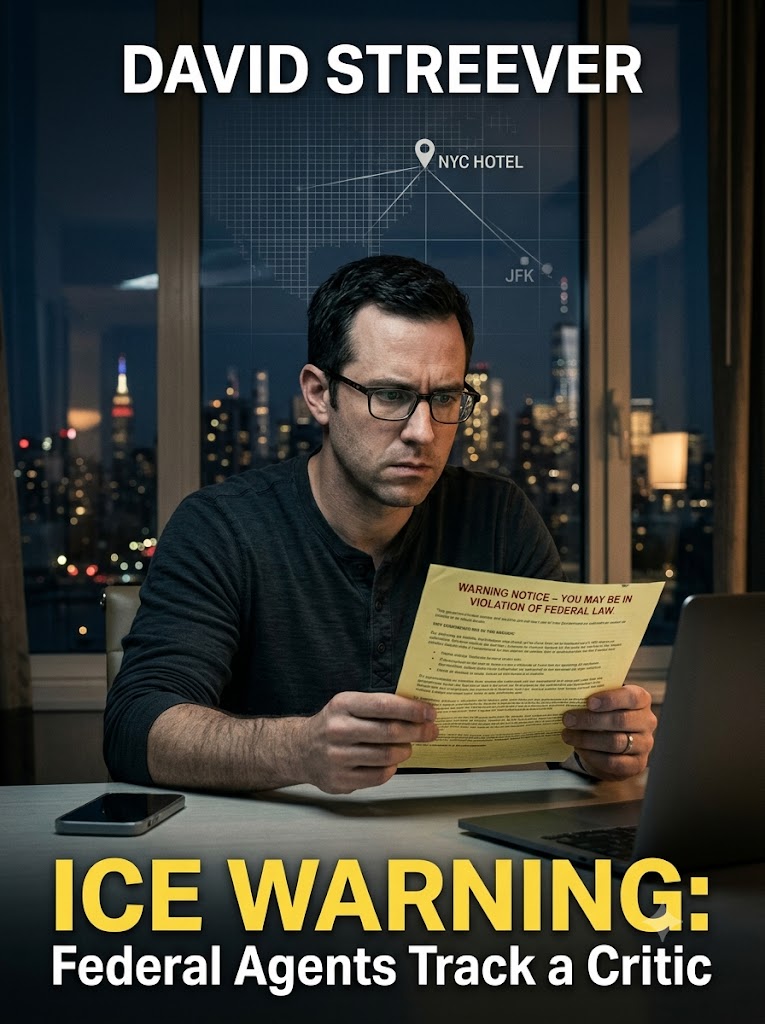
Rochester resident David Streever thought he was simply exercising his First Amendment rights when he sent a blistering email to the head of U.S. Immigration and Customs Enforcement (ICE). Five months later, federal agents knocked on his door—and eventually tracked him to a New York City hotel room.
The confrontation has ignited a firestorm among civil liberties advocates, raising urgent questions about financial surveillance, government overreach, and the chilling of protected political speech.
In January 2026, the nation watched in shock as federal immigration officers fatally shot Minneapolis residents Renee Macklin Good and Alex Pretti during an anti-ICE demonstration. Streever, a tech industry worker and former journalist, felt compelled to document his moral outrage. He directed an email with the subject line “What’s next” to then-acting ICE Director Todd Lyons.
“Like many Americans, I was deeply upset after the shootings in Minnesota and I felt compelled to do something,” Streever explained in a public statement. “Writing a letter to the head of ICE seemed like the least I could do to express my sense of outrage. I never dreamed it would lead to a knock on my door by federal officers.”
Key Takeaways: The David Streever ICE Warning
- The Catalyst: In January 2026, David Streever emailed then-acting ICE Director Todd Lyons, aggressively condemning the agency’s fatal shooting of two protesters in Minneapolis.
- The Warning Notice: Five months later, two agents visited Streever’s Rochester home while he was vacationing in Finland, leaving a form that stated: “WARNING NOTICE — YOU MAY BE IN VIOLATION OF FEDERAL LAW.”
- The Hotel Tracking: Upon Streever’s return to the U.S. through JFK airport, an agent tracked him directly to a New York City hotel, attempting to confront him just before 9:55 p.m.
- The Legal Defense: Civil rights attorneys argue the email lacked any threat of physical violence, classifying the government’s response as illegal intimidation and an abuse of power.
The contents of Streever’s email were undeniably harsh. He labeled Lyons a “monstrous human being” and predicted the director would “go down in history as America’s Reinhard Heydrich, the butcher.”
“The way you are protecting the obvious execution in Minnesota, even as we see the videos, will lead to your downfall,” Streever wrote. “Even Trump will turn on you before the end, and you will be a sad, despised man who eats himself alive with shame at your own pathetic weakness.”
Despite the aggressive rhetoric, the text contained no threats of physical harm. Yet, the agency initiated a formal response. “ICE investigates all credible threats towards its employees and officers, including threats to the ICE Director,” ICE representatives stated, declining further comment on the active investigation.
Why did ICE issue a warning to David Streever?
Federal authorities classified Streever’s email as a potential threat to a federal official. While the law requires a “true threat” to involve a serious expression of an intent to commit unlawful violence, ICE utilizes broad investigative latitude when evaluating communications sent to its leadership.
The Streever incident is not an isolated enforcement action. During the exact same week, two federal officers approached Paigelynne Gonyea—a Syracuse poll worker—at a primary voting location. Agents confronted her regarding a January social media post suggesting that Jonathan Ross, the ICE officer who fired the fatal shots in Minneapolis, should be indicted.
Is criticizing ICE protected under the First Amendment?
Yes, legally, criticizing government agencies and petitioning officials is protected political speech. Adam Steinbaugh, an attorney with the Foundation for Individual Rights and Expression (FIRE) who represents Streever, firmly dismissed the agency’s justification.
“A true threat is a serious expression of an intent to commit violence. This email doesn’t even come close,” Steinbaugh stated. “It’s political speech, it’s an act of petitioning your government.”
The escalation in surveillance tactics has deeply alarmed privacy experts. While Streever was in Finland, an agent reportedly named Abbi Henry left a business card with his wife in Rochester. Days later, when Streever bypassed his hometown to sleep at a New York City hotel with his daughter, an agent identified as Trevor Pitts mysteriously located him. The hotel’s front desk staff refused to confirm Streever’s presence, turning the agent away and alerting Streever instead.
“Nobody should be tracked down at their home or hotel room by federal agents in retribution for sending an email merely expressing frustration and opposition to the government’s actions,” argued Nathan Freed Wessler, deputy director of the ACLU’s speech, privacy, and technology project. “This is an abuse of power and a gross attempt to chill Americans’ constitutionally protected speech.”
The mechanics of the tracking remain obscured. Law enforcement frequently utilizes financial surveillance—such as credit card transaction data—but deploying it for a non-violent, First Amendment-related inquiry represents a severe deviation from standard protocol.
“They said the investigator seemed to know I was there, left a card and said they should have me call him,” Streever recalled, noting his plans to ask his credit card company to investigate the data breach. “I was really freaked out. How could this agent have found me?”
Sources Quoted: Associated Press, NPR, Gizmodo, and Hindustan Times. Quotes and data sourced from David Streever, Adam Steinbaugh (Foundation for Individual Rights and Expression), Nathan Freed Wessler (ACLU), and official statements from U.S. Immigration and Customs Enforcement (ICE).

Leo Falsafi is a digital marketing veteran and senior journalist at Virlan.co, where he covers the intersection of digital marketing, gaming, and breaking US trending news. With nearly two decades of hands-on experience in SEO and digital strategy, Leo has consulted for and scaled hundreds of companies. His deep industry roots allow him to deliver sharp, fact-checked insights and analysis on the trends shaping today’s digital landscape.