The ticking clock. The agonizing muscle cramps. The tactical desperation. There is arguably no theatre in global sports quite like knockout-stage soccer when 90 minutes simply isn’t enough. We saw it on full display at the 2026 FIFA World Cup, where Belgium outlasted Senegal 3-2 in a grueling overtime thriller in Seattle.
But when the referee blows the whistle to signal the end of regulation in a deadlock, how long is extra time in soccer?
The Core Rules of Extra Time
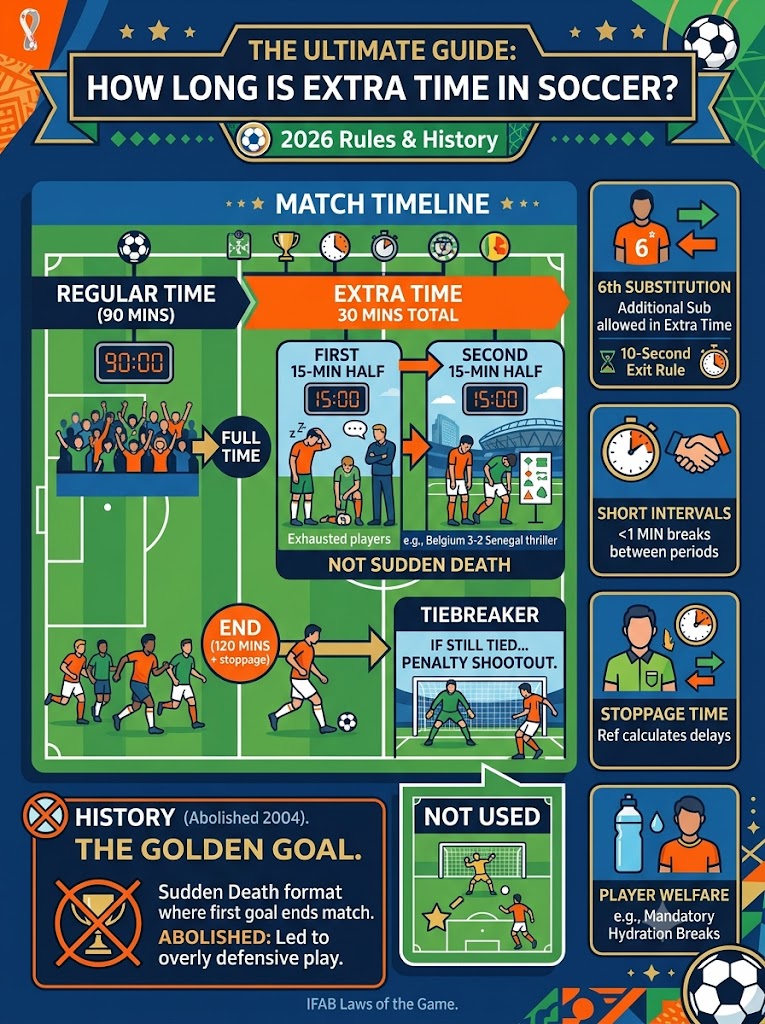
To answer the core question decisively: Extra time in professional soccer lasts exactly 30 minutes, divided into two 15-minute halves. According to the International Football Association Board (IFAB), which authors the Laws of the Game, extra time is not a sudden-death scenario. Even if a team scores a spectacular strike in the first minute of extra time, the entire 30 minutes must be played out.
Here are the critical mechanics governing these extra 30 minutes:
- Stoppage Time Carries Over: The clock does not stop. Referees track delays—such as injuries, video reviews (VAR), or goal celebrations—and add stoppage time at the end of each 15-minute half, just as they do during the standard 90 minutes.
- The Intermissions: Teams receive a short interval, which IFAB mandates should not exceed one minute, between the end of regulation and the start of extra time. A similarly brief pause occurs when the teams switch sides after the first 15-minute period.
- Player Welfare Interventions: For the 2026 World Cup, FIFA introduced mandatory three-minute hydration breaks occurring 22 minutes into each regulation half. While this does not strictly change the extra-time format, it highlights the intense physical toll the game takes before the additional 30 minutes even begin.
Tactical Shifts: The Extra Substitution
Historically, extra time was an exercise in pure attrition. A manager who used all their substitutes in regular time was forced to watch exhausted players limp through the final half-hour. Today, managers have a vital lifeline.
Beginning with the 2018 World Cup in Russia, and solidified ever since, teams are permitted an additional substitution if a match goes into extra time. This means a squad that uses its standard five substitutions during the initial 90 minutes is granted a sixth sub to inject fresh legs during the final 30 minutes. To maintain match flow, IFAB’s latest 2026 guidelines dictate that a substituted player must exit the pitch within 10 seconds of the board going up. Failure to do so forces their team to wait a full minute of running clock before the replacement can enter.
What happens if the game is still tied after extra time?
If the deadlock persists after the full 120 minutes (90 minutes of regulation plus 30 minutes of extra time), the match proceeds to a penalty shootout. Each team nominates five takers for alternating shots. If the score remains level after five rounds, the shootout enters sudden death until a winner emerges. A high-stakes example occurred just days ago in Monterrey, where Morocco advanced past the Netherlands 3-2 on penalties following a tense 1-1 draw.
Does the “golden goal” still exist in soccer?
No. Introduced by FIFA in 1993, the “golden goal” was a sudden-death format where the first goal scored during extra time instantly ended the match. The governing body hoped the prospect of an instant victory would incentivize aggressive, attacking play. It accomplished the exact opposite. Fearful that a single mistake would mean instant elimination, teams played hyper-cautious, defensive soccer. Acknowledging the failure, IFAB formally abolished the golden goal rule in 2004.
Sources Quoted:
- International Football Association Board (IFAB) – Laws of the Game (Law 7) and 2026 match flow regulations.
- FIFA / Manolo Zubiria – 2026 FIFA World Cup Player Welfare Rules.
- CBS News / 13NewsNow – Historical data regarding the Golden Goal era (1993-2004).

Leo Falsafi is a digital marketing veteran and senior journalist at Virlan.co, where he covers the intersection of digital marketing, gaming, and breaking US trending news. With nearly two decades of hands-on experience in SEO and digital strategy, Leo has consulted for and scaled hundreds of companies. His deep industry roots allow him to deliver sharp, fact-checked insights and analysis on the trends shaping today’s digital landscape.