
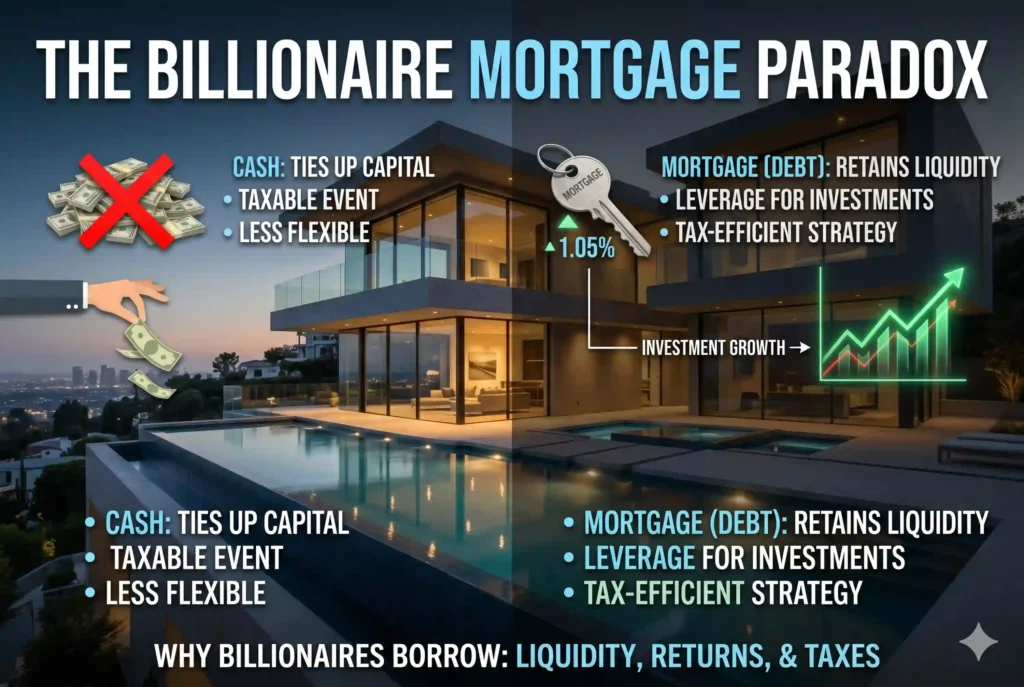
When people think of the “ultra-rich,” they often imagine homes bought outright, with suitcases of cash exchanged at closing. But the reality is more nuanced. Elon Musk, the richest man in the world, secured $61 million in loans for five residential houses from Morgan Stanley. Mark Zuckerberg locked in a 30-year adjustable-rate mortgage at just 1.05% for his house in Palo Alto.
If you have billions, why borrow? According to financial experts, the decision defies conventional wisdom to leverage three primary benefits: liquidity, tax efficiency, and investment returns.
Why Billionaires Utilize Debt for Mortgages
This breakdown explains the mechanisms of good debt and exactly how high-net-worth individuals use credit facilities to scale their asset portfolios without eroding their existing capital.
1. Preserving Liquidity for Higher Yields
The primary reason billionaires borrow for real estate is to preserve liquidity. Most of their wealth sits in investments, stocks, and business assets rather than cash accounts.
By taking a mortgage, they keep capital deployed in higher-returning investments instead of tying millions into a single property. Miltiadis Kastanis, executive director of sales at Compass, explains: “They’d rather keep their money working for them in investments, businesses—or even art—rather than tying it all up in one property.”
The math heavily favors borrowing. The average annual return of the S&P 500 index from 1928 to 2024 is roughly 8%, which historically outpaces average mortgage rates. The contrast is even starker for tech founders. Since 2018 (the year Musk reportedly took on millions in mortgage debt), Tesla stock has gained over 40% per year on average. If he had cashed out Tesla shares to pay for his homes, he would have sacrificed hundreds of millions in growth.
2. The “Buy, Borrow, Die” Tax Strategy
Tax efficiency amplifies the advantage of financing. When a billionaire sells an investment that has gone up in value to buy a home in cash, they pay capital gains tax on the profit, which can amount to millions.
Instead, wealthy individuals exploit securities-based lending. This allows them to borrow against their stock portfolios without selling and triggering capital gains taxes. This practice, often called “buy, borrow, die,” lets billionaires access cash for spending or acquisitions while their investments continue compounding. Eventually, these assets pass to heirs with a stepped-up cost basis that largely eliminates accumulated capital gains taxes.
Furthermore, the U.S. tax law does not treat borrowed money as taxable income. For everyday buyers and billionaires alike who itemize their tax deductions, the interest paid on up to $750,000 of a mortgage balance is tax-deductible.
3. The Asset-Backed Cash Offer
There is a strategic sequence to high-end real estate financing. In highly competitive markets, the ultra-wealthy will often get an asset-backed loan against their investment portfolio to make an all-cash offer on a property. This simplifies the home buying process and makes the offer incredibly enticing to the seller, as there is no risk of a traditional bank mortgage falling through.
Once the house is secured, the buyer will take out a traditional mortgage against the property at their leisure, using those funds to pay back the initial margin loan. Mortgages generally offer better, fixed long-term rates than floating-rate asset-backed loans.
Beyond Tech Billionaires
This financial playbook extends well beyond Silicon Valley. Even celebrities worth hundreds of millions find borrowing advantageous:
- Paris Hilton took out a $43.75 million mortgage with JPMorgan Chase at 5.25% after purchasing a $63 million mansion in Beverly Hills.
- Beyoncé and Jay-Z took out a $53 million mortgage on an $88 million hillside estate in Los Angeles, despite having an estimated combined net worth of over $1.5 billion at the time.
Ultimately, millionaires and billionaires manage their personal financial affairs the way they would run a business—by utilizing their entire balance sheet to fund their spending and investing. The smartest financial move is ensuring your money constantly works for you, rather than letting it sit trapped within the walls of a house.

Leo Falsafi is a digital marketing veteran and senior journalist at Virlan.co, where he covers the intersection of digital marketing, gaming, and breaking US trending news. With nearly two decades of hands-on experience in SEO and digital strategy, Leo has consulted for and scaled hundreds of companies. His deep industry roots allow him to deliver sharp, fact-checked insights and analysis on the trends shaping today’s digital landscape.