The 2026 Calendar Anomaly: Navigating America’s 250th Birthday
In 2026, the United States is poised to celebrate a monumental milestone: the Semiquincentennial. As the White House recently declared regarding the upcoming Freedom 250 celebrations, “With a single sheet of parchment and 56 signatures, America began the greatest political journey in human history.”
Yet, for businesses, payroll administrators, and financial traders, the 250th anniversary introduces a stark logistical quirk. Because July 4th, 2026, falls directly on a Saturday, the federal government and financial sectors must navigate a fractured weekend observance schedule. Depending on the industry, Friday, July 3rd, is either a mandatory day of rest or a fully functional business day.
If you are planning banking transactions, scheduling corporate payroll, or executing stock trades, here is the definitive intelligence on how the July 3rd observance will impact operations.
Is July 3rd a Federal Holiday?
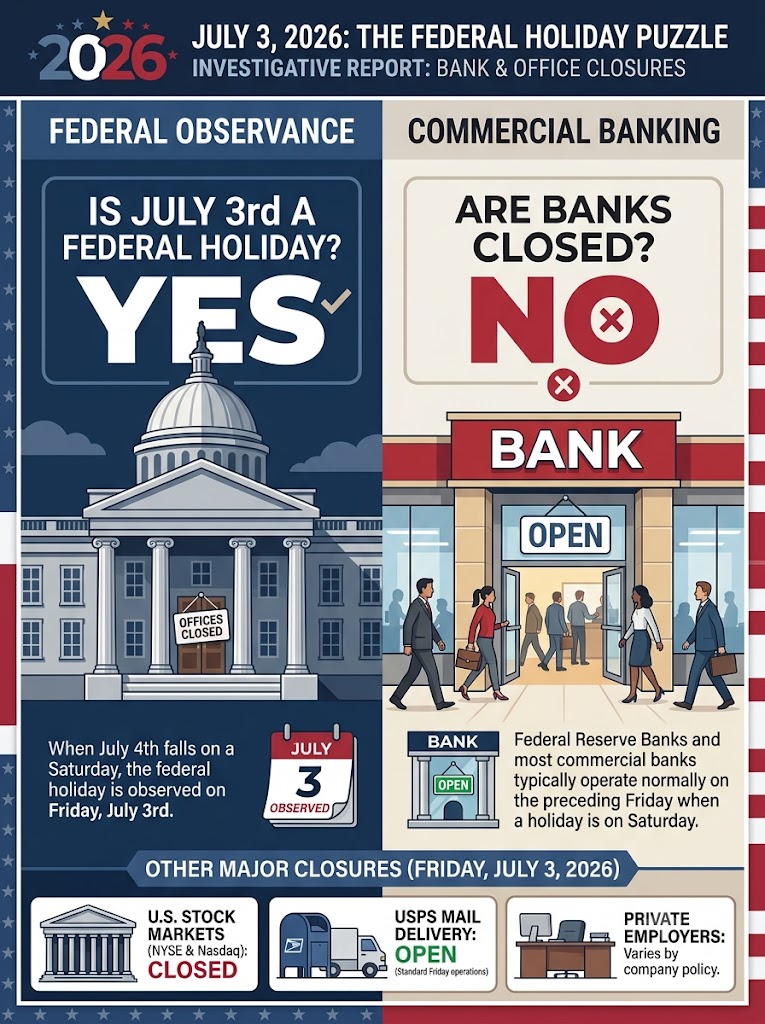
Yes and no. Technically, Independence Day is the legally recognized holiday, which has been a federal institution since 1870. However, federal observance rules dictate that when a designated holiday lands on a Saturday, government offices observe the holiday on the preceding Friday.
Consequently, Friday, July 3, 2026, acts as the observed federal holiday for non-essential government personnel. The Board of Governors of the Federal Reserve system, along with various federal administrative offices, will be completely shuttered.
But what does this mean for the private sector and commercial banking infrastructure? This is where the scheduling becomes deeply fragmented.
Are Banks Closed on July 3, 2026?
For the vast majority of American consumers and corporate entities, banks are completely open on Friday, July 3, 2026. While the federal government recognizes the Friday observance, the banking sector adheres to a highly specific subset of operational guidelines dictated by the Federal Reserve Bank. According to the Federal Reserve’s K.8 official holiday mandate regarding weekend observances, the central banking architecture splits its operations:
- The Board of Governors: Closed on Friday, July 3rd.
- Federal Reserve Banks and Branches: Fully open and operating normally on Friday, July 3rd.
Because commercial banks and consumer-facing financial institutions map their schedules directly to the Federal Reserve Banks—not the Board of Governors—retail banking operations will proceed without interruption.
Key Takeaways for Payroll and Direct Deposit:
- No Processing Delays: Because the commercial banking network remains fully functional on July 3rd, businesses do not need to process payroll early.
- Direct Deposits: Standard direct deposits will land in consumer accounts on their regular Friday schedule. As payroll provider OnPay notes, “Because the banking network is fully functional on Friday, July 3, 2026, you can disregard these early deadlines this week and process on your regular schedule.”
- Saturday Closures: Consumers should anticipate physical branch locations to be locked on Saturday, July 4th, though ATMs and mobile banking applications will remain operational.
Wall Street Goes Dark: Stock Market Closures
While commercial banks remain operational, Wall Street takes a decisively different approach. The financial markets prioritize the federal observance schedule.
If you are looking to execute trades heading into the historic holiday weekend, you must adjust your timeline. U.S. financial markets, including the New York Stock Exchange (NYSE) and Nasdaq, will be completely closed on Friday, July 3, 2026. Furthermore, the bond market operates on an even tighter timeline. According to the Securities Industry and Financial Markets Association (SIFMA) and market data platforms like Kiplinger, the bond market will undergo an early closure at 2:00 p.m. Eastern Time on Thursday, July 2, 2026, before remaining closed through Friday. Regular trading across all indices will not resume until Monday, July 6th. (Note: Cryptocurrency markets operate 24/7 and are entirely unaffected by federal observances).
Mail Delivery: The USPS Schedule
The United States Postal Service (USPS) operates on its own distinct cadence for weekend holidays.
Despite the Friday federal observance by other government entities, the USPS will run regular delivery operations on July 3rd. The actual suspension of service happens on the holiday itself. The Postal Service confirmed it will temporarily suspend operations and regular mail delivery on Saturday, July 4. Post office retail counters will be locked, and regular mail delivery will not resume until Monday, July 6th.
Are banks closed July 3rd?
No. Commercial banks and Federal Reserve Banks remain open on Friday, July 3, 2026. Because July 4th falls on a Saturday, banks will simply close on Saturday to observe the holiday, leaving Friday as a standard, fully operational business day.
Is the stock market open on July 3, 2026?
No. Both the NYSE and Nasdaq observe the federal Friday shift and will be completely closed on July 3, 2026. The bond market will also be closed on Friday, following an early 2:00 p.m. closure on Thursday, July 2.
Sources Quoted:
- The White House (Freedom 250 Initiative): Quoted regarding the 250th anniversary of American Independence.
- Federal Reserve Board (K.8 Holiday Schedule): Sourced for specific operational distinctions between the Board of Governors and Federal Reserve Banks.
- OnPay / Payroll Insights: Sourced for commercial banking schedules and corporate payroll direct deposit operations.
- NYSE, Nasdaq & SIFMA: Sourced for equity and bond market trading hours and early closure schedules.
- Kauaʻi Now News (USPS Press Releases): Sourced for verified Postal Service closures and mail suspension timelines.

Leo Falsafi is a digital marketing veteran and senior journalist at Virlan.co, where he covers the intersection of digital marketing, gaming, and breaking US trending news. With nearly two decades of hands-on experience in SEO and digital strategy, Leo has consulted for and scaled hundreds of companies. His deep industry roots allow him to deliver sharp, fact-checked insights and analysis on the trends shaping today’s digital landscape.