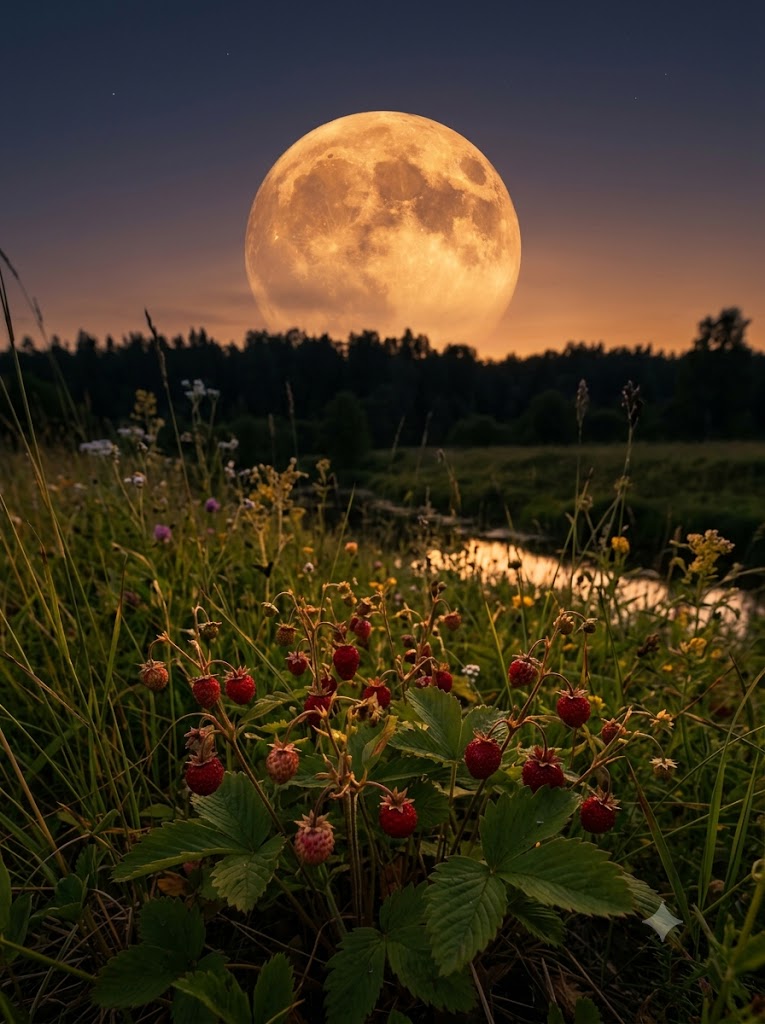
On Monday, June 29, 2026, the Strawberry Moon will reach its peak illumination. For stargazers, astronomy buffs, and casual sky-watchers alike, this specific celestial event packs a unique combination of orbital mechanics, atmospheric optical illusions, and centuries-old cultural history.
Here is a deep dive into exactly what you need to know about the 2026 Strawberry Moon.
Core Celestial Facts: The 2026 Strawberry Moon
For those looking to track the event or set up their optics, here are the hard data points for this year’s lunar display:
- Peak Illumination Date & Time: Monday, June 29, 2026, at exactly 7:57 p.m. EDT (23:56 UTC).
- Orbital Status: This event marks the third and final “Micro Moon” of 2026.
- Constellation Placement: The moon will dominate the constellation Sagittarius, positioned within the famous “Teapot” asterism and passing near the 3rd-magnitude star Phi (φ) Sagittarii.
- Visibility Window: For optimal viewing, face the southeastern horizon around sunset to catch the moon as it rises.
The Science of the “Micro Moon” and the Atmospheric Illusion
There’s a lot of hype surrounding supermoons. The 2026 Strawberry Moon, however, delivers the exact opposite. Because this full moon occurs concurrently with apogee—the absolute farthest point from Earth in the moon’s elliptical orbit—it is officially categorized as a Micro Moon. While it is technically smaller in the sky, the human eye rarely detects the mathematical difference.
In fact, you will probably think the moon looks unusually large. Why? Because the Strawberry Moon occurs shortly after the summer solstice, forcing it to follow one of the lowest possible paths across the night sky for the entire year. This exceptionally low trajectory triggers the famous “Moon Illusion,” a trick of the human brain that perceives objects on the horizon as vastly larger than when they sit high at the zenith.
Furthermore, that low-hanging position forces the moonlight to travel through a much thicker slice of Earth’s atmosphere. As the light travels, shorter, cooler wavelengths scatter away. What survives the journey to your retinas are the warmer, longer wavelengths. The result isn’t a strawberry pink, but rather a rich, golden, amber, or deep orange hue that dominates the dusk skyline.
Where Did the “Strawberry Moon” Name Come From?
Contrary to modern internet lore, the moon wasn’t named for its visual color. The title is a purely seasonal marker rooted deeply in Indigenous North American traditions.
Historically, the Algonquian, Ojibwe, Dakota, and Lakota peoples utilized the lunar cycle to track seasonal agricultural and foraging shifts. June’s full moon aligned perfectly with the brief, vital window when wild June-bearing strawberries ripened across the northeastern continent.
Other indigenous groups recognized different ecological milestones for the exact same moon. The Anishinaabe called it the “Blooming Moon,” the Haida referred to it as the “Berries Ripen Moon,” and the Tlingit of the Pacific Northwest dubbed it the “Birth Moon” because June brought a heavy influx of newborn wildlife.
Across the Atlantic, European cultures adopted their own agrarian terminology. They labeled it the Honey Moon, the Rose Moon, or the Mead Moon—the latter signifying the time to mow summer meadows and drink mead to celebrate the longest days of the year near the solstice.
Is the Strawberry Moon actually pink or red?
No. Despite the fruity moniker, the Strawberry Moon does not inherently shine pink. If it takes on a reddish, golden, or orange tint, it is strictly due to atmospheric scattering. When the moon is positioned very low on the horizon, its light passes through dense atmospheric layers that filter out blue wavelengths, leaving only the warmer colors visible to the naked eye.
Why is the Strawberry Moon so low in the sky?
The moon’s path across the night sky is inversely related to the sun’s path during the day. Because the Strawberry Moon always falls near the summer solstice—the time when the sun reaches its absolute highest point in the Northern Hemisphere—the full moon is subsequently forced into its lowest arc of the year.
Sources Quoted: Sourced from 2026 orbital data, skywatching guides, and historical records via Astronomy Magazine, Space.com, CNET, HowStuffWorks, and the University of Colorado Boulder’s Fiske Planetarium.

Leo Falsafi is a digital marketing veteran and senior journalist at Virlan.co, where he covers the intersection of digital marketing, gaming, and breaking US trending news. With nearly two decades of hands-on experience in SEO and digital strategy, Leo has consulted for and scaled hundreds of companies. His deep industry roots allow him to deliver sharp, fact-checked insights and analysis on the trends shaping today’s digital landscape.