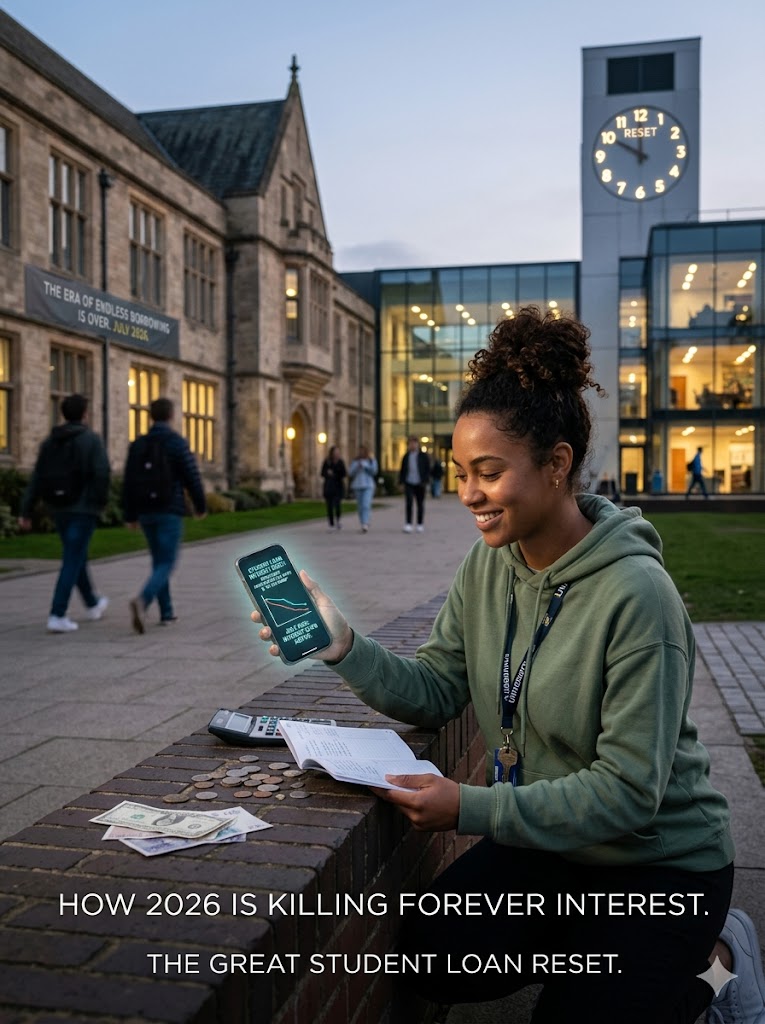
Welcome back to the student debt saga. If you’ve been paying attention to the higher education space this year, you know 2026 is shaping up to be a historic turning point. Across the globe—from Washington D.C. to London—governments are stepping in to overhaul how student loans work.
The era of signing blank checks for graduate school and watching your loan balance balloon to double its original size? It’s effectively over. Here is a deep dive into the massive legislative shifts happening right now, and what they mean for your financial future.
🇺🇸 The U.S. Overhaul: Enter the “One Big Beautiful Bill”
Last year, on July 4, 2025, the One Big Beautiful Bill Act (OBBBA) was signed into law. While it was broadly known as a massive tax and spending package, its student loan provisions—which take full effect in July 2026—are arguably the most consequential changes to federal higher education policy in decades.
1. The End of the SAVE Plan & The Rise of RAP
The previous SAVE plan is officially eliminated under the OBBBA. In its place, the government introduces the Repayment Assistance Plan (RAP). Why the swap? The core objective of RAP is to prevent the excessive interest accumulation that has historically trapped borrowers in debt spirals. Under previous systems, a borrower could make minimum payments for a decade and still owe more than they initially borrowed. RAP includes provisions to halt this runaway interest, ensuring borrowers can actually pay down their principal. According to the Congressional Budget Office (CBO), these sweeping loan changes will save taxpayers an estimated $307 billion over the next decade.
2. Hard Caps on Borrowing (The Death of the Blank Check)
For years, graduate students and parents could borrow virtually unlimited amounts up to a college’s self-determined “cost of attendance.” That gravy train has officially left the station. The OBBBA enforces strict statutory caps on federal lending:
- Graduate Students: Capped at $20,500 annually ($100,000 lifetime limit).
- Professional/Medical Students: Capped at $50,000 annually ($200,000 lifetime limit).
- Parent PLUS: Capped at $20,000 annually per child ($65,000 lifetime limit).
By capping federal lending, policymakers hope to force the most expensive universities to lower tuition prices rather than endlessly passing the tab to the taxpayer.
3. The “Do No Harm” Rule
Under the newly implemented “Do No Harm” (DNH) provision, colleges are finally on the hook. Programs that consistently graduate students with earnings too low to justify their debt will face severe accountability measures and risk losing access to federal funding entirely.
🇬🇧 Across the Pond: Slashing the UK’s Interest Penalty
The U.S. isn’t alone in rethinking student debt interest. In the UK, the debate centers heavily around the notorious “Plan 2” student loans, which have saddled graduates with above-inflation interest rates—often applied at the Retail Prices Index (RPI) plus an additional 3%.
1. The Push to Cap at RPI
To ease the burden, there are major proposals on the table to eliminate this above-inflation penalty entirely. The Conservative party has proposed capping the maximum interest rate on Plan 2 student loans strictly at standard RPI. By removing the extra 3%, older Plan 2 loans would finally be brought into alignment with the much fairer terms of the newer “Plan 5” loans (which apply to cohorts starting from 2023/24). While this won’t drastically alter immediate monthly payments—which remain locked at 9% of income over a specific earnings threshold—it will significantly lower the total debt pile that graduates face over their 30-year repayment lifecycle.
2. The Campaign for CPI
Advocacy groups like Rethink Repayment are pushing the envelope even further. They argue that the government should abandon RPI altogether, tie interest rates to the lower CPI (Consumer Prices Index) inflation metric, and slash the graduate repayment rate from 9% to 5% of income.
💡 The TL;DR Takeaway
If you are dealing with student loans in 2026, the game has fundamentally changed. Governments are strictly limiting how much you can borrow on the front end, but they are finally offering aggressive protections against interest accumulation on the back end. Whether it’s the US’s new RAP system halting runaway balances or the UK slashing the RPI premium, the message is clear: the days of “forever interest” are coming to a close.
Authors & News Outlets Report: This article utilizes 2026 data and policy analysis from Preston Cooper (American Enterprise Institute), T. Myers (Digital Commons @ Florida Atlantic University), J. Looby (American Dental Association), B.J. Cook (Urban Institute), A. Gillen (Cato Institute), and K. Ogden & B. Waltmann (Institute for Fiscal Studies).

Leo Falsafi is a digital marketing veteran and senior journalist at Virlan.co, where he covers the intersection of digital marketing, gaming, and breaking US trending news. With nearly two decades of hands-on experience in SEO and digital strategy, Leo has consulted for and scaled hundreds of companies. His deep industry roots allow him to deliver sharp, fact-checked insights and analysis on the trends shaping today’s digital landscape.