The wait is over. SpaceX has officially hit the public markets under the ticker SPCX, and the sheer scale of the event has permanently altered the financial landscape. Wall Street and retail investors alike are watching the largest Initial Public Offering in history unfold on the Nasdaq today.
Here is the deep dive into the numbers, the hidden winners, and what this means for the space economy moving forward.
The Record-Breaking Numbers
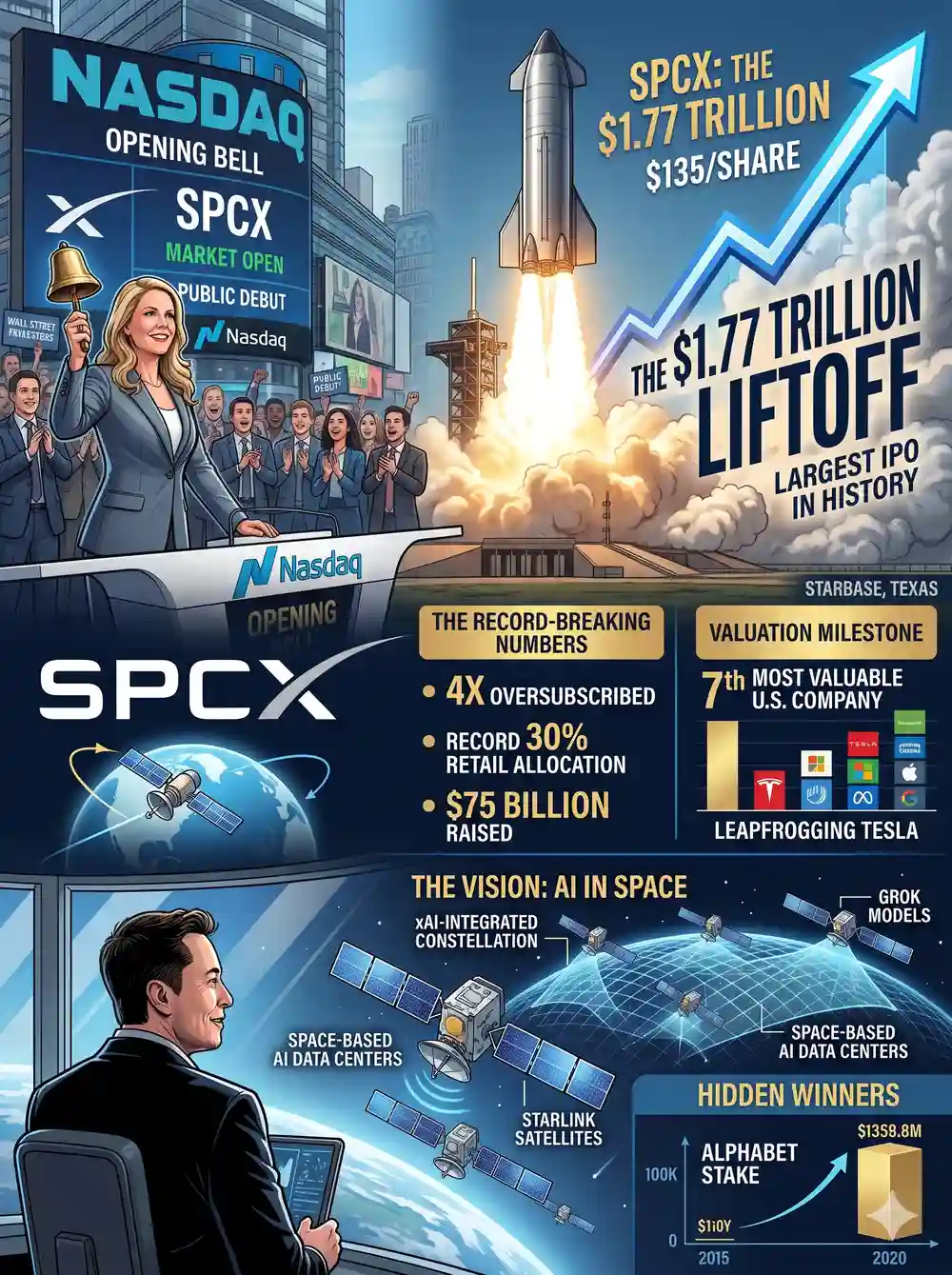
The financial mechanics of this IPO are staggering, shattering previous market debuts. Here is the exact breakdown of how SPCX is hitting the tape:
- The Price & Scope: Shares officially priced at $135 each. The company offered 555.6 million shares, raising a record-breaking $75 billion.
- The Valuation: The offering values SpaceX between $1.77 and $1.78 trillion. This instantly makes it the seventh most-valuable U.S. company, leapfrogging Elon Musk’s other corporate crown jewel, Tesla.
- Insatiable Demand: The IPO was reportedly four times oversubscribed, drawing retail orders in excess of $100 billion.
- Retail Victory: Unlike traditional IPOs that reserve a meager 5% to 10% for everyday traders, SpaceX targeted a massive 30% retail allocation.
- The Greenshoe Option: Underwriters hold an option to sell an additional ~83 million shares if demand outstrips the initial allotment, which could bring in another $11.2 billion.
The Trillion-Dollar Man and the xAI Merger
Elon Musk and SpaceX President and COO Gwynne Shotwell rang the opening bell on Friday morning—Shotwell from the Nasdaq in New York City, and Musk from Starbase in Texas.
This IPO sets the stage for Musk to become the world’s first trillionaire, fueled by his combined stakes in Tesla and SpaceX. But the vision pitched to investors extends far beyond reusable Falcon 9s and Starships. Musk noted that while he initially gave SpaceX “less than a 10% chance of succeeding at all,” the company has been cash-flow positive since roughly 2015 (though it carries a $41.3 billion accumulated deficit since its 2002 founding).
The ultimate growth thesis? AI in space. In February 2026, SpaceX acquired Musk’s artificial intelligence startup, xAI. The strategic roadmap now involves deploying over 100,000 satellites into orbit to establish AI data centers in space, leveraging xAI’s Grok models and infrastructure.
The Hidden Winners: Alphabet’s Stealth Victory
While retail investors fight for shares and banks rake in an estimated $500 million in underwriting fees, one legacy tech giant is sitting on a goldmine. More than a decade ago, Alphabet invested $900 million into SpaceX. Following subsequent additions to their position, Alphabet now owns roughly 4.9% of the $1.77 trillion company. As Alphabet ramps up its own heavy spending on AI infrastructure, this SpaceX stake represents a highly lucrative balance-sheet asset.
What’s Next?
As market makers match buy and sell orders to establish SPCX’s first public trades, the broader space sector is feeling the gravity of the moment. Competitors like Rocket Lab and Virgin Galactic saw immediate premarket volatility as liquidity shifts toward the new apex predator of the sector.
The world’s most valuable private company is private no longer. The space race has been fully financialized.
Author & Outlet Report: This analysis quotes and synthesizes reporting by Pras Subramanian (Yahoo Finance), Lora Kolodny, Samantha Subin, MacKenzie Sigalos, and the live coverage team at CNBC, alongside breaking news from the Associated Press.

Leo Falsafi is a digital marketing veteran and senior journalist at Virlan.co, where he covers the intersection of digital marketing, gaming, and breaking US trending news. With nearly two decades of hands-on experience in SEO and digital strategy, Leo has consulted for and scaled hundreds of companies. His deep industry roots allow him to deliver sharp, fact-checked insights and analysis on the trends shaping today’s digital landscape.

Pras Subramanian
Lora Kolodny
Samantha Subin