What Is Cookie Stuffing?
In the world of affiliate marketing fraud, cookie stuffing is a method used by fraudulent affiliates to trick websites into thinking they have sent them traffic when they have not done so. The practice is also called cookie dropping and is one of the most common and widespread types of this fraud, in use for decades.
A cookie stuffer is purposefully trying to gain commission for referring a user to a website without doing so. The cookie contains false information that says the user was convinced by the affiliate and clicked through from the latter’s site.
Bill Gates' daughter Phoebe accused of 'cookie stuffing' scheme that has max penalty of 20 years in prison: reports https://t.co/PlBHx8iq4L pic.twitter.com/22uYgl5y8D
— New York Post (@nypost) August 12, 2026
How Cookie Stuffing Works
Someone visits an affiliate website. The website generates dozens, if not hundreds, of cookies for various popular and related products, and sometimes for various different shops. These cookies are covertly dropped onto the visitor’s browser. The user is not aware of this. These cookies remain in the browser unless they are deleted. (Much) later, the user visits one of those online shops and buys one of the products.
You can also stuff cookies via browser injection. This is a bit trickier to pull off but essentially consists of the fraudsters building or buying browser extensions and using them to drop affiliate cookies on organic traffic that is on the vendor’s website. All cookie stuffing happens without the user’s knowledge.
Accusations of Cookie Stuffing Levelled at Phoebe Gates’ Phia
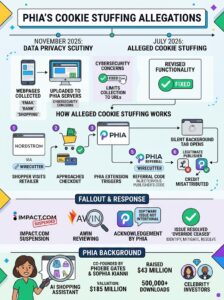
Phia, the shopping plugin co-founded by Phoebe Gates, the daughter of Bill Gates, and entrepreneur Sophia Kianni, has been accused of misconduct. The company, which launched in 2025 and classifies itself as a “personal shopping assistant,” is a browser extension that compares prices and discovers discount codes for fashion items.
However, last week, Bloomberg, independent researcher and consultant Ben Edelman and Capital One Shopping — also a browser extension — shared alleged evidence of misconduct after conducting testing.
Bloomberg Testing and Misconduct Evidence
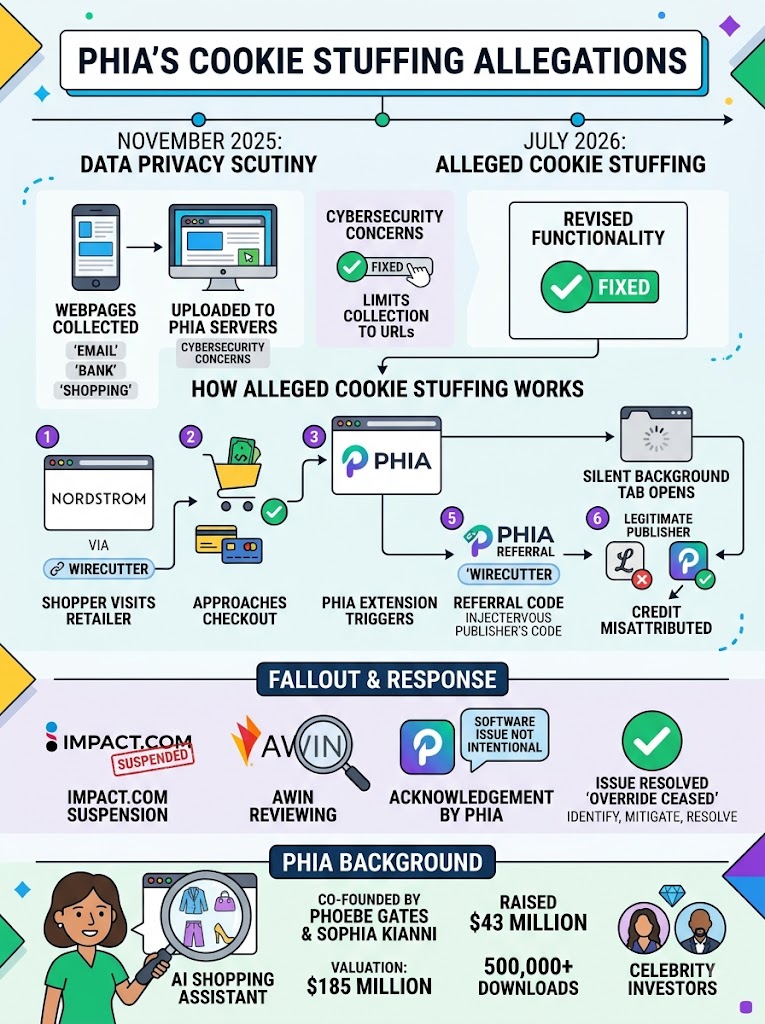
According to Edelman’s findings, Phia appeared to be “materially out of compliance with network and merchant agreements.” Bloomberg also tested the mobile browser extension across over 50 websites and found that during checkout, the app automatically opened a background tab and injected its own referral code, overriding publishers’ referrals.
In one test described in the investigation, Bloomberg followed a Nordstrom link from a Wirecutter article about Fourth of July deals. Phia allegedly opened another tab in the background during checkout and replaced Wirecutter’s referral information with its own. The extension reportedly behaved similarly when Bloomberg reached a shopping site through a paid advertisement from another publisher.
Suspension and Phia’s Response
Since the release of the test findings, affiliate platform impact.com has suspended the company from its network. Bloomberg reported that Awin is also reviewing the allegations.
In this case, Bloomberg shared that a Phia spokesperson acknowledged the situation and once notified of the issue, the company had been working to “identify, mitigate, and has since resolved the issue.”
“Within the last 24 hours, we were made aware that in a recent release our codebase was causing misattributions from a subset of users,” a Phia spokesperson told Bloomberg. The company said its team worked through the night to identify and correct the issue.
Bloomberg confirmed that when it retested independently, the override had ceased. It remains unclear whether the fix will be enough to satisfy Impact.com, retailers, and other affiliate partners reviewing the affected transactions.
Phia’s History of Controversies: Data Tracking and Cookie Stuffing
Discover the background of Phoebe Gates’s shopping startup Phia, from its 2025 data privacy scandal to the 2026 cookie stuffing allegations.
A Track Record of Scrutiny
The 2025 Data Collection Controversy
The Phia allegations also arrive after an earlier controversy involving the amount of information collected by its browser extension. In November 2025, cybersecurity researchers found that the extension was transmitting copies of webpages users visited back to the company’s servers, including pages unrelated to shopping. Those pages could include sensitive websites such as email inboxes and bank accounts, according to the report.
Phia said the data was anonymous, was used to determine which websites involved shopping, and was not stored. The company removed the feature after concerns were raised and said it would limit its collection to website URLs.
The 2026 Cookie Stuffing Allegations
Phoebe Gates’ startup Phia has allegedly been wrongfully claiming credit for online sales it didn’t drive. Bloomberg, Capital One Shopping and independent researcher Ben Edelman tested the app and discovered that Phia silently opens a background tab and links its own affiliate code, allowing it to wrongfully claim commission on sales.
The practice is known as “cookie stuffing” or attribution fraud. In plain terms, Phia could receive credit, and potentially a commission, for a purchase even when the shopper had not discovered the product through Phia or interacted with one of its recommendations.
Suspension and Response
Since the release of the test findings, affiliate platform impact.com has suspended the company from its network. Bloomberg reported that Awin is also reviewing the allegations.
Phia acknowledged that there had been a problem, although the company characterized it as a software issue rather than an intentional business practice. A Phia spokesperson acknowledged the violation, stating that it has now been fixed.
It remains unclear whether the fix will be enough to satisfy Impact.com, retailers, and other affiliate partners reviewing the affected transactions.

Leo Falsafi is a digital marketing veteran and senior journalist at Virlan.co, where he covers the intersection of digital marketing, gaming, and breaking US trending news. With nearly two decades of hands-on experience in SEO and digital strategy, Leo has consulted for and scaled hundreds of companies. His deep industry roots allow him to deliver sharp, fact-checked insights and analysis on the trends shaping today’s digital landscape.