The 2026 Michigan Senate Primary: A Narrow Progressive Lead
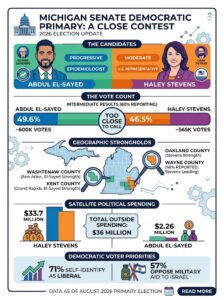
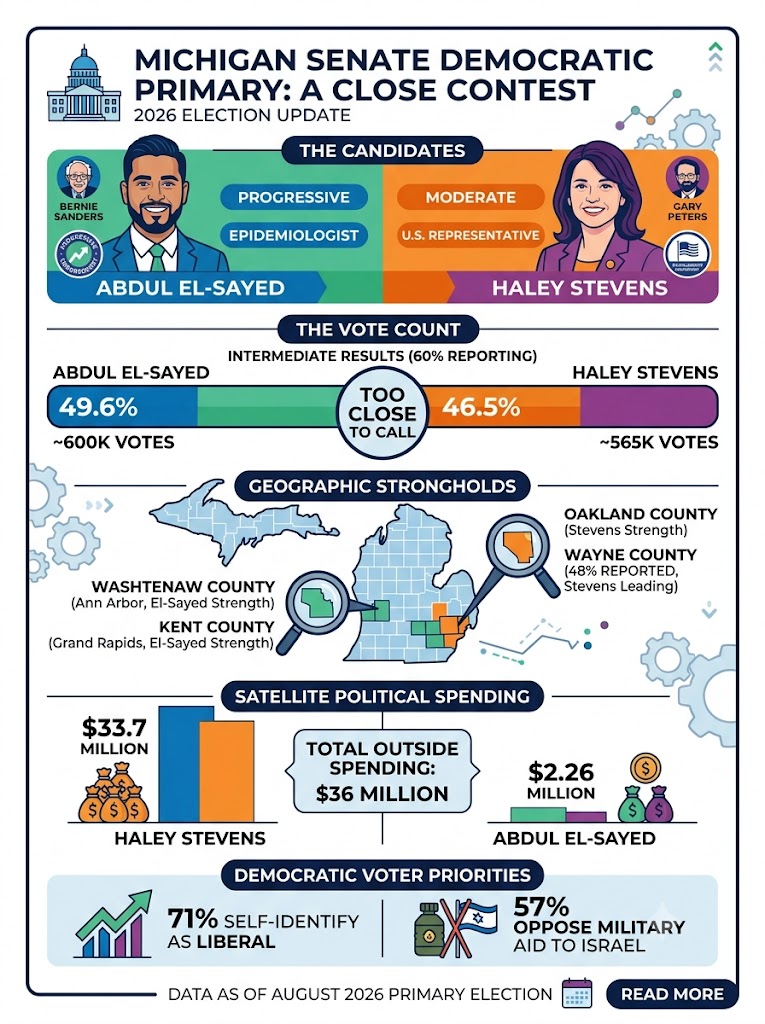
Following the August 4, 2026 primary election, the Democratic race to replace retiring two-term U.S. Senator Gary Peters remains too close to call. As the ballots are tallied, progressive candidate Abdul El-Sayed—an epidemiologist and former public health official—is maintaining a slight edge over moderate U.S. Representative Haley Stevens.
The contest is heavily scrutinized as it represents Michigan’s first truly competitive Democratic Senate primary in over three decades. El-Sayed, who previously ran for Michigan governor in 2018, entered the race carrying the backing of figures like Senator Bernie Sanders, while Stevens secured the endorsement of the departing incumbent, Gary Peters, on July 13, 2026.
Current Vote Breakdown
With approximately 60% of the vote reported, the margins remain incredibly tight.
| Candidate | Alignment | Percentage | Estimated Votes |
| Abdul El-Sayed | Progressive | 49.5% – 49.8% | ~600,241 |
| Haley Stevens | Moderate | 46.5% – 46.6% | ~565,113 |
(Note: Data reflects intermediate counts from major tracking outlets and Ballotpedia aggregations.)
Geographic and Demographic Divides
The incoming results highlight a stark geographic and ideological division across Michigan’s electorate:
- Progressive Strongholds: El-Sayed is demonstrating substantial strength in Washtenaw County—which includes Ann Arbor and the University of Michigan—as well as Kent County, home to Grand Rapids.
- Establishment Centers: Representative Stevens is currently outperforming in Oakland County, covering Detroit’s northern suburbs.
- The Deciding Factor: Wayne County, Michigan’s largest voting bloc, has only reported 48% of its ballots, with Stevens holding an estimated eight-point lead in those early returns.
The Money and the Message
The primary has drawn national attention not just for its competitiveness, but for the sheer volume of outside spending and ideological proxy-war implications.
Satellite Spending Discrepancies
By late July 2026, satellite political groups had poured a combined $36 million into the contest. The financial distribution heavily favored the establishment wing, with $33.7 million deployed to support Stevens, compared to $2.26 million spent bolstering El-Sayed.
A Test of Democratic Priorities
Political observers note the Michigan outcome could heavily influence the Democratic Party’s strategy heading into the 2028 presidential cycle. The primary has drawn distinct battle lines over foreign policy and economic populism.
Recent Reuters/Ipsos polling data suggests a shifting base, with 71% of Democratic voters now self-identifying as liberals (an increase from 55% in 2012). The same data indicates shifting views on foreign policy, specifically regarding the Middle East—a central theme in the El-Sayed vs. Stevens matchup. According to the poll, 57% of Democratic voters opposed continued military and economic assistance to Israel, while only 16% remained in support.
Sources Quoted
Authors/Outlets: Information gathered and verified via The Economic Times, The Guardian (Live Updates), Ballotpedia (Candidate profiles and historical polling), Bridge Michigan (Election Dashboards), Fox 2 Detroit, and PBS NewsHour.

Leo Falsafi is a digital marketing veteran and senior journalist at Virlan.co, where he covers the intersection of digital marketing, gaming, and breaking US trending news. With nearly two decades of hands-on experience in SEO and digital strategy, Leo has consulted for and scaled hundreds of companies. His deep industry roots allow him to deliver sharp, fact-checked insights and analysis on the trends shaping today’s digital landscape.