Spain’s sun-drenched lifestyle and flat-tax incentives have made it a magnet for remote workers, but the bureaucratic landscape just shifted. Following the official elimination of the Spanish Golden Visa in 2025 due to housing market reforms, the Digital Nomad Visa (DNV) has become the undisputed premium route for high-skilled non-EU expats.
Yet, securing this coveted residency in 2026 requires more than a laptop and a dream.
Spanish authorities have updated the financial thresholds and tightened compliance measures. Immigration officials are now rigorously cross-checking entry and exit records to ensure applicants actually live in the country. If you are planning to trade your home office for a café in Madrid or a terrace in Valencia, here is the verified, hard data on what it takes to qualify this year.
The 2026 Income Thresholds: What It Actually Costs
The most critical hurdle for the Spain Digital Nomad Visa is the income requirement, which is directly pegged to Spain’s Minimum Interprofessional Salary (SMI).
In early 2026, Spain’s Council of Ministers raised the SMI to €1,221 gross per month. Because Spanish minimum wage is paid in 14 installments, the math catches many applicants off guard. You cannot simply double the monthly minimum; the official calculation uses the annual figure.
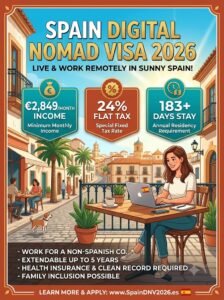
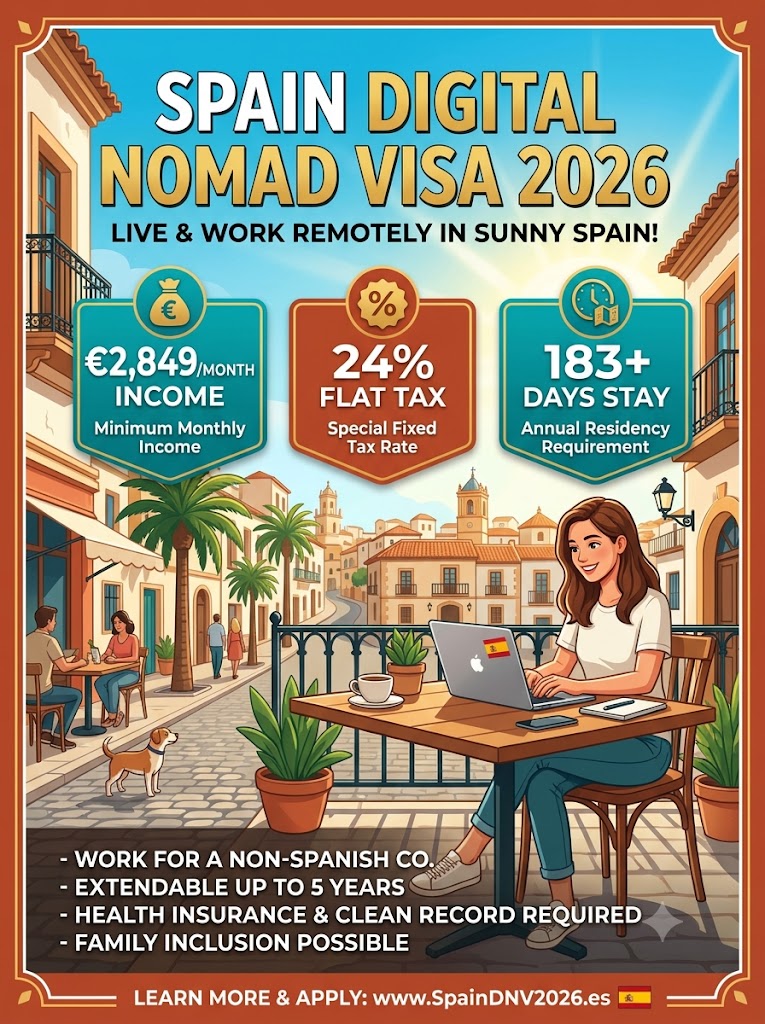
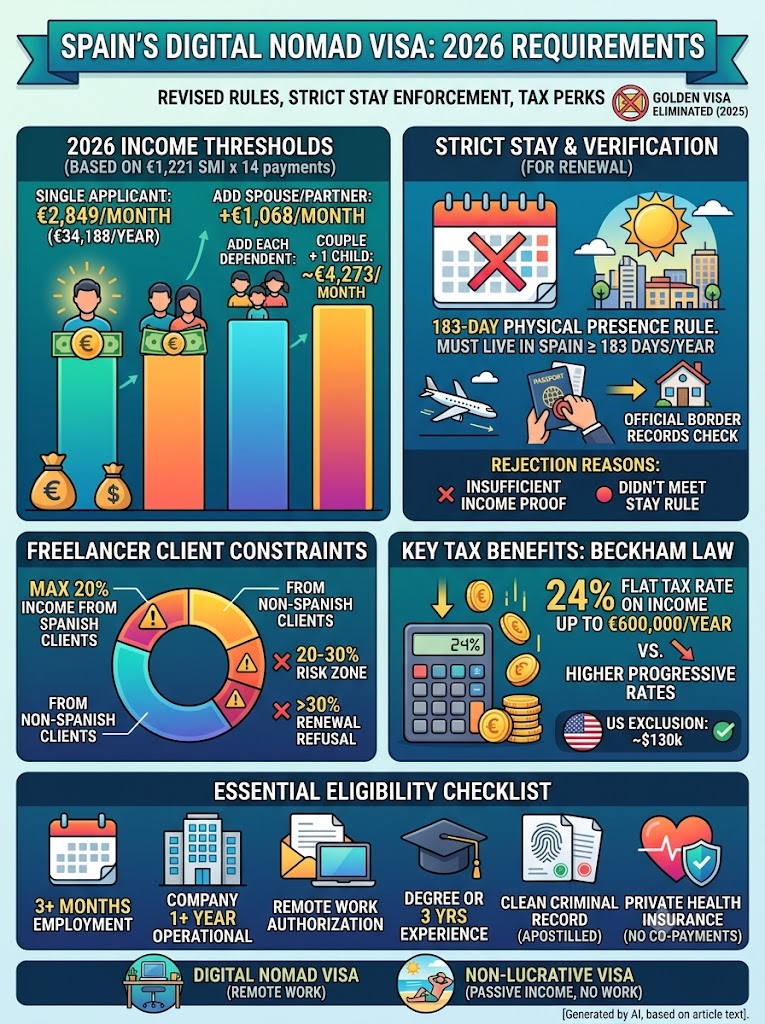
To qualify as a single applicant in 2026, you must prove a minimum monthly income of €2,849 (or €34,188 per year). This applies to income before Spanish tax deductions.
Bringing a family? The financial bar scales accordingly:
- First family member (spouse/partner): Adds 75% of the SMI to your requirement, an additional €1,068 to €1,069 per month.
- Each additional dependent (children): Adds 25% of the SMI, an additional €356 to €357 per month.
For example, a couple with one child now needs to document roughly €4,273 to €4,275 in reliable monthly income to clear the consular approval stage.
Documenting Your Revenue
Consulates do not accept projected earnings. You must provide historical proof. This includes three months of bank statements, payslips, or official client invoices demonstrating a consistent earnings pattern.
Strict New Verification: The 183-Day Rule
Getting the visa is only phase one. Keeping it is where authorities are currently cracking down.
Global mobility experts report that Spanish immigration authorities are strictly enforcing the physical presence requirement for renewals. To maintain your visa, you must spend a minimum of 183 days (six months) inside Spain.
Officials are no longer taking applicants at their word. They are actively cross-checking border entry/exit records alongside local municipal registration (empadronamiento) documents. Insufficiently documented income and failure to meet the physical stay requirements have become the most common rejection points.
The 20% Spanish Client Cap
Freelancers and self-employed entrepreneurs face an additional operational constraint. You are permitted to take on Spanish clients, but no more than 20% of your total income can be sourced from Spanish companies.
Industry specialists warn that pushing this boundary is incredibly risky. Earning between 20% and 30% from local sources places you in a “documented-justification risk zone,” and exceeding 30% will almost certainly result in a renewal refusal.
Tax Advantages: Understanding the 24% Flat Rate
If you navigate the income and presence requirements successfully, the financial upside is substantial.
Qualifying remote workers can opt into a special tax regime, commonly referred to as the “Beckham Law”. As of 2026, this framework allows eligible individuals to pay a flat 24% tax rate on Spanish-sourced employment income up to €600,000 per year. Anything above that ceiling is taxed at 47%.
To qualify for this regime, you must not have been a Spanish tax resident during any of the five tax periods preceding your move. For US citizens, this pairs with IRS provisions; for the 2025/2026 tax years, Americans meeting the Physical Presence Test can potentially exclude up to $130,000 of foreign-earned income from US taxes.
Essential Eligibility Checklist for 2026
Before booking an appointment and paying the standard €80 consular visa fee, ensure you meet the baseline employment and administrative criteria:
- Employment History: You must have worked for your current employer (or freelance clients) for at least 3 months prior to application.
- Company Age: Your foreign employer or client’s business must have been operational for a minimum of one year.
- Remote Authorization: W-2 employees need explicit written consent from their employer confirming the role can be performed remotely from Spain.
- Qualifications: You need a university degree, professional certification, or at least 3 years of relevant professional experience.
- Clean Criminal Record: A background check spanning the past 2 years is required (such as the FBI Identity History Summary for US applicants), apostilled and sworn-translated into Spanish. You also need a sworn declaration covering the past 5 years.
- Healthcare: Proof of comprehensive private health insurance with zero co-payments (sin copago) and no deductibles.
The Non-Lucrative Visa Alternative
If your income is passive rather than active (such as pensions, investments, or rental yields), the DNV is the wrong path. Spain’s Non-Lucrative Visa (NLV) requires a lower threshold of approximately €2,400 per month tied to the IPREM indicator. However, the NLV strictly prohibits all forms of work, including remote work for foreign companies.
Sources Quoted:
Data, legal parameters, and 2026 immigration thresholds were sourced from Greenback Expat Tax Services, Immigrant Invest, Citizen Remote, and global mobility insights from Jobbatical.

Leo Falsafi is a digital marketing veteran and senior journalist at Virlan.co, where he covers the intersection of digital marketing, gaming, and breaking US trending news. With nearly two decades of hands-on experience in SEO and digital strategy, Leo has consulted for and scaled hundreds of companies. His deep industry roots allow him to deliver sharp, fact-checked insights and analysis on the trends shaping today’s digital landscape.