For nearly two years, the gaming industry has watched a legal titan try to crush an overnight indie sensation. But as of July 2026, Nintendo’s much-hyped patent infringement lawsuit against Palworld developer Pocketpair looks less like a lethal strike and more like a multimillion-dollar miscalculation.
With the official launch of Palworld 1.0 just days ago, the dust is finally settling on a legal battle that was supposed to redefine intellectual property in gaming. Instead, it has exposed severe structural weaknesses in Nintendo’s litigation strategy, resulting in a drastically narrowed lawsuit, sharply worded reprimands from Japanese officials, and a maximum potential payout that barely covers the cost of a mid-sized sedan.
Here is exactly how Pocketpair outmaneuvered the biggest legal bully in the video game industry.
A Drastically Narrowed Scope: The Latest Nintendo Palworld Lawsuit Update
When Nintendo and The Pokémon Company first filed suit against Pocketpair, the assumption was that the gaming giant was fighting for an injunction that could pull Palworld off digital shelves worldwide.
That threat is now effectively zero.
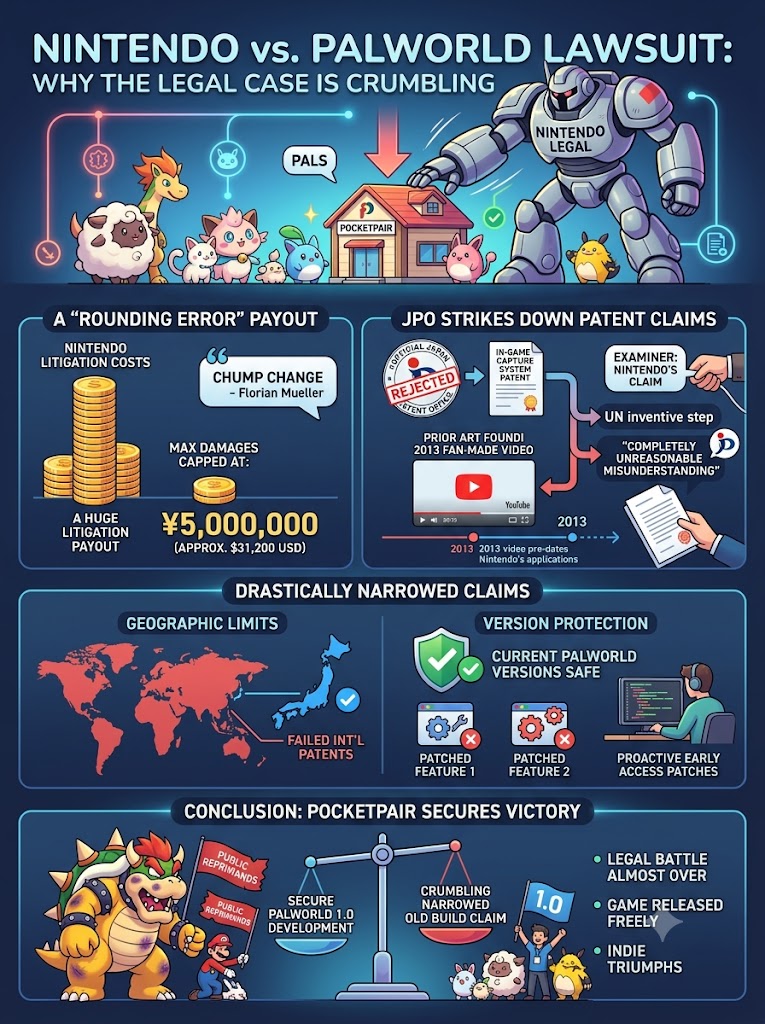
In late 2025, Nintendo was forced to quietly amend its claims. Because Pocketpair proactively patched out two specific game mechanics during early access to reduce its patent exposure, Nintendo’s lawsuit is now strictly confined to older, outdated builds of the game. Furthermore, the claims are geographically limited exclusively to Japan, as Nintendo failed to secure equivalent international patent protections in time.
The financial result of this narrowed scope is staggering.
According to Florian Mueller, an intellectual property expert at Games Fray, the maximum possible damages Nintendo can extract are capped at roughly ¥5 million. At current conversion rates, that equates to a paltry $30,000 to $31,200 USD.
Mueller bluntly described the potential payout as “chump change” and “just a rounding error compared to Nintendo’s litigation expenses”. He added that regarding the game’s future, “Nintendo has zero chance of prevailing over current Palworld versions”.
The Japan Patent Office Bites Back: A Sharp-Tongued Rejection
While the lawsuit limps toward a November judicial opinion at the Tokyo District Court, Nintendo has been fighting—and losing—a parallel battle with the Japan Patent Office (JPO).
In mid-July 2026, the JPO issued a final examination decision officially rejecting Nintendo’s divisional patent application (No. 2026-019762), which attempted to lock down an “in-game monster-capturing system”. But it wasn’t just that the patent was rejected; it was how it was rejected.
Why the Patent Infringement Claims Failed to Stick
To prove Nintendo’s application lacked an inventive step, the JPO cited a 2013 YouTube gameplay video of a fan-made indie game titled Pokémon Generations as “prior art”. Because the mechanics of throwing a ball to capture a monster existed in that 2013 video, Nintendo could not claim to have newly invented it years later.
Nintendo fought back furiously. The company argued that the examiner was acting “extremely inappropriately,” claiming the 2013 fan video was copyright infringement (using unauthorized depictions of Ash, Pikachu, and Poké Balls) and therefore shouldn’t be legally eligible as prior art.
The JPO was entirely unamused.
In a written response that Japanese patent attorney Kiyoshi Kurihara noted contained language “rarely seen in standard patent practice,” the JPO examiner ruthlessly shut down Nintendo’s argument. The JPO clarified that under domestic patent law, whether an invention infringes on copyright has zero bearing on determining its technical novelty. The examiner drily noted that Nintendo’s stance strayed from “standard thinking for patent practitioners” and dismissed the company’s complaints as a “completely unreasonable misunderstanding”.
Pocketpair’s Hidden Scars: The Real Cost of Litigation
From a purely legal standpoint, Pocketpair has effectively won. Palworld 1.0 launched completely free of any Nintendo patent threats, and the financial damages will be practically nonexistent.
However, the “David vs. Goliath” victory wasn’t without internal casualties. Nintendo’s underlying goal is rarely just about financial compensation; it’s about establishing a chilling effect to discourage other developers from occupying similar creative territory.
John Buckley, the communications lead at Pocketpair, confirmed that operating under the shadow of Nintendo’s legal team took a heavy toll behind the scenes.
“It impacted morale, for sure,” Buckley admitted in a recent interview. “Last year, we publicly stated that we had to change two features in the game due to the ongoing litigation. Unfortunately, it is still very much ongoing. It obviously has an impact on development”.
Buckley noted that the lawsuit was a genuine shock to the team, as Palworld had undergone extensive legal reviews prior to its record-breaking early access launch. The studio genuinely believed they had cleared all copyright hurdles—which they did. Nintendo’s pivot to weaponizing deeply specific, geographically limited gameplay patents was a curveball that forced Pocketpair to make design choices based on courtroom strategy rather than creative intent.
Ultimately, the Nintendo Palworld lawsuit will likely go down in gaming history as a pyrrhic maneuver. Nintendo spent immense corporate energy and capital to force a minor patch in a rival game, while enduring public reprimands from the Japan Patent Office. Meanwhile, Pocketpair kept the servers running, pushed out their 1.0 release, and proved that a well-prepared indie studio can occasionally stare down the biggest titan in the industry—and win.
Sources Quoted:
Insights and direct quotes were sourced from intellectual property expert Florian Mueller (via Games Fray), Pocketpair communications lead John Buckley (via Games.gg), Japanese patent attorney Kiyoshi Kurihara (via Automaton), and legal analysis published by TechDirt.

Leo Falsafi is a digital marketing veteran and senior journalist at Virlan.co, where he covers the intersection of digital marketing, gaming, and breaking US trending news. With nearly two decades of hands-on experience in SEO and digital strategy, Leo has consulted for and scaled hundreds of companies. His deep industry roots allow him to deliver sharp, fact-checked insights and analysis on the trends shaping today’s digital landscape.