The stubbornness of the 30-year fixed mortgage rate is becoming the defining economic story of mid-2026. If you’ve been sitting on the sidelines waiting for rates to plunge back into the 5% range, the latest data paints a sobering picture of why that wait might be longer than expected.
Here is a deep dive into exactly where rates stand this week, what is keeping them artificially high, and how the smartest voices in real estate are forecasting the next 18 months.
The Current Reality: Hovering Near 6.6%
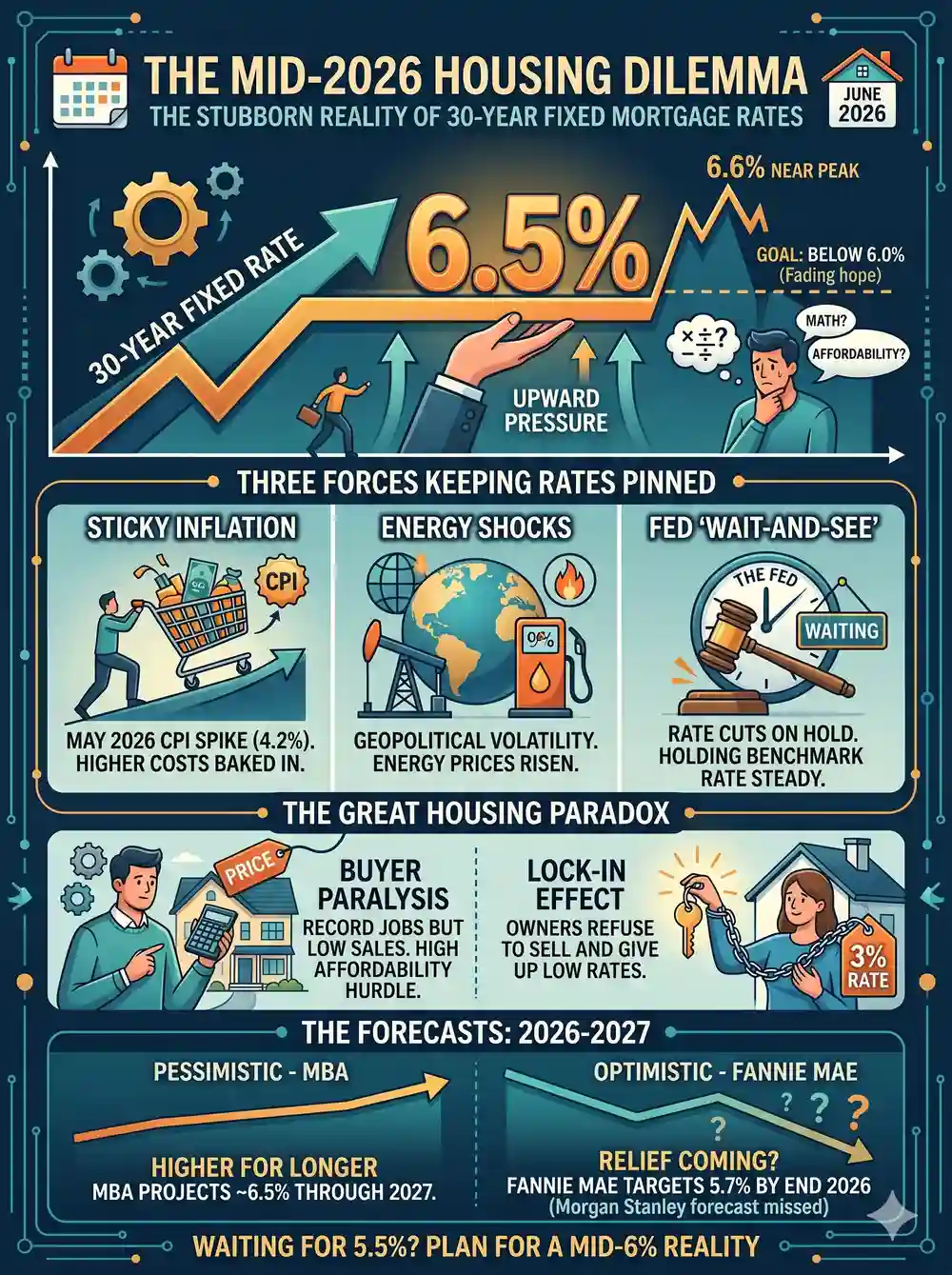
Despite hopes earlier in the year, sub-6% mortgage rates are fading in the rearview mirror. According to the latest Primary Mortgage Market Survey from Freddie Mac, the 30-year fixed-rate mortgage averaged 6.52% for the week ending June 11, 2026.
This represents an uptick from 6.48% the previous week. While this is slightly down from the harshest peaks of the last two years, it remains a massive affordability hurdle for everyday buyers.
The “Why”: Three Forces Keeping Rates Pinned
It is a common misconception that the Federal Reserve directly sets mortgage rates. In reality, fixed mortgage rates are loosely tethered to the 10-year Treasury yield (the return investors get for buying U.S. government debt), which currently sits stubbornly above 4.5%.
Why are bond markets demanding such high yields? Three factors:
- Sticky Inflation: The Consumer Price Index (CPI) unexpectedly spiked to 4.2% in May 2026 — the highest level we have seen since 2023. This pushed inflation well above the Federal Reserve’s target of 2%.
- Geopolitical Energy Shocks: The ongoing conflict in the Middle East has created highly volatile global oil prices. When energy costs rise, everything else becomes more expensive to produce and transport, baking inflation deeper into the economy.
- The Fed’s “Wait-and-See” Stance: Because inflation remains hot, the Federal Reserve has signaled that near-term rate cuts are off the table. As long as the Fed holds its benchmark rate steady, mortgage lenders have no incentive to lower theirs.
The Great Housing Paradox
We are currently experiencing a fascinating economic anomaly. Usually, high employment means a booming housing market. Right now, that relationship is entirely broken.
Lawrence Yun, the chief economist at the National Association of Realtors (NAR), perfectly summarized the current disconnect: “We have a record-high level of jobs. We should have record-high levels of home sales, theoretically.”
Instead, home sales remain paralyzed. Buyers with excellent jobs simply cannot make the math work when pairing a 6.5%+ mortgage rate with record-high home prices. Meanwhile, current homeowners refuse to sell because it would mean trading their existing 3% or 4% rate for a new loan near 6.6% — a phenomenon known as the “lock-in effect.”
The Forecast: Who Should You Believe?
If you are trying to time the market, forecasters are sharply divided on where we go from here:
- The Pessimists (Higher for Longer): The Mortgage Bankers Association (MBA) projects that 30-year rates will remain elevated, averaging around 6.5% through the rest of 2026 and entirely into 2027.
- The Optimists (Relief is Coming): Fannie Mae is holding onto a more optimistic model, projecting a steady decline down to 5.7% by the end of 2026. (For context, Morgan Stanley also predicted rates would fall to 5.75% by mid-2026, a forecast that has already been proven overly optimistic by current market conditions).
The Bottom Line: If you need to buy a home, plan your budget around a mid-6% reality. Waiting for rates to drop to 5.5% is a gamble that fights the current momentum of inflation, global energy markets, and the Federal Reserve.
Quote & Sourcing Report: This article quotes commentary from Lawrence Yun, Chief Economist at the National Association of Realtors (NAR), and relies on reporting by Chris Martin from ECIKS.org, which aggregates June 2026 data and forecasts from Freddie Mac, Bankrate, Fortune, the Mortgage Bankers Association, Fannie Mae, and Morgan Stanley.

Leo Falsafi is a digital marketing veteran and senior journalist at Virlan.co, where he covers the intersection of digital marketing, gaming, and breaking US trending news. With nearly two decades of hands-on experience in SEO and digital strategy, Leo has consulted for and scaled hundreds of companies. His deep industry roots allow him to deliver sharp, fact-checked insights and analysis on the trends shaping today’s digital landscape.