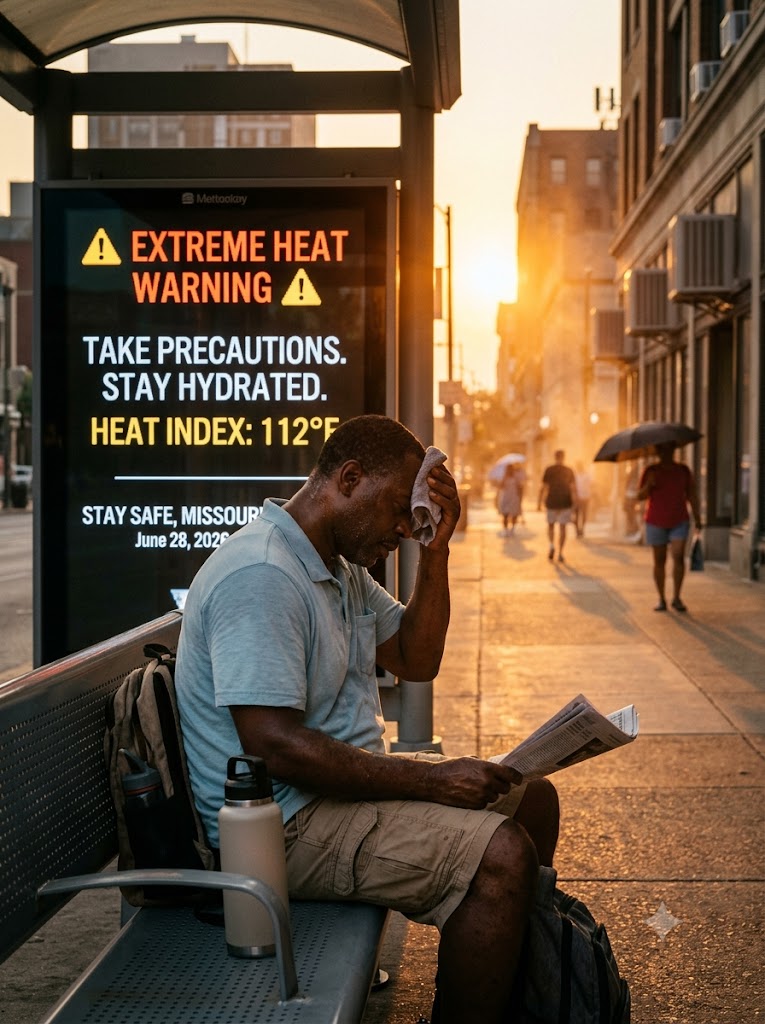
The United States is currently staring down the barrel of a weeklong atmospheric furnace. As of June 28, 2026, the National Weather Service (NWS) has blanketed swaths of the country—from Missouri to Middle Tennessee and Western Kentucky—under a severe Extreme Heat Warning. Forecasts indicate a relentless heat wave that is expected to stretch well into the Fourth of July weekend.
This isn’t merely a string of hot summer days. With afternoon temperatures hovering between 95 and 97 degrees, oppressive humidity and southern winds are driving heat index values up to 110 degrees, with isolated locations predicted to endure a stifling 115 degrees. But the true danger lies not just in the daytime peaks; it lies in the nighttime lulls.
The Peril of Warm Nights
Historically, public attention during extreme weather focuses entirely on the daytime apex. Yet, atmospheric scientists and public health officials are increasingly sounding the alarm on the hidden threat of elevated overnight temperatures.
Christine Wielgos, a Warning Coordination Meteorologist, recently highlighted that one of the most concerning aspects of this current heat wave is the sheer lack of overnight relief. Lows are projected to stall in the mid-to-upper 70s. These unusually warm nights actively prevent homes, infrastructure, and the human body from adequately cooling down before the next day’s thermal assault begins. According to Wielgos, this unbroken cycle of heat stress significantly increases the risk of heat-related illnesses—especially for the elderly, young children, athletes, and outdoor workers.
The medical ramifications of prolonged heat exposure are well-documented and severe. The notorious 2021 Pacific Northwest “heat dome” forced over 1,000 heat-related emergency department visits. Furthermore, a long-term review by the National High School Sports Related Injury Surveillance System tracked an estimated 51,943 excessive heat illnesses across nine high school sports between 2005 and 2020. Once internal body temperatures hit 103°F, heat stroke—characterized by hot, red, dry skin, a rapid pulse, and confusion—becomes an immediate 911 emergency.
From “Excessive” to “Extreme”: The Policy Shift
It is vital to note the recent linguistic and policy shift surrounding these alerts. On March 10, 2025, the National Weather Service officially renamed the “Excessive Heat Warning and Watch” to the “Extreme Heat Warning and Watch.” This update, driven by 2018 public survey results, was designed to better communicate the severe, life-threatening nature of these events to the general public.
- Trigger Criteria: In most U.S. regions, an Extreme Heat Warning is triggered when the heat index is forecast to hit at least 105°F for more than three hours a day over two consecutive days, or if it exceeds 115°F for any duration.
- The Heat Index Factor: The Heat Index calculates how hot it actually feels by marrying air temperature with relative humidity. Crucially, these values are calculated for shaded, light-wind areas; standing in direct sunlight can spike the perceived temperature by an additional 15 degrees.
- Mitigation Protocols: Local emergency management and health departments rapidly open cooling centers, such as the Salt Fork YMCA lobby in Marshall, Missouri, to protect vulnerable populations. Meanwhile, the Occupational Safety and Health Administration (OSHA) requires that outdoor workers undergo heat acclimatization, utilize shaded environments, and follow strict work/rest schedules.
What is the difference between an Extreme Heat Watch and an Extreme Heat Warning?
An Extreme Heat Watch acts as a preliminary alert, issued 12 to 48 hours in advance, indicating that the conditions for an extreme heat event are favorable, but the exact timing and severity remain uncertain. An Extreme Heat Warning is an urgent, definitive notice issued within 12 to 24 hours of the heat index reaching dangerous criteria, signaling that a high-threat heat event is imminent or already occurring.
Why are high overnight temperatures so dangerous during a heat wave?
When overnight temperatures fail to drop below the mid-70s, the human cardiovascular system does not get a chance to recover from the daytime heat stress. This lack of a biological “cooling off” period prevents the body from resetting its core temperature, which drastically accelerates the onset of heat exhaustion and heat stroke during the following day.
Sources Quoted: Information was extracted from the National Weather Service (NWS) database, Heat.gov, Wikipedia’s repository on the 2025 NWS meteorological policy updates, KMMO News (Marshall, MO), WPKY News Edge (Western Kentucky) quoting Warning Coordination Meteorologist Christine Wielgos, and regional severe weather alerts spanning Middle Tennessee.

Leo Falsafi is a digital marketing veteran and senior journalist at Virlan.co, where he covers the intersection of digital marketing, gaming, and breaking US trending news. With nearly two decades of hands-on experience in SEO and digital strategy, Leo has consulted for and scaled hundreds of companies. His deep industry roots allow him to deliver sharp, fact-checked insights and analysis on the trends shaping today’s digital landscape.