The affiliate marketing industry is projected to reach nearly $32 billion by 2031. With over 80% of brands worldwide now running affiliate programs, the model has shifted from volume-driven micro-commissions to strategic, high-value partnerships.
High-ticket affiliate marketing—promoting premium products where a single conversion yields substantial payouts—is redefining the affiliate landscape in 2026.
The Market Context: The Shift to High-Ticket Economics
Recent data from Cognitive Market Research indicates the global affiliate marketing industry was valued at over $18.5 billion in 2024. Total spending in the US affiliate marketing sector is projected to reach nearly $12 billion in 2025 (an 11.9% year-over-year increase) and over $13 billion in 2026. The US dominates the market with nearly a 31.6% global share, followed by China (10.3%) and Germany (5.9%).
“Affiliate marketing has emerged as one of the most dynamic strategies for business growth. It lets companies reach new audiences while growing meaningful, long-term relationships,” states Adi Avraham, SEO growth specialist at Wix.
This growth fuels the high-ticket model. High-ticket affiliate marketing involves promoting products and services that pay $500+ per sale or $100+/month in recurring commissions. Instead of chasing hundreds of small, impulsive sales, affiliates focus on targeted buyers seeking consultative solutions.
Also read: What Is Cookie Stuffing? The Phoebe Gates Phia Controversy Explained
Structuring a High-Ticket Strategy vs. Low-Ticket Approaches
High-ticket affiliate marketing fundamentally differs from low-ticket models like Amazon Associates.
- Low-Ticket: Characterized by product prices of $1–$200, low commission per sale, the need for high sales volume, a broad audience requirement, and quick impulse buys.
- High-Ticket: Defined by product prices of $500–$10,000+, high commissions per sale, low required sales volume, a targeted and engaged audience, and a strategic, consultative sales process.
According to Authority Hacker, affiliate marketers with over 10 years of industry experience earn over $44,000 per month on average. To achieve this, the focus must shift from pure traffic volume to buyer intent, trust, and compliance.
When evaluating high-ticket programs, experts advise prioritizing:
- Commission Structure: High one-time payouts or recurring commissions.
- Cookie Duration: Programs offering 60–180+ day cookies are optimal for premium buyers who have a longer conversion journey.
- Product Reputation: Promoting products that solve critical problems.
The Most Profitable High-Ticket Niches in 2026
The best high-ticket niches align with 2026 consumer and technological trends, offering evergreen buyer demand and sustainable commission economics.
1. Software as a Service (SaaS), AI, and Automation Tools
SaaS, particularly for specific industries, is highlighted as the strongest vertical for new operators. Industry-specific SaaS often runs $200 to $2,000 per month, with affiliate programs paying $200+ per signup. The global IT spending is expected to reach $6.16 trillion by 2026. Tools encompassing AI writing, workflow automation, and specialized CRMs offer significant recurring revenue potential (often 20–50% recurring or $100–$500 per signup).
2. Web Hosting and Digital Infrastructure
Web hosting remains a classic high-ticket niche. The buyer intent on hosting comparison content is extremely high, as average buyers sign up for 12 to 36-month plans. This structure generates larger per-conversion payouts than typical SaaS products, often ranging from $50 to $500.
3. Online Education and Course Platforms
The online education industry is expected to exceed $500 billion by 2026. Course platforms offer strong recurring commissions as underlying customers stay subscribed for years. Affiliates often earn 20–45% per enrollment or $100–$500 per student.
4. Cybersecurity and Privacy Services
The global cybersecurity market is projected to pass $250 billion by 2026. Privacy and data safety are critical for modern companies, and tools like VPNs, password managers, and endpoint protection offer typical commissions of $100–$400 per sale or 30% recurring.
5. Premium Wellness and Health
Premium wellness (saunas, cold plunges, infrared therapy) has seen explosive growth. Direct-to-consumer brands in these categories run affiliate programs with 5 to 15 percent commissions on $3,000+ products, translating to payouts of $150 to $450 per conversion.
The Organic Approach: Traffic and Trust
Nearly seven in 10 (69%) affiliate marketers use SEO to drive organic traffic, making it the dominant strategy. In high-ticket niches, generating generic content is insufficient. The most effective approach involves creating deep, decision-support content: tutorials showing real workflows, head-to-head tool comparisons, and success stories backed by data.
Top-Tier High-Ticket Programs to Consider
Based on industry curation, several programs stand out for strong payouts and affiliate support:
- Partnero (Partnership & Affiliate Management): Offers a 50% commission on the first sale and a 30% recurring monthly commission for up to 24 months, with a 60-day cookie window.
- Kinsta (Managed WordPress Hosting): Affiliates can earn a one-time payout up to ~$500 per referral plus a 10% monthly recurring commission (60-day cookie).
- HubSpot (CRM and Automation): Provides a 30% recurring commission on referrals for up to 12 months with a 180-day cookie window.
By focusing on deep expertise within growing technical and consumer trends, high-ticket affiliate marketing in 2026 offers predictable income models for focused strategists.
What Is Affiliate Marketing? The 2026 Blueprint to Earning Commissions
Discover exactly what affiliate marketing is, how it works, and the 2026 statistics driving this multi-billion dollar performance-based industry.
What Is Affiliate Marketing?
Affiliate marketing is a performance-based marketing program, where an external partner is rewarded a commission for delivering a specific result to a merchant or advertiser. The result is often a valid sale, however it can also be a completed lead form, a new free trial user, or even a new newsletter subscriber. There are typically four parties involved in affiliate marketing: Affiliates: The promoters of the product. Product creators: The creators of the product. Networks: The networks managing the affiliates. Consumers: The end users of the product.
Affiliate Marketing vs. Referral Marketing
In referral marketing, the people promoting your brand are satisfied customers. In affiliate marketing, the people promoting your brand are content creators with a platform. These individuals may never have bought your product before joining your affiliate network. Affiliate rewards, however, are commission-based. Affiliate marketers receive a percentage of the sales they generate. Referral marketing requires a more gradual approach, since you can scale only as your existing customer base grows. By recruiting high-performing brand ambassadors with large followings, brands can acquire new customers quickly.
Commission Models and Earning Structure
How much commission is structured depends on the affiliate program terms. Pay-Per-Click (PPC): The affiliate gets paid for all clicks that were generated, regardless of whether a lead or sale happened. Pay-Per-Lead (PPL): The affiliate gets paid for every lead they generated. This could be an online form submission, trial creation, or any pre-purchase. Pay-Per-Sale (PPS): The affiliate gets paid for every sale they generated. This is the most common model since all the risk is on the affiliate.
The State of the Industry: 2026 Statistics
By the end of 2026 the influencer marketing industry is set to exceed $40 billion. Our State of Influencer Marketing Benchmark Report shows that 85% of marketers now consider influencer marketing an effective channel for achieving their goals. In fact, studies show that 72% of consumers trust recommendations from influencers—even those they don’t personally know—more than messaging that comes directly from brands or businesses. For every $1 spent on influencer marketing, brands earn an average of $5.78.
How to Start Affiliate Marketing
How to Start Affiliate Marketing: Choose a platform and niche. Build an audience. Sign up for an affiliate program. Choose products to promote. Create remarkable content that promotes your affiliate products. Optimize and track. Get paid. To be an affiliate, you need to have influence. Establishing a website or blog that specializes in a niche is the best way to establish influence. Whether you focus on finance, personal health, business, or even cats, a niched blog or website will help you gain influence and build an audience. Develop a strategy — What problems are you solving? What niche or audience do you want to serve? Outline the above, and determine how you want to get there while offering something unique or a little different. Simply put, to earn big commissions in affiliate marketing you want to get the right product/service in front of the right audience with the right message.
Is Affiliate Marketing Legit? The 2026 Guide to Scams & Earnings
An authoritative, data-driven report on the legitimacy of affiliate marketing, 2026 industry statistics, and how to spot common scams.
What Is Affiliate Marketing and Is It Legitimate?
Affiliate marketing is a legitimate, legal, and well-established business model and online business opportunity, one that generates tens of billions of dollars in tracked, attributable revenue every year for brands ranging from solo DTC businesses to Fortune 500 companies. It is a standard business model used by brands like Amazon, Shopify, and Alliance Virtual Offices. Unlike pyramid schemes, which are built on recruitment for monetary gain without any real product or service exchange, affiliate marketing is a legitimate business model centered around the promotion of tangible products or services, with earnings coming from actual sales commissions.
The 2026 Statistics: Industry Value and Earning Potential
The global affiliate marketing industry is valued at $17 to $18.5 billion in 2025, with projections to exceed $20 billion in 2026. A market of that scale does not exist on the back of a scam. It exists because the underlying model works: brands pay for performance, publishers earn for results, and customers get product recommendations that help them make purchasing decisions. 74% of brands increased their affiliate investment in 2025 due to rising costs in other marketing channels. These numbers come from credible sources including the IAB, Grand View Research, EMARKETER, and Shopify. The majority of committed affiliate marketers, 81.2%, earn more than $20,000 per year, indicating that affiliate marketing delivers meaningful income for serious practitioners. Success in affiliate marketing follows a power-law distribution: 41% of affiliates earn less than $1,000 monthly, while 15% earn between $80,001 and $1 million or more annually.
The Legal and Regulatory Framework
In the United States, the Federal Trade Commission (FTC) has guidelines that require affiliates to disclose their relationships with the companies they promote. This means you have to tell your audience that you might earn a commission if they purchase through your link. In the European Union, the General Data Protection Regulation (GDPR) governs how affiliate tracking cookies can be placed and what data can be collected through affiliate activity. Tax obligations are also real. In the US, if you earn over $600 from a network, you will likely receive a 1099 form.
How to Avoid Affiliate Marketing Scams
Affiliate marketing scams exist in several forms: fake gurus promising overnight wealth, pay-to-join schemes, fake affiliate programs that never pay out, and programs that encourage fraudulent affiliates to use fake leads or bot traffic to game commission systems. Spoof traffic is fake or non-human traffic sent to your website, making it look like there are more visitors than there actually are. The fake affiliate traffic is generated by bots or scripts that mimic real users. Legitimate affiliate programs are free to join, offer transparent commission structures, and are hosted on reputable affiliate networks like Awin, CJ Affiliate, or Impact. If a program requires an upfront “registration fee,” “membership access fee,” or a mandatory product purchase before you can start promoting, that is a critical red flag.
Amazon Affiliate Marketing 2026: Complete Guide to Associates Commissions
A definitive breakdown of Amazon affiliate marketing in 2026, featuring verified commission rates by category, earning potential, and a step-by-step startup guide.
What is Affiliate Marketing with Amazon?
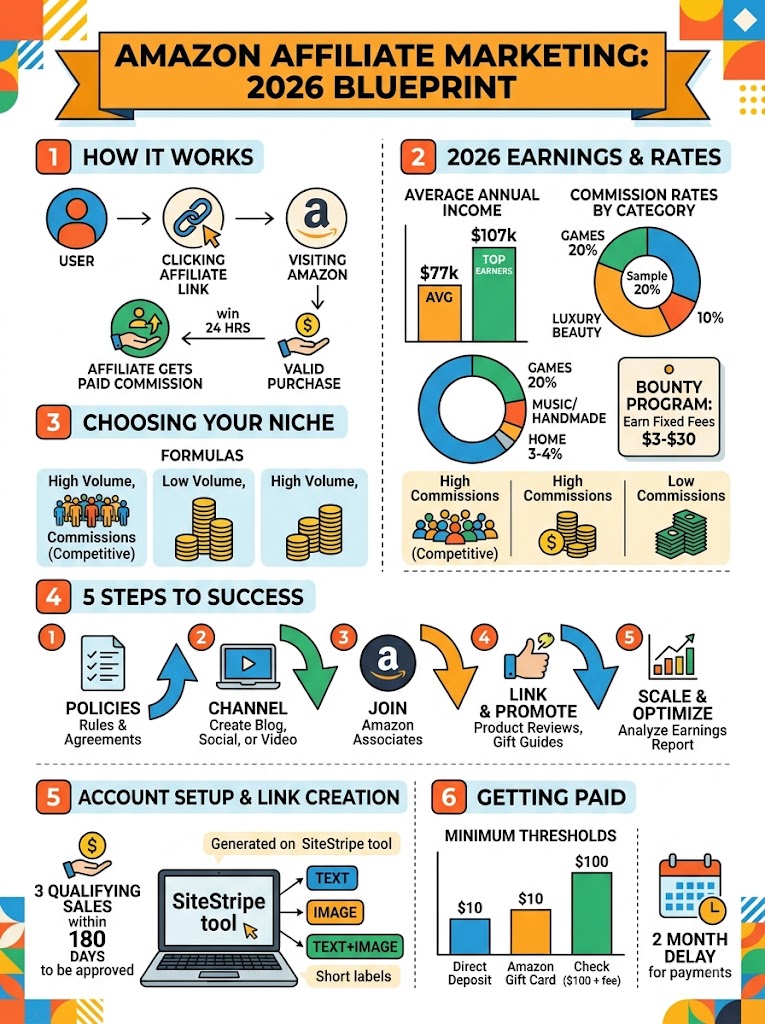
What is Affiliate Marketing with Amazon? Affiliate marketing with Amazon means referring visitors to your website to Amazon products through a special tracking link that helps you get credit for the referral. If the person you referred makes a purchase on Amazon within 24 hours of clicking your link, you’ll receive an affiliate commission for your role in the sale. The beauty of the Amazon affiliate program is that the person you refer doesn’t need to buy the exact item you recommended for you to earn a commission.
This is a win-win situation for everyone involved. Sellers benefit from the additional sales and visibility, while affiliates get an additional income.
Amazon Affiliate Earnings and 2026 Commission Rates
According to ZipRecruiter’s June 2026 data, the national average salary for an Amazon affiliate is $77,893 per year. Top earners in the 90th percentile make up to $107,500, while the lowest 14% earn between $35,000 and $43,500.
Not all products are created equal when it comes to Amazon’s affiliate program, so make sure you read the detailed breakdown of commissions before embarking on your affiliate journey. Amazon’s commission rates vary by category, range from 0% to 20%, and most affiliates have no idea where their niche actually falls on that scale.
- By category, Amazon Games ranks top with the highest commission rate of 20%. This category includes video games developed and published by Amazon for PCs and consoles.
- As of 2026, luxury beauty products offer the highest commission rate at 10%, followed by digital and physical music, digital videos, and handmade items at 5%.
- Most other categories fall between 1% and 4%, with many home and everyday items typically offering around 3% to 4%.
- There is also a 4% commission rate on any niche category that hasn’t been listed.
There are also certain products that you can’t receive commission on, including gift cards, alcohol, Kindle sales, vehicles, prescription medication, and restaurant deliveries.
Amazon Bounty program: Earn fixed fees ($3 to $30) when customers sign up for Amazon services like Prime or Audible.
Choosing an Affiliate Niche
Before you set up website hosting and buy a domain name, you’ll need to decide which niche you want to enter based on its earning potential and level of competition. To pick an affiliate niche, you’ll want one of these three formulas:
- High volume, high commissions. This is the most competitive type of affiliate marketing, in niches like web hosting, SaaS products, and finance.
- Low volume, high commissions.
- High volume, low commissions.
How to Become a Successful Amazon Affiliate
Here’s how to become a successful Amazon affiliate:
- Learn the programs policies and operating agreements.
- Research and create your marketing channel.
- Become an Amazon affiliate.
- Create and promote your affiliate links.
- Get your first payout.
- Optimize your content with the Earnings Report.
- Scale your Amazon affiliate operation.
Amazon affiliates promote affiliate links through a variety of content types, including social media posts, YouTube videos, product reviews, roundups and comparisons, gift guides, and more. Once you’ve had everything set up and verified, and you’ve been successfully approved for your chosen affiliate products and links, you’ll use your various channels to advertise these products. This can be done via blogs, videos, social media posts, and emails.
Amazon Associates Account Setup and Link Generation
As soon as you’ve made three qualified sales through your affiliate links, you’ll be fully integrated into the program. Do keep in mind that you only have 180 days to complete the qualifying sales, otherwise your account will be closed.
You can use the SiteStripe tool to create an affiliate link for any product, all you need to do is visit the product page. You can create multiple types of links using SiteStripe including text, image, text + image, or custom native shopping ads.
Amazon Affiliate Payment Methods and Thresholds
What is the minimum payment (commission) threshold on Amazon?
- Direct Deposit: $10 minimum.
- Amazon Gift Card: $10 minimum.
- Check: $100 minimum (plus the $15 processing fee).
Once you reach that threshold, Amazon pays out on a two month delay.
Leo Falsafi is a digital marketing veteran and senior journalist at Virlan.co, where he covers the intersection of digital marketing, gaming, and breaking US trending news. With nearly two decades of hands-on experience in SEO and digital strategy, Leo has consulted for and scaled hundreds of companies. His deep industry roots allow him to deliver sharp, fact-checked insights and analysis on the trends shaping today's digital landscape.