We used to have a very simple arrangement with search engines. We fed them keywords, backlinks, and technically sound pages. In return, they fed us traffic. It was a transactional, predictable ecosystem.
That era is dead.
Today, the internet is being consumed, summarized, and regurgitated by large language models (LLMs) and AI buying agents. These autonomous actors don’t care about your ten blue links. They care about structured, machine-readable truth. And right now, a massive disconnect has emerged between who companies think they are and who the machines think they are.
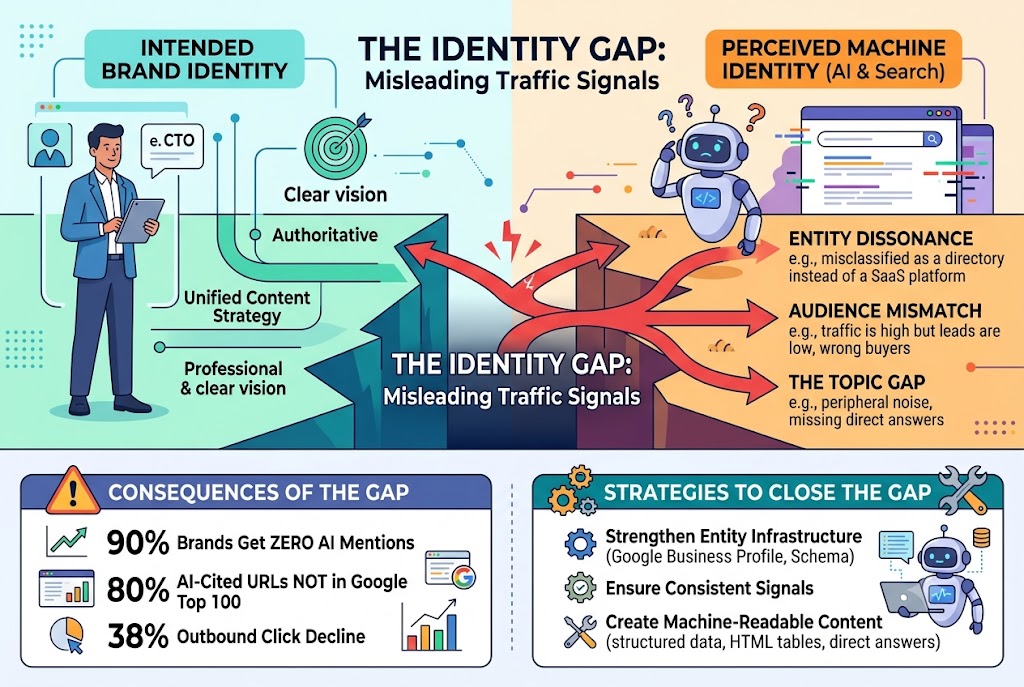
In the SEO space, we call this the “Identity Gap.” It occurs when the traffic signals your site produces inadvertently reinforce an incorrect or entirely unhelpful brand identity to traditional search algorithms and modern AI engines. If you’ve ever looked at your analytics and wondered why your traffic is climbing while your qualified leads are plummeting, you are likely falling into this exact chasm.
What the Data Actually Says About AI Visibility
Let’s look at the harsh reality of the current landscape. We are past the point of treating AI Overviews (AEO) and Generative Engine Optimization (GEO) as mere extensions of traditional SEO. They operate on entirely different behavioral models.
A massive study conducted in May 2026 by Identity First Media revealed a staggering baseline: 90% of brands receive absolutely zero AI search mentions. If a buyer asks ChatGPT or Perplexity for a vendor recommendation in your niche, nine out of ten companies do not exist.
You might think your aggressive traditional SEO strategy will save you. It won’t. Recent research from Ahrefs analyzing over 15,000 queries found that 80% of the URLs cited by AI systems never even appear in Google’s top 100 search results.
Let that sink in. You can be entirely invisible on traditional search and still be the number one recommended vendor by an AI buying agent—or vice versa.
Furthermore, relying on the old playbook is getting actively penalized by user behavior. A randomized field experiment conducted in early 2026 by researchers at the ISB Institute of Data Science discovered that when an AI summary appears in search, outbound clicks to publishers plummet by 38%. The modern buyer doesn’t want to browse your site; they want the AI to synthesize your value for them. If the AI doesn’t understand your identity, you don’t make the shortlist.
The Three Symptoms of a Fractured Brand Identity
How do you know if your brand is suffering from an identity gap? According to recent breakdowns from Search Engine Land, the disease typically presents itself through three distinct symptoms.
1. Entity Dissonance
This is the deepest and oldest issue. Entity dissonance happens when the engines literally misclassify your business.
Maybe Google thinks you’re a software directory instead of a SaaS platform. Maybe it fastens your brand identity to a similarly named, entirely unrelated company in another country. When your homepage copy, your schema markup, and your LinkedIn presence all say slightly different things, the machine gets confused. It opts out of recommending you. The wider the disagreement across your digital footprint, the deeper the problem sits in the entity layer.
2. Audience Mismatch
Traffic is a vanity metric if it doesn’t convert. Audience mismatch occurs when the searchers arriving at your site are a fundamentally different population from the people who actually buy your product.
For years, we’ve brushed this off as a “user intent” issue. But it’s actually an identity problem. If your content library attracts junior developers looking for free coding calculators, but your sales team is trying to close enterprise CTOs, your site’s identity is actively sabotaging your revenue.
3. The Topic Gap
This happens when you write endlessly about the periphery of your industry while leaving your buyer’s most critical questions completely unanswered. You generate noise, but you fail to provide the structured, crawlable answers—like pricing, exact specifications, and shipping policies—that AI agents actively look for when comparing vendors.
Also read: How to Find Free & Low-Cost Guest Posting Sites (DA 20+) in 2026
How to Close the Gap and Reclaim Your Narrative
Closing the identity gap isn’t about writing more blog posts. It’s about building a robust, machine-readable brand knowledge infrastructure.
AI systems recommend brands based on association strength and topical presence. To fix the gap, you have to align every signal you broadcast.
First, resolve your entity dissonance. This means aggressive consistency in brand naming, verifying your Google Business Profile, and utilizing Organization schema with sameAs attributes pointing to authoritative, third-party sources. You must establish your entity identity in Google’s Knowledge Graph forcefully and clearly.
Second, restructure your critical data. Stop burying your product specifications in beautifully written prose. AI systems building real-time product comparisons extract information from structured HTML tables much more reliably than from narrative copy. Make your policies, pricing, and availability explicitly crawlable.
The identity gap is ultimately an alignment problem. It’s what happens when your brand, your product, and your SEO operate in silos. In 2026, the brands that win won’t just be the ones that publish the most content. They will be the ones that teach the machines exactly who they are, who they serve, and why they matter.
Sources Quoted:
Data and concepts were sourced from recent 2026 industry reports, including Ahrefs (AI citation research), Identity First Media (AI search mention studies), the ISB Institute of Data Science (click-through degradation metrics), and Search Engine Land (the three symptoms of the identity gap).
Leo Falsafi is a digital marketing veteran and senior journalist at Virlan.co, where he covers the intersection of digital marketing, gaming, and breaking US trending news. With nearly two decades of hands-on experience in SEO and digital strategy, Leo has consulted for and scaled hundreds of companies. His deep industry roots allow him to deliver sharp, fact-checked insights and analysis on the trends shaping today's digital landscape.