
If you’ve ever typed a URL that ended in .io and found yourself immediately locked in a multiplayer battle with strangers from around the world — you’ve played an io game. No account. No download. No tutorial. Just instant, competitive fun.
But what exactly are io games? Where did they come from? How do they work? And why are millions of people still playing them in 2026?
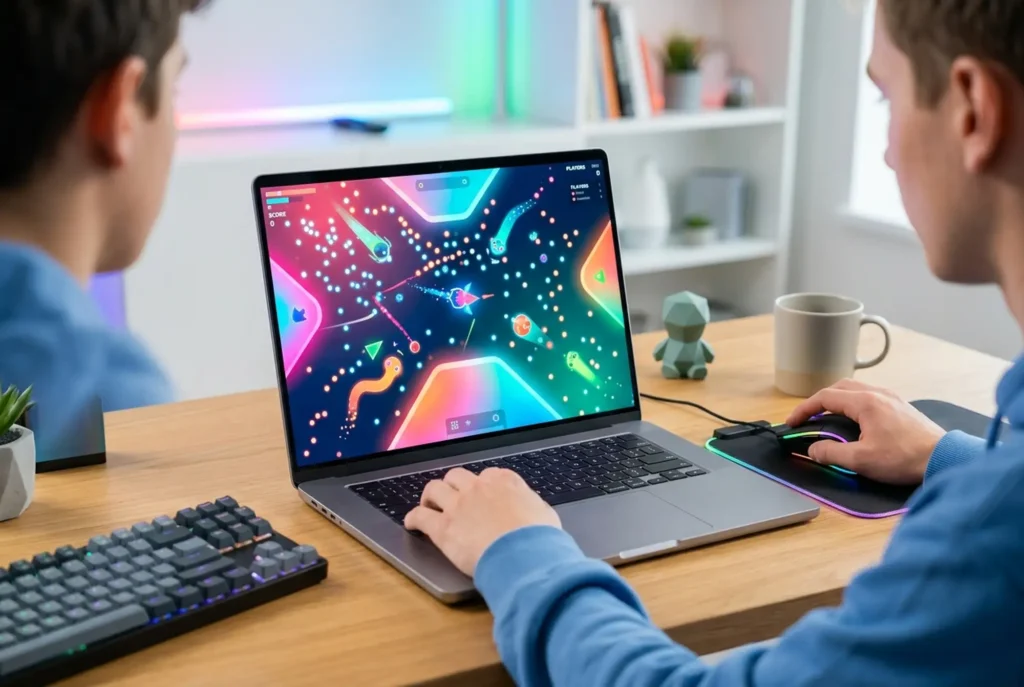
This is the only guide you need.
What Are IO Games?
IO games (also written as .io games) are free, browser-based multiplayer games that you can play instantly without downloading anything or creating an account. You open a link, enter a username, and you’re dropped straight into a live game with real players from around the world.
The defining characteristics of every io game:
- Free to play — no purchase, no paywall, no subscription
- Browser-based — runs inside Chrome, Firefox, Safari, or Edge
- Multiplayer by default — you’re always competing against or with real people
- No download required — nothing to install, nothing to update
- Simple controls — usually just a mouse or arrow keys
- Short sessions — a full round in 5–15 minutes
That combination of zero friction and instant competition is why io games became one of the most-played genres on the internet.
Where Does the “.io” Come From?
The .io extension is the country-code domain for the British Indian Ocean Territory — a small group of islands in the Indian Ocean. It became popular with developers because it’s short, sounds techy (.io = Input/Output in computing), and was widely available to register in the early 2010s.
The first major game to use it was Agar.io in 2015. Its success was so massive that every browser game developer that followed started using .io in their game names — not because they hosted on that domain, but because players had come to associate .io with “free browser multiplayer game.” The domain became a genre.
Today, you’ll find io games hosted on all sorts of domains, but the .io name stuck as the label for the whole category.
The Origin Story: How IO Games Were Born
Agar.io (2015) — The Game That Started Everything
On April 28, 2015, a 19-year-old Brazilian developer named Matheus Valadares posted a link to 4chan. The link went to a browser game he’d built in roughly four days. It was called Agar.io.
The gameplay was strikingly simple: you control a colored circle (a “cell”) on a large grid. You eat smaller circles to grow. Larger circles eat you. The goal is to become the biggest cell on the server.
That’s it.
Within weeks, Agar.io was being played by millions. It became a global phenomenon, was acquired by Miniclip, hit mobile platforms, and is still played today. More importantly, it proved a concept: a massively multiplayer browser game with a five-second learning curve could compete with anything the gaming industry was producing.
Every io game that exists today traces its roots back to that 4chan post.
Slither.io (2016) — The Genre Explodes
In 2016, developer Steven Howse released Slither.io, a modern browser take on the classic Snake game. You control a glowing worm. You grow by eating glowing dots. You die if your head touches another player’s body — but if another player runs into your body, they explode and you eat their mass.
By June 2016, Slither.io had over 60 million daily players. It became the most Googled game of that entire year — beating every console and PC release.
The io game gold rush was on.
2017–2019 — The Wild Era
Between 2017 and 2019, a new io game launched almost every week. Developers discovered you could build a viral multiplayer game with a small team and a clever mechanic. Titles like Paper.io, Surviv.io (a battle royale in the browser), Hole.io, Krunker.io, and Diep.io each attracted millions of players.
The genre also became the unofficial gaming platform of classrooms worldwide — easy to open in a school browser tab, impossible to put down during lunch break.
2020–Present — Maturity and Staying Power
IO games got a second surge during the COVID-19 pandemic, when people worldwide needed quick, accessible entertainment. Since then, the genre has matured: the weekly launch flood slowed, but the best titles kept growing. Games like Krunker.io, Shell Shockers, and Bloxd.io have active communities, regular updates, and competitive scenes that have lasted years.
In 2026, browser gaming is an $8 billion market. IO games are a permanent fixture.
How Do IO Games Actually Work?
You don’t need a gaming PC. You don’t need to install anything. So what’s happening under the hood?
IO games run entirely inside your web browser using three core technologies:
1. HTML5 Canvas
This is what draws the game on your screen. Every pixel, every player, every animation is rendered in real time inside a standard <canvas> element in the browser. No Flash. No plugins.
2. JavaScript
The game logic runs in JavaScript — the same language that powers most of the web. Movement calculations, collision detection, scoring, and game state all happen here.
3. WebSockets
This is the secret to real-time multiplayer. WebSockets keep an open, persistent connection between your browser and the game server. When you move your character, that data is sent to the server in milliseconds. The server updates all other players. Their movements come back to you just as fast. The result: you and dozens of strangers are playing the same game, live, in a browser tab.
That’s the whole stack. It’s elegant, lightweight, and works on virtually any device made in the last decade.
The Most Popular IO Games Right Now
Not sure where to start? These are the titles that define the genre:
| Game | Type | Why It’s Iconic |
|---|---|---|
| Agar.io | Cell growth | The original. Still fun. |
| Slither.io | Snake | Most Googled game of 2016. |
| Paper.io 2 | Territory control | Simple mechanic, endlessly deep |
| Hole.io | Physics | Eat the city. Satisfying. |
| Diep.io | Tank shooter | Progression system, many modes |
| Bloxd.io | 3D sandbox | Minecraft-meets-io in your browser |
| Surviv.io | Battle royale | Full BR, zero download |
| Deadshot.io | FPS shooter | Surprisingly polished shooting |
| Krunker.io | FPS shooter | Has a competitive scene and skins economy |
| Skribbl.io | Drawing party | Perfect with friends |
You can play all of these — and many more — directly on VIRLAN’s IO Games section.
IO Games vs Regular Browser Games — What’s the Difference?
People sometimes use “browser game” and “io game” interchangeably, but there’s a real distinction:
| Feature | IO Games | Regular Browser Games |
|---|---|---|
| Multiplayer | Always (core mechanic) | Often single-player |
| Session length | Short (5–20 min) | Can be long |
| Account required | Usually no | Sometimes yes |
| Competitive | Always | Not always |
| Real-time opponents | Yes | Rarely |
IO games are specifically multiplayer-first. That’s the defining element. A single-player puzzle game in a browser is a browser game. A single-player puzzle game where you compete on a leaderboard against live players in real time? That’s io territory.
Why Are IO Games So Addictive?
There’s real psychology behind the pull:
- Zero friction — you’re playing within 10 seconds of finding the game. No commitment required.
- Short feedback loops — you grow, you dominate, you die, you restart. Each cycle is quick enough that “one more round” is always believable.
- Real competition — you’re not beating an AI. You’re beating a person. That’s a different dopamine hit.
- Skill ceiling — they’re easy to learn and hard to master. Beginners can play. Experts dominate.
- Spectating your death — in most io games, when a bigger player eats you, you briefly watch them. You see how good they are. You want to get there.
That combination is almost impossible to put down.
Are IO Games Safe?
Yes — io games are generally safe to play, especially on curated platforms like VIRLAN. A few things to know:
- No downloads = no malware risk from the game itself. Everything runs in the browser sandbox.
- Chat features in some games (like Skribbl.io) are community-moderated. Younger players should be aware.
- School filters sometimes block
.iodomains. If a game isn’t loading at school, check out VIRLAN’s unblocked alternatives. - Data privacy — most io games don’t require accounts, so there’s minimal personal data involved. Always check a game’s own privacy policy.
VIRLAN links directly to official game sites and does not host games on its own servers, so you always play on the original developer’s platform.
Can You Play IO Games on Mobile?
Most modern io games are built with HTML5, which means they’re playable on mobile browsers. Games like Agar.io, Slither.io, and Paper.io 2 work well on touchscreens.
For the best experience:
- Use Chrome on Android or Safari on iOS
- Landscape mode usually works better than portrait
- Some games (especially FPS io games like Krunker.io) are better suited to desktop with a mouse
IO Games for Beginners — Where to Start
If you’ve never played an io game before, here’s the recommended starting path:
- Agar.io — Start here. It’s the origin. Controls: move your mouse. That’s literally it.
- Slither.io — Next. Same concept, snake format. Learn to trap other players.
- Paper.io 2 — Territory control. Slightly more strategic.
- Hole.io — Physics-based chaos. Very satisfying on your first play.
- Skribbl.io — Great for playing with friends. Drawing + guessing, real-time.
From there, you’ll naturally find the genres you like — battle royale, shooters, strategy — and can explore from those.
Final Word
IO games are one of the internet’s most enduring gaming formats because they cracked the formula nobody else had: multiplayer that anyone can play, anywhere, right now. No setup. No cost. No barrier.
From a 4chan post in 2015 to an $8 billion industry in 2026, the genre has earned its place. And the best part? Every game is one click away.
Ready to play? Browse the full collection at VIRLAN IO Games →


































Leave a Reply