
The End of Upgrade Hell: Unity 7 Debuts in Q1 2027 with CoreCLR and “Opt-In” AI
The games industry has long accepted a painful, unspoken rule: upgrading your engine mid-development is a recipe for disaster. It breaks dependencies, ruins custom code, and stalls production. At Unite Seoul 2026, Unity effectively rewrote that rule.
The company has officially pulled the curtain back on Unity 7, a sweeping evolution of its game authoring platform scheduled to enter beta in December 2026 before a full Q1 2027 launch. But the real story isn’t just the sheer graphical horsepower or the new suite of AI tools. It’s how the transition will actually work for developers currently deep in production.
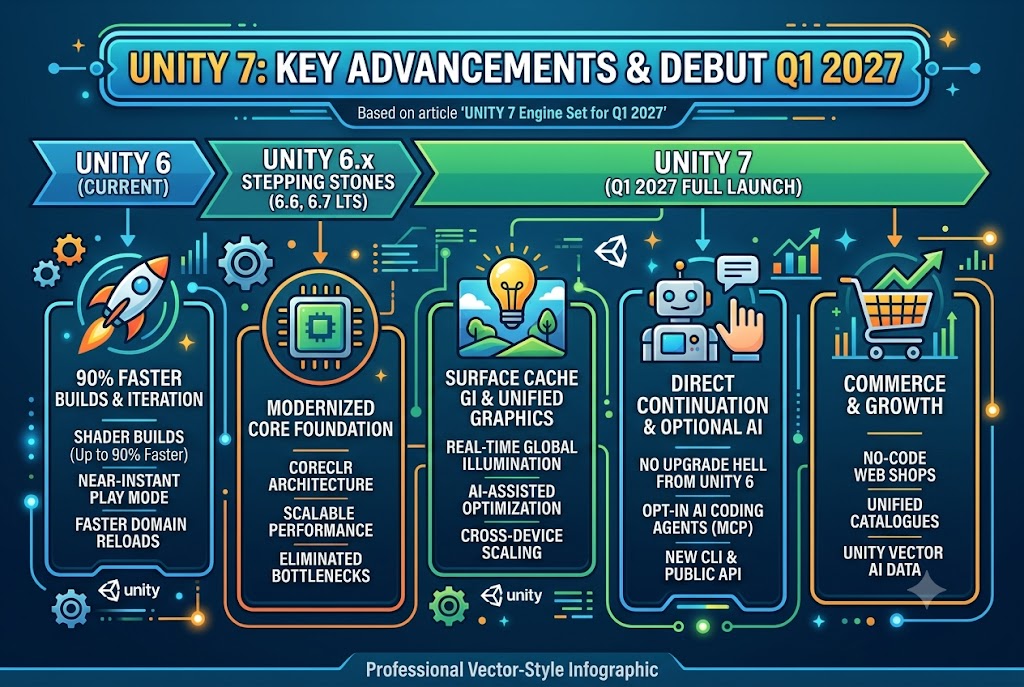
A Direct Continuation: Killing the Traditional Version Upgrade
Historically, jumping to a newly numbered Unity release meant a steep learning curve and significant technical debt. Unity 7 fundamentally changes this paradigm by acting as a “direct continuation” of the Unity 6 architecture.
“Because the architecture underneath doesn’t change at the moment of version transition, teams can adopt with ease,” explained Adam Smith, Unity’s Senior Vice President of Product. The workflow developers rely on will remain fully supported. No rebuilding. No new language to learn. Nothing broken in the transition.
To achieve this seamless leap, Unity is laying a meticulous runway. According to Director Chris Harden, stepping-stone updates like Unity 6.6 and 6.7 LTS will introduce foundational elements—including malloc-based multithreading and a modern logging system named ‘Lightwave’—ensuring that the underlying engine foundation is production-verified long before the “Unity 7” banner goes live.
Under the Hood: CoreCLR, Surface Cache GI, and 90% Faster Builds
The technical benchmarks coming out of the Unite Seoul presentation are aggressive. Unity 7 is constructed on a modernized CoreCLR foundation, built from the ground up to slash iteration times and eradicate the notorious bottlenecks that plague large-scale production.
What does that look like in practice? Domain reloads will now only touch changed code. Play Mode is near-instant. Shader builds are reportedly up to 90% faster.
Graphically, Unity 7 introduces real-time global illumination via Surface Cache GI, unifying the rendering pipeline heavily around the Universal Render Pipeline (URP). The engine pairs this with AI-assisted graphics optimization designed to dynamically scale visual fidelity. This means the same high-end PC lighting architecture can seamlessly scale down to run efficiently on mobile devices.
Furthermore, Unity 7 cracks open the Editor ecosystem. A brand-new Command-Line Interface (CLI) and public API will allow artists and producers to push builds and validate assets directly from their own external tools, completely bypassing the need for full Editor access.
The AI Elephant in the Room: MCP and “Optional” Integration
You can’t discuss a 2027 software launch without addressing artificial intelligence. Unity 7 bakes in a free-to-use Model Context Protocol (MCP) that connects AI coding agents directly into the engine, pointing toward a future where human developers and AI co-produce assets in real time.
But Unity is walking a fine line. Aware of the industry’s polarized stance on generative AI, leadership stressed that these tools are strictly opt-in.
“If your studio has committed to keeping AI out of your creative work—you’re not on the sidelines of this release,” Smith clarified. “Unity 7 is built for a future where humans and coding agents can work together. But the choice is always the team’s, not the platform’s.”
Commerce Meets Code: Unity Vector and No-Code Shops
Development tools aren’t the only focus; monetization is tightly integrated into the new architecture. Unity 7 will roll out direct-to-consumer In-App Purchases (IAP) and no-code web shops. Crucially, these commerce hubs utilize unified catalogues that feed player purchasing data directly into Unity Vector, the company’s proprietary AI engine. This allows studios to streamline their financial strategy and game growth without requiring a dedicated, enterprise-level data science team.
Unity 7 isn’t just a visual upgrade; it’s an overhaul of the entire game production pipeline. By eliminating the friction of version migration while integrating next-generation rendering, Unity is betting big on agile, cross-discipline teams.
As Matt Bromberg, Unity President and CEO, stated during the reveal: “Game development is changing faster than at any point in history. The future belongs not to the biggest team, but to those who can use new technology to create something unique and find an audience. Unity 7 is the platform that meets this moment.”
Sources Quoted:
Data, technical specifications, and executive quotes were sourced and verified via live reporting from PocketGamer.biz, Mobilegamer.biz, GamesIndustry.biz, WN Hub, and InvenGlobal covering the Unite Seoul 2026 conference.

























Leave a Reply