
Explore Generative Engine Optimization (GEO), the new frontier of search. Learn the key differences between GEO and SEO, essential strategies to adapt, and how to win in the age of AI-powered answers.
What is Generative Engine Optimization (GEO)?
Generative Engine Optimization (GEO) is the practice of creating and structuring digital content to be understood, trusted, and ultimately cited or included in the synthesized answers generated by AI-powered engines. The term was formally introduced in a November 2023 academic paper, which described it as “a new paradigm that helps content creators improve the visibility of their content in answers generated by generative engines.”
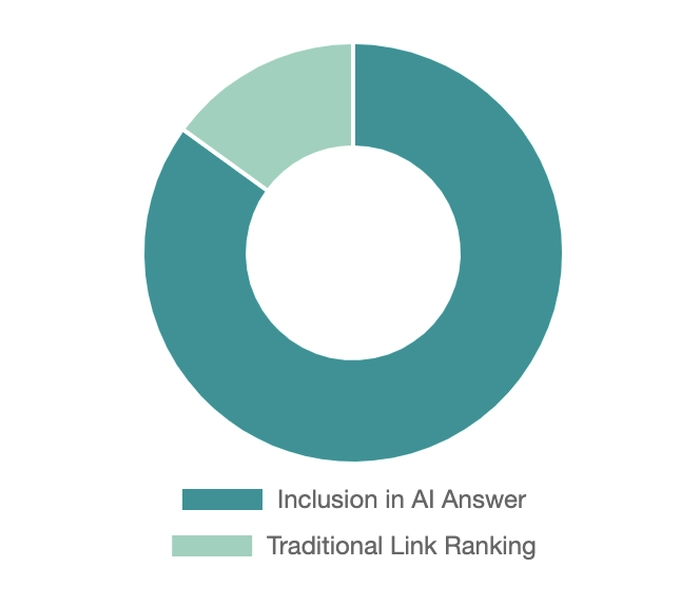
Target Platform and Goal
Unlike SEO, which targets traditional Search Engine Results Pages (SERPs), GEO targets Generative Engines. These platforms don’t just point to information; they consume, process, and synthesize it into a single, cohesive, and often conversational response.
The primary goal of GEO is not to achieve the #1 ranking for a webpage link. Instead, the objective is to become a trusted source that the AI model references directly in its output, achieving a prominent “share of voice” within the AI-generated answer itself.
Mechanism: How Generative Engines Work
Generative Engines are powered by Large Language Models (LLMs). These models are trained on vast datasets of text and code from across the internet. When a user poses a query, the engine scours its knowledge base and trusted web sources, identifies the most relevant and authoritative information, and then summarizes, contextualizes, and synthesizes it into a direct answer. GEO is the art and science of ensuring your content is a primary ingredient in that synthesis.
GEO vs. SEO: What’s The Difference?
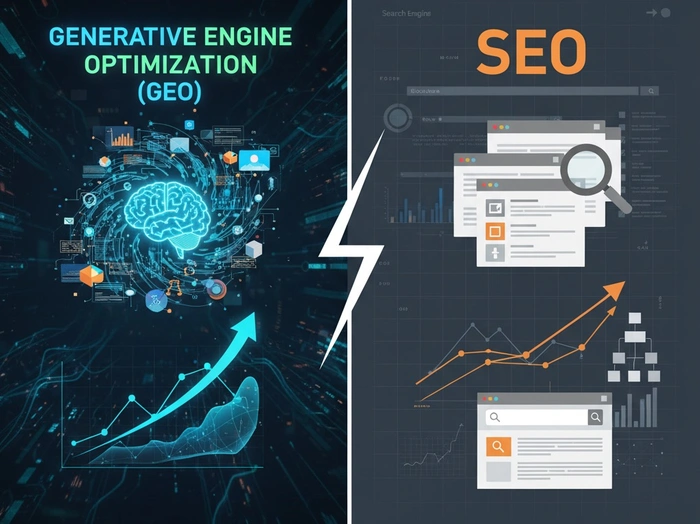
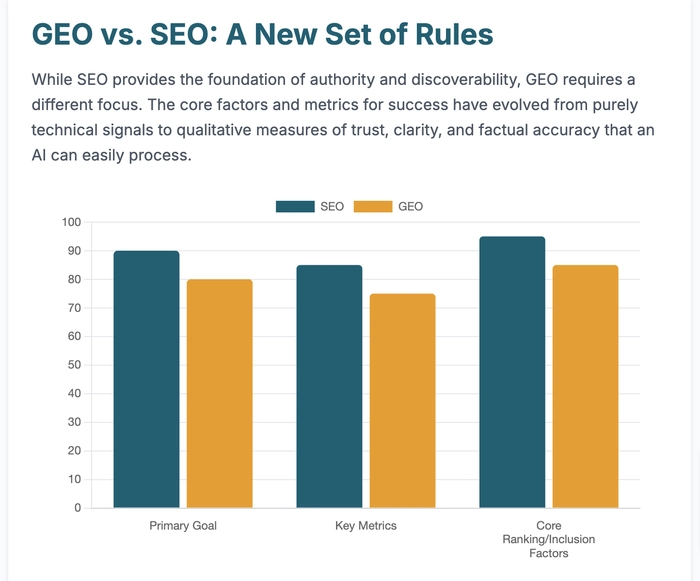
While GEO and SEO share a foundation in high-quality content, their goals, tactics, and metrics are fundamentally different.
| Dimension | SEO (Search Engine Optimization) | GEO (Generative Engine Optimization) |
| Primary Goal | Rank a webpage link high on a SERP to earn clicks and drive traffic. | Get content cited, referenced, or included in an AI-generated answer. |
| Target Platforms | Traditional search engines (Google, Bing). | AI Overviews, Chatbots (Google SGE, ChatGPT, Perplexity). |
| Core Factors | Keywords, backlinks, domain authority, technical site health. | Clarity, structured data, factual accuracy, E-E-A-T signals, direct answers. |
| Key Metrics | Click-Through Rate (CTR), organic traffic, keyword rankings, bounce rate. | Citation frequency, Share of AI Voice, Generative Appearance Score. |
The Relationship: Does GEO Replace SEO?
No, GEO does not replace SEO. Rather, GEO builds upon SEO. A strong SEO foundation—including technical site health, domain authority, and high-quality content—is the entry ticket for GEO. Search engines are more likely to trust content for AI-generated answers if it already ranks well and is considered authoritative in traditional search. Think of strong SEO as the foundation that makes your content eligible for consideration by a generative engine.
From SEO To GEO: How To Adapt To The New Visibility Rules
Adapting to GEO requires a strategic and tactical evolution. It’s a mental shift from “optimizing for a link” to “optimizing to be the answer.”
The Strategic Shift
Content creators must now think like an AI. The new goal is to produce content so clear, well-structured, and authoritative that a machine can easily parse it, verify its facts, and present it as a trustworthy solution to a user’s query. The focus moves from attracting a click to influencing the final, synthesized answer.
Also Read: Increase Domain Authority & Domain Rating: A Strategic Guide
Generative Engine Optimization (GEO) and the Evolution of Search
I. The Generative Engine Paradigm Shift: Defining Generative Engine Optimization (GEO)
1.1. The Erosion of Organic Traffic and the Rise of Generative Engines
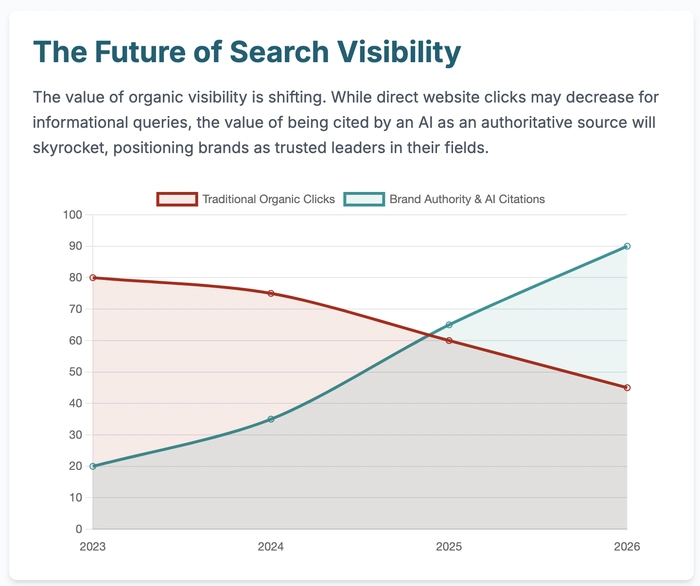
The architecture of digital information retrieval, which dominated the internet economy for over two decades, is undergoing a fundamental structural fracture. Traditional Search Engine Optimization (SEO), built on the premise of driving traffic through high rank on a results page, is being challenged by the integration of Large Language Models (LLMs) into the search environment. This transition signals the end of the traditional search funnel, where the consumer journey was linear and predominantly centered on a single major search provider.1
The contemporary consumer journey now resembles a “Constellation,” characterized by fragmented decision-making across a diverse web of platforms, including Google, TikTok, Reddit, Amazon, specialized LLM interfaces like ChatGPT and Claude, and embedded AI search features in browsers like Safari.1 Traditional search engines, once the undisputed hub of online discovery, now account for only an estimated 27% of all search activity, meaning 73% of consumer deliberation and decision-making occurs elsewhere.1 Organizations that remain fixated solely on optimizing for the classic Google SERP are succumbing to what has been termed “the Google Trap,” missing critical micro-moments where consumers are finalizing their purchases or forming their brand perceptions.1
Quantifying the Risk of Traffic Loss
The financial implications of this shift are profound, particularly for publishers and content creators who rely on high organic traffic volumes. The introduction of Generative AI features, such as Google’s AI Overviews, directly increases the prevalence of zero-click searches, as the LLM synthesizes and presents the answer directly on the results page.3 Existing data confirms a substantial impact on website referrals: research indicates a measurable link to a 25% drop in publisher referral traffic due to AI Overviews.5 Looking forward, industry projections are even more stark, with forecasts suggesting that organic search traffic could decrease by as much as 50% by 2028 as consumers become increasingly reliant on AI-powered search alternatives.3
However, the impact of this traffic erosion is not uniform across all content types. Analysis reveals a nuanced reality: informational queries are the most significantly affected category, confirming that consumers are satisfied when the AI provides a comprehensive definition or summary without needing to click through.3 Conversely, high-value, unique content, and branded searches demonstrate greater resilience, continuing to drive high-intent traffic to official websites.3
This observation necessitates a fundamental strategic reevaluation. Since informational content experiences the greatest reduction in click-through rates, strategists must accept that the optimization objective for this category of content is not the direct click, but rather citation and authority—measured as Share of AI Voice (SOAV). Conversely, commercial or transactional content must be aggressively engineered for exceptional quality and conversion capability, thereby justifying the higher value and intent of the reduced, but more qualified, organic traffic that does manage to bypass the AI overview.
The New Query Landscape
The operational dynamics of AI-native search differ significantly from traditional keyword search. Queries posed to LLM interfaces are typically longer, averaging 23 words compared to the previous average of four words.2 Furthermore, the user sessions are deeper, averaging six minutes per interaction.2 The generative system responds by synthesizing personalized, multi-source answers, relying on integrated reasoning capabilities and memory of previous interactions.2 This behavior confirms that optimization strategies must shift from targeting static keywords to anticipating complex user intent and participating in a multi-source synthesis process. The requirement for content to be optimized across community platforms and social channels (Reddit, TikTok, LinkedIn Articles) that LLMs actively scrape for authority signals confirms that Generative Engine Optimization must be viewed as an integral component of a holistic Search Everywhere Optimization strategy.1
1.2. Generative Engine Optimization (GEO) Defined
Generative Engine Optimization (GEO) is defined as the necessary discipline of adapting digital content and managing online presence specifically to improve visibility and inclusion within the results produced by generative artificial intelligence (GenAI) systems.8 The term was formally introduced in an academic paper in November 2023.8
Unlike SEO, which focuses on attaining a high Page Rank in conventional search engines, the core goal of GEO is citation and inclusion: the primary objective is to ensure that a brand or publisher is accurately cited or represented within the synthesized AI answer.8 The objective shifts from securing a high rank in a list of links to achieving high Source Citation Authority within the generated output.2 The scope of GEO extends across all major LLM-driven interfaces, including Google AI Overviews (SGE), ChatGPT, Microsoft Copilot, Perplexity, and new AI-native search integrations built into operating systems and browsers.2
1.3. The Technical Mechanism of Generative Search
GEO fundamentally targets the technical pipeline responsible for delivering AI-generated answers, known as Retrieval-Augmented Generation (RAG). RAG involves retrieving relevant, pre-processed pieces of content—referred to as “chunks”—from a specialized vector database before the LLM generates the final textual answer.10
LLM Ingestion Strategies and Data Preparation
The success of content in a generative environment depends heavily on how efficiently the LLM can parse and summarize it. LLMs employ various ingestion strategies, such as the “Stuff” method (dumping all documents into a single prompt) or the “Map-Reduce” method.11 The Map-Reduce technique is particularly relevant for GEO, as it requires the LLM to summarize each document individually before combining the summaries into a final coherent answer. This process inherently favors content that is highly structured, concise, and easy to summarize.11
Due to the inherent context window limitations of LLMs, large documents must be logically segmented. This process, known as chunking, splits data into smaller, meaningful pieces that are indexed, embedded as vector representations, and stored in a vector database.10 Effective GEO depends on adopting content-aware chunking strategies. Simple fixed-size chunking can inadvertently break context and ignore the document’s internal structure, leading to inaccurate retrieval and potentially poor results (hallucinations) in the final AI output.10 Content-aware methods, which adhere to semantic structure (splitting by sentences, paragraphs, or established headings), are necessary to preserve meaning and ensure accurate retrieval.12
This mechanism elevates clean HTML architecture and hierarchical structure to the level of a primary technical factor for LLM success. Optimization shifts from primarily focusing on pleasing a basic search crawler (speed and indexability) to facilitating highly efficient data processing by a sophisticated neural network (parsability and context preservation). Clear hierarchical structuring, such as consistent H2 and H3 alignment 13, and logical flow are paramount because this structure directly informs the LLM’s RAG chunking process, making well-structured content easier to embed, retrieve, and ultimately cite with high fidelity.10
II. Comparative Analysis: SEO vs. GEO
The strategic difference between traditional SEO and emerging GEO is often misunderstood as a simple substitution. In reality, they represent a divergence in optimization goals driven by different platform behaviors.
2.1. Fundamental Differences in Goal and Output
The objective contrast defines the entire strategy:
- Goal: SEO seeks high rank to maximize raw organic traffic volume.9 GEO seeks inclusion and citation to maximize brand influence within the AI-generated answer.2
- Reward Mechanism: Traditional SEO rewards precision and repetition (keyword density, exact matching).2 Generative engines reward content that is well-organized, concise, dense with meaning, and structurally easy to parse.2
- The Role of Links: SEO was fundamentally built on the link economy, where backlinks quantified authority.2 While backlinks remain important for establishing baseline trust 14, GEO is fundamentally built on the language economy, prioritizing contextual relevance and how easily facts can be extracted and synthesized.7
2.2. Comparison of Optimization Factors
The factors that signal quality and authority also diverge in how they are interpreted by the two systems:
E-E-A-T Quantification
Google’s E-E-A-T (Experience, Expertise, Authoritativeness, and Trustworthiness) remains a critical concept, but LLMs quantify these signals differently. LLMs identify E-E-A-T not just through external link profiles but by assessing the in-depth structure and semantic richness of the content itself.13 This involves analyzing factors such as the implementation of clear
H2 and H3 alignments to explore a subject comprehensively, the meaningful and sparing use of niche or advanced terminology, and the inclusion of verifiable elements like citations, statistics, and case examples.13
While LLMs primarily focus on contextual relevance 7, external authority signals established by traditional SEO, such as a strong backlink profile, consistent Digital PR activity, and an established company age, remain vital trust signals that LLMs look for when determining source credibility.14
Keyword Strategy and Authority Signals
SEO traditionally relied on achieving target keyword density and exact match placements. GEO, in contrast, focuses heavily on question-based targeting and anticipating complex user intent. Content should be written in a helpful, conversational tone, avoiding keyword-stuffed jargon.9 This aligns the content with the natural language processing capabilities of LLMs, enabling them to better understand and respond to the way people actually speak and ask questions.15
A crucial distinction in authority signals is that generative AI systems tend to trust what third parties say about a brand more than what the brand says about itself.16 Consequently, reputable third-party citations, such as mentions in analyst reports, established industry publications, and influential trade media, are indispensable for the grounding process used by LLMs.6
2.3. The New Measurement Framework: Metrics for AI Success
Traditional SEO metrics—keyword rankings, organic traffic volume, and general click-through rate (CTR)—are insufficient for measuring visibility and influence in the generative layer.9 A new framework focused on inclusion, influence, and quality attribution is required.
Generative Engine Optimization Metrics vs. Traditional SEO Metrics
| Metric Category | Traditional SEO Metric | Generative Engine (GEO) Metric | Strategic Implication |
| Visibility | Keyword Ranking Position | Generative Appearance Score (GAS) 8 | Measures the frequency and prominence of a source within AI-generated responses 8, focusing on inclusion, not SERP position. |
| Influence | Organic Click-Through Rate (CTR) | Share of AI Voice (SOAV) 17 | Quantifies the proportional frequency a brand is mentioned or cited in AI answers across a target set of competitive queries.17 |
| Attribution | Organic Traffic Volume | AI Citation Tracking & Conversion Rate 9 | Monitoring mentions and quantifying leads generated via AI-attributed channels, demonstrating ROI regardless of a direct click.8 |
| Technical Health | Crawl Errors/Index Status | Content Parsability/Embedding Quality 19 | Measures how effectively content structure (schema, architecture) facilitates LLM ingestion via vector databases. |
The Generative Appearance Score (GAS) and Share of AI Voice (SOAV) represent predictive indicators of future brand authority and performance. High SOAV signifies that the LLM algorithms—often proprietary black boxes—deem the source highly authoritative, eligible, and reliable for complex synthesis.20 This process establishes brand perception early in the user journey, frequently before the consumer even clicks through to the website.20 Consequently, consistently high citation frequency acts as a persistent, AI-driven form of brand advertising, reducing friction and increasing conversion rates later in the sales funnel.20
III. The GEO Adaptation Playbook: Strategic Shift and Actionable Tactics
Adapting to the generative search environment requires a strategic pivot that touches content creation, technical architecture, and external public relations.
3.1. Content Engineering for LLM Parsability and Trust
The content strategy must shift away from general topic coverage toward highly specific, query intent-based assets designed for knowledge capture.18
Strategic Content Shifts
Content must be prioritized for the types of queries LLMs are built to answer. A study confirmed that comparative listicles are the most common cited asset (32.5% of all cited sources), followed closely by opinion pieces and blog posts.7 Content types should explicitly address identified topics and questions related to commercial investigation and transactional queries, such as “alternatives,” “best,” and “comparison”.7
The written style must prioritize clarity, conciseness, and simple formatting, often utilizing bullet points or phrases like “in summary” to facilitate easy parsing.2 The content must leverage conversational language, anticipating user intent without relying on overly dense, keyword-stuffed jargon.15
Source Visibility Boosters and E-E-A-T
The content must transition into “Fact-Dense Content Production”.18 Specific factors that have been demonstrated empirically to boost source visibility in AI outputs include the explicit inclusion of
citations, statistics, and direct quotations from relevant sources.7 These elements provide the verifiable data points necessary for RAG systems to ground the LLM’s final answer, rewarding the source with higher citation probability.18 This necessity elevates the role of the data analyst and researcher within the content creation process, requiring the integration of verifiable claims as a standard operating procedure.
To satisfy the LLM’s quantification of E-E-A-T, content must avoid surface-level or thin coverage. Instead, it should implement deep structural elements, such as clear H2 and H3 alignments to explore subjects from multiple angles, incorporating niche or advanced terminology meaningfully, and supporting claims with case examples and relevant FAQs.13
3.2. Technical GEO Foundation: Structured Data and Clean Architecture
Schema markup is the bedrock of technical GEO. Generative engines do not just crawl pages; they actively parse structured data.19 Schema acts as a “compass” for the AI, helping it distinguish facts from fluff, thereby enabling structured ingestion.19 It functions as essential “metadata fuel” for the vector databases and embeddings used in the RAG pipeline.19 Google’s SGE specifically prioritizes context-rich, schema-tagged content, with some experts stating that, “Without structured data, your brand has no seat at the AI table”.19
Priority Schema Implementation for Generative engines focuses on types that clearly define entities, relationships, and instructional content.
Priority Schema Markups for Generative Engine Optimization (GEO)
| Schema Type | GEO Purpose | AI Overviews/LLM Benefit | Key Placement |
| FAQPage | Directly answers common user questions.23 | Explicitly communicates Q&A pairs for direct extraction and citation, enhancing Answer Engine Optimization (AEO).24 | Support pages, comprehensive blog content. |
| HowTo | Optimizes step-by-step instructions.23 | Enables structured, easily summarized process flows for agentic AI tasks.24 | Tutorials, instructional guides, workflow documentation. |
| Product/Offer | Provides essential commerce data (price, reviews).23 | Facilitates rich, data-driven comparisons by generative shopping assistants, enabling complex product graphs.19 | E-commerce listings and catalog pages. |
| Organization/LocalBusiness | Establishes brand identity and geographic relevance.26 | Confirms corporate authority and physical presence for localized queries.26 | Home page, contact pages, localized landing pages. |
The consistent use of structured data is particularly beneficial for small or local entities. By implementing LocalBusiness schema and integrating highly localized content—such as case studies tied directly to specific ZIP codes or landmarks 27—local entities provide LLMs with precise vector inputs necessary to localize answers, thereby improving visibility for geo-specific queries and successfully competing with larger national entities.26
3.3. Authority Building through Digital PR and Media Strategy
The generative search landscape confirms that Authority Building via Digital PR is a crucial cornerstone of GEO.7 Generative AI scrapes and weighs third-party endorsements heavily, establishing a strong trust preference for information found externally about a brand rather than self-published claims.6
Actionable PR Strategies
Digital PR must be operationalized as a direct technical E-E-A-T lever. Securing mentions in reputable sources injects high-trust signals into the LLM’s training and grounding corpus. This external validation directly reinforces the E-E-A-T signals that determine source eligibility, converting the qualitative value of a press mention into measurable authority equity reflected in a higher Share of AI Voice.6
Key strategies include:
- Targeting Influential Media: Focus efforts on securing placements in niche trade media and publications recognized as authoritative by industry experts and technical stakeholders.6
- Expert Commentary: Proactively offer industry insights or expert commentary for inclusion in analyst reports, media features, and industry-oriented podcasts.6
- Consistency and Monitoring: Ensure consistent brand messaging, domain strategy, and trustworthy backlinks across all channels that LLMs may scrape.6 Crucially, organizations must actively monitor mentions using dedicated AI citation tracking tools.28 If misinformation appears, swift correction via updated press releases or direct outreach is necessary to ensure the AI models capture the latest, most accurate data.6
IV. Decoding the Acronym Soup: GEO, AEO, LLMO, and SEO
The introduction of new optimization paradigms has led to a proliferation of acronyms. It is essential to define and functionally differentiate these terms to ensure a unified and coherent strategy.15
- SEO (Search Engine Optimization): The foundational practice of optimizing for high rank in traditional SERPs, focusing on technical health, link equity, and maximizing traffic volume.15
- AEO (Answer Engine Optimization): A content-focused strategy aiming to structure content to yield direct, concise answers suitable for featured snippets, quick answers, and voice search.30 AEO focuses on instant intent satisfaction through Q&A formats and conversational keywords.30
- LLMO (Large Language Model Optimization): The technical dimension focused on ensuring LLMs can efficiently ingest and process content. This involves the technical implementation of structured data, vector embeddings, and effective content chunking.15
- GEO (Generative Engine Optimization): The strategic convergence of AEO and LLMO, focused on achieving measurable influence (citation and brand mention) within the platforms that generate synthesized, multi-source answers.15
Synthesis of Optimization Approaches: A Unified Strategy
| Optimization Acronym | Primary Goal | Platform Focus | Key Technical Factor | GEO Relationship |
| SEO | Achieve High Rank (Traffic) | Traditional Google/Bing SERPs | Backlinks, Keyword Density, Page Speed | Provides the fundamental technical health and authority base (E-E-A-T). |
| AEO | Be the Direct Answer (Snippet) | Featured Snippets, Voice Search, Quick Answers | Q&A Formatting, Concise Answers, FAQ Schema | A foundational content strategy for aligning with generative search intent. |
| LLMO | Enhance AI Content Ingestion (Visibility) | Underlying Vector Databases, LLM Models (GPT, Gemini) | Structured Data, Chunking Strategy, Embeddings | The core technical process that enables measurable GEO success. |
| GEO | Get Cited in AI Outputs (Influence) | Google AI Overviews, ChatGPT, Generative Engines | E-E-A-T, Source Citation Boosters, Conversational Tone | The strategic convergence of LLMO and AEO tactics toward brand influence. |
4.2. Synthesizing the Search Strategy: The Search Everywhere Optimization Context
It is critical to recognize that these concepts are not replacing SEO; rather, they are extending its domain. Search demand for the term “SEO” has continued to grow, underscoring its enduring relevance.29 SEO remains the technical bedrock that establishes domain authority and technical health. GEO is an additive discipline that builds upon this foundation, ensuring that content visibility is maintained across the fragmented “Constellation” of search.29
The overarching strategic framework should be Search Everywhere Optimization. This integrated approach recognizes that consumers are making decisions across platforms—from Amazon and TikTok to ChatGPT and Google.1 By incorporating GEO, organizations ensure they have necessary touchpoints throughout the complex, non-linear user journey, moving beyond the limitation of optimizing solely for Google’s ranking algorithm.31
V. Conclusion: Measuring Impact and Future Outlook
5.1. Quantifying the ROI of Citation and Influence
The most significant strategic challenge presented by generative search is the threat of substantial traffic reduction. However, early empirical evidence suggests that while traffic volume may decrease, the quality and conversion efficiency of the remaining traffic increase dramatically, offering a path to positive Return on Investment (ROI) for GEO initiatives.
Case studies confirm that AI-driven leads are highly qualified: one study showed that leads generated via AI-attributed channels reported a 25X higher conversion rate compared to leads from traditional search.18 Furthermore, organizations actively pursuing GEO have reported measurable results, including a 32% increase in branded search volume and a 41% higher conversion rate specifically on AI-attributed leads.21 This evidence demonstrates that the AI generative process acts as a highly effective, high-intent qualifying filter.
The ROI of GEO is therefore quantified by tracking three phases of influence 20:
- Inclusion: Are you appearing in AI outputs? (Measured by Generative Appearance Score).
- Eligibility: What is your authority, and how are you being cited? (Measured by Share of AI Voice).
- Impact: How does this influence bottom-line metrics, such as branded search volume and conversion rates from AI-attributed channels?
By establishing early brand perception through high citation rates, organizations are cultivating authority and trust before the consumer even clicks to the website, creating a measurable impact on the sales cycle.20
5.2. Strategic Recommendations for 2025 and Beyond
Based on the demonstrated mechanisms of generative engines and the shifting search landscape, the following strategic recommendations are required for maintaining and growing digital presence in the age of generative AI:
- Mandate a GEO-First Content Strategy: Organizations must pivot resource allocation toward the creation of highly structured, fact-dense content designed explicitly for LLM parsability, shifting the focus from maximizing keyword volume to maximizing content quality and comprehensive user intent coverage.7 This includes integrating the role of research and data analysis directly into the content pipeline to ensure the inclusion of specific citations, statistics, and verifiable claims that LLMs prioritize.7
- Operationalize Technical GEO through Structured Data: Treat clean architecture and robust schema markup (particularly FAQPage, HowTo, and Product schemas) as mandatory elements for LLM visibility.19 Organizations must ensure the consistent integrity and validation of this structured data, recognizing that schema is the “metadata fuel” for AI ingestion systems.19 Local businesses must leverage
LocalBusiness schema and geo-specific content to maximize localized citation opportunities.26 - Integrate Digital PR as a Technical E-E-A-T Lever: Aggressively pursue third-party endorsements in trusted media and industry analyst reports.6 This strategy is essential for injecting the external trust signals that generative models rely upon for source eligibility, directly boosting the Share of AI Voice and establishing measurable authority equity.16
- Adopt Generative Metrics for Measurement: Move decisively beyond traditional SEO metrics. The implementation of Generative Appearance Score and Share of AI Voice tracking is necessary to accurately measure brand influence, quantify the strategic investment in GEO, and link citation eligibility directly to branded search lift and higher conversion rates.8
FAQs
GEO is the necessary discipline of adapting digital content and managing your online presence specifically to improve visibility and inclusion within the results produced by generative artificial intelligence (GenAI) systems, such as Google AI Overviews, ChatGPT, and Copilot.
The core goal of GEO is citation and inclusion—ensuring your brand or content is accurately cited, referenced, or summarized within the AI-generated answer. Traditional SEO focuses on achieving a high Page Rank to maximize raw organic traffic volume.
AI systems favor content that is clear, well-structured, written specifically for user intent (such as product reviews, comparisons, or how-to guides), and is dense with meaning and facts. Content assets that are highly cited often include comparative listicles, blog posts, and opinion pieces.
Schema markup is the bedrock of technical GEO, acting as “metadata fuel” for vector databases and Retrieval-Augmented Generation (RAG) pipelines. It functions as a “compass” for the AI, helping it distinguish facts from non-factual content, which is necessary for efficient data processing.
Priority schema types include FAQPage (to facilitate direct Q&A extraction), HowTo (to optimize step-by-step instructions) , and
Product/Offer (to provide rich data for generative shopping assistants). Organization and LocalBusiness schema are also crucial for establishing trust and relevance.
While traditional signals like backlink profiles remain important, LLMs quantify E-E-A-T by assessing the in-depth structure and semantic richness of the content itself. This includes implementing clear H2 and H3 alignments, using niche terminology meaningfully, and supporting claims with citations, statistics, and case examples.
AEO (Answer Engine Optimization) is the content strategy aiming for concise, direct answers suitable for featured snippets.
LLMO (Large Language Model Optimization) is the technical process focused on content ingestion, such as structured data and chunking. GEO (Generative Engine Optimization) is the overarching strategy that converges AEO and LLMO tactics to achieve measurable influence (citation and brand mention) in synthesized AI outputs.
Success is measured using new metrics focused on influence, rather than just traffic volume. Key metrics include the
Generative Appearance Score (GAS), which tracks the frequency and prominence of a source in AI outputs, and Share of AI Voice (SOAV), which quantifies how often a brand is mentioned or cited in AI answers across target queries.
No. SEO remains the foundational practice that establishes technical health, link equity, and overall domain authority. GEO is an additive discipline that builds upon a strong SEO base, extending content visibility across the fragmented “Constellation” of generative search platforms.
Yes. The integration of AI Overviews increases zero-click searches.20 Research suggests a measurable link to a 25% drop in publisher referral traffic due to these features.21 However, analysis shows that high-value commercial content and branded searches show greater resilience and can generate highly qualified, higher-converting traffic.
Also read: Is Google’s AI Mode Killing Blog Traffic?
No, SEO is not dead. It is the foundation upon which GEO is built. Strong traditional SEO performance, including technical health and domain authority, is a prerequisite for being considered a trustworthy source by generative engines.
While there’s no single magic bullet, creating high-quality, well-structured content that directly answers user questions and is backed by verifiable data is the most critical element. Emphasizing E-E-A-T (Experience, Expertise, Authoritativeness, Trustworthiness) is paramount.
Measuring GEO is still an emerging field. Key metrics include tracking how often your brand or content is cited in AI Overviews for target queries (Citation Frequency) and your overall visibility within AI answers for your topic (Share of AI Voice). New tools are being developed to help automate this tracking.
No. Keyword research is still essential for understanding user intent, and backlinks remain a powerful signal of authority for both traditional search engines and the LLMs that power generative search. However, the focus should shift from exact-match keyword stuffing to using keywords to frame comprehensive, context-rich answers.
Works cited
- Search Everywhere Optimization: Winning Beyond Google – SEO Bot: https://seobotai.com/blog/search-everywhere-optimization-winning-beyond-google/
- How Generative Engine Optimization (GEO) Rewrites the Rules of Search | Andreessen Horowitz: https://a16z.com/geo-over-seo/
- The Future of Organic Search in 2025 – TheeDigital: https://www.theedigital.com/blog/future-of-organic-search-2025
- Google and AI Overview. The collapse of organic traffic. – HT&T Consulting: https://www.htt.it/en/google-and-ai-overview-the-collapse-of-organic-traffic/
- Google AI Overviews linked to 25% drop in publisher referral traffic, new data shows: https://digiday.com/media/google-ai-overviews-linked-to-25-drop-in-publisher-referral-traffic-new-data-shows/
- Why PR Is Critical for Generative Engine Optimization (GEO) – Innovative Marketing for B2B Tech Companies – Publitek: https://www.publitek.com/using-pr-for-geo-generative-engine-optimization/
- What’s Generative Engine Optimization (GEO) & How To Do It: https://foundationinc.co/lab/generative-engine-optimization
- Generative engine optimization – Wikipedia: https://en.wikipedia.org/wiki/Generative_engine_optimization
- GEO vs SEO: Understanding the Differences – Neil Patel: https://neilpatel.com/blog/geo-vs-seo/
- 25 chunking tricks for RAG that devs actually use | by
- Summarize Text | 🦜️ LangChain: https://python.langchain.com/docs/tutorials/summarization/
- Chunking Strategies for LLM Applications – Pinecone: Https://www.pinecone.io/learn/chunking-strategies/
- EEAT for AI Search: Experience, Expertise, Authority, and Trust in the LLM Era – SamBlogs: https://samblogs.com/eeat-for-ai-search-in-the-llm-era/
- LLM Search Optimization: The Executive’s Guide to Success: https://brandauditors.com/blog/guide-to-llm-search-optimization/
- GEO vs AEO vs LLMO vs SEO: A Clear Guide to Their Differences – Blue Train Marketing: https://www.bluetrain.co.uk/geo-vs-aeo-vs-llmo-vs-seo/
- 8 Generative Engine Optimization (GEO) Strategies For Boosting AI Visibility in 2025: https://www.searchenginejournal.com/boost-search-visibility-geo-writesonic-spa/554057/
- How to Measure and Grow Your Share of Voice in AI Search – Exposure Ninja: https://exposureninja.com/blog/share-of-voice-in-ai-search/
- Generative Engine Optimization (GEO) Case Study: 3X’ing Leads – Go Fish Digital: https://gofishdigital.com/blog/generative-engine-optimization-geo-case-study-driving-leads/
- The Role of Schema Markup in Generative Engine Optimization (GEO) – VISIBLE: https://govisible.ai/blog/the-role-of-schema-markup-in-generative-engine-optimization/
- APAC Summit 2025: Rethinking Brand Visibility And Trust In The Age Of AI – PRovoke Media: https://www.provokemedia.com/latest/article/apac-summit-2025-rethinking-brand-visibility-and-trust-in-the-age-of-ai
- Measuring the ROI of GEO: How to Estimate Traffic and Brand Lift from AI Citations: https://www.hashmeta.ai/blog/measuring-the-roi-of-geo-how-to-estimate-traffic-and-brand-lift-from-ai-citations
- Content for the SGE Era: Writing for Google’s AI-Powered Search Results – emfluence: https://emfluence.com/blog/content-for-the-sge-era-writing-for-googles-ai-powered-search-results
- Schema markup for GEO: How to optimize your content for AI – KI Company: https://www.ki-company.ai/en/blog-beitraege/schema-markup-for-geo-optimization-how-to-make-your-content-visible-to-ai-search-engines
- How to Optimize Content for AI Answers: A Step-by-Step Playbook – O8 Agency: https://www.o8.agency/blog/ai/how-to-optimize-content-for-ai-answers
- The Three Faces of Generative AI – CMS Wire: https://www.cmswire.com/digital-experience/the-three-faces-of-generative-ai/
- Schema Markup for GEO SEO | AI-Friendly Structured Data, https://www.getpassionfruit.com/blog/ai-friendly-schema-markup-structured-data-strategies-for-better-geo-visibility
- Building Brand Authority Through GEO: Winning Local Trust with Smarter SEO – INSIDEA: https://insidea.com/blog/seo/geo/building-brand-authority-through-geo/
- 9 Best Generative Search Optimization Tools for 2025 – Blog: https://www.blog.darwinapps.com/blog/9-best-generative-search-optimization-tools-for-2025
- SEO vs. GEO, AEO, LLMO: What Marketers Need to Know – Backlinko: https://backlinko.com/seo-vs-geo
- GEO, AEO, AIO, and LLMO: Are These Simply Evolved SEO? – Writesonic: https://writesonic.com/blog/what-is-geo-aeo-llmo
- Meet SEO’s New Era: Search Everywhere Optimization: https://www.seo.com/ai/search-everywhere-optimization/
 Bridging the Digital Divide: Empowering Businesses With Cutting-Edge Tech Insights
 Maximizing Value in CS2 Skin Trading
 Insights and Innovations: Oil Trading in a Crypto Era
 The Power of Positive Reviews: Maximizing the Benefits for Your Business
 The power of a customized domain name for a business
 The Essential Role of Document Translation in a Globalized World
 Crafting an Effective Knowledge Base Content Strategy for Your Business
 SEO Strategies for the Modern iGaming Landscape: Content That Builds Trust, Not Hype
 Is Google’s AI Mode Killing Blog Traffic?
 Why Are Investors So Interested in Social Casino Startups? A 2025 Market Guide
 Google Gambling SEO 2025: YMYL/E-E-A-T, Indexing & Compliance for US/UK iGaming
 Why Customer Psychology Responds Strongly To Rewards