
Google’s AI Overviews are changing search by providing direct answers, causing organic click-through rates to drop by up to 32%. This guide explains the impact on small blogs and provides actionable SEO strategies to survive the shift from a “click economy” to a “visibility economy.”
How to Future-Proof Your Blog Against Google’s AI Mode?
The traditional search ecosystem that small and medium-sized blogs have relied on for years is irrevocably changed. The documented decline in organic traffic for informational content is a direct result of Google’s new mission to become an “answer engine.” However, this shift is not an existential threat but an opportunity for adaptation and differentiation. The new KPIs for success are brand visibility, authority, and conversion rates, not just raw traffic volume.
The Existential Shift from Clicks to Visibility: A Comprehensive Report on the Impact of Google’s AI Mode on SEO and Small/Medium Blogs
I. The Existential Shift from Clicks to Visibility
The introduction and expansion of Google’s Search Generative Experience (SGE), which produces AI Overviews, represents the most profound transformation of the search landscape in decades. For small and medium-sized blogs, particularly those that depend on organic traffic from Google Search, this shift poses a direct challenge to their established business models. The traditional paradigm of the “10 blue links” is giving way to an “answer engine” model, where Google seeks to satisfy a user’s query directly on the search results page (SERP), often without the need for a click-through to an external website.1 This has led to what is being referred to as a “Google zero” future, where traffic referrals for a vast amount of content may significantly decline or entirely cease to exist.3
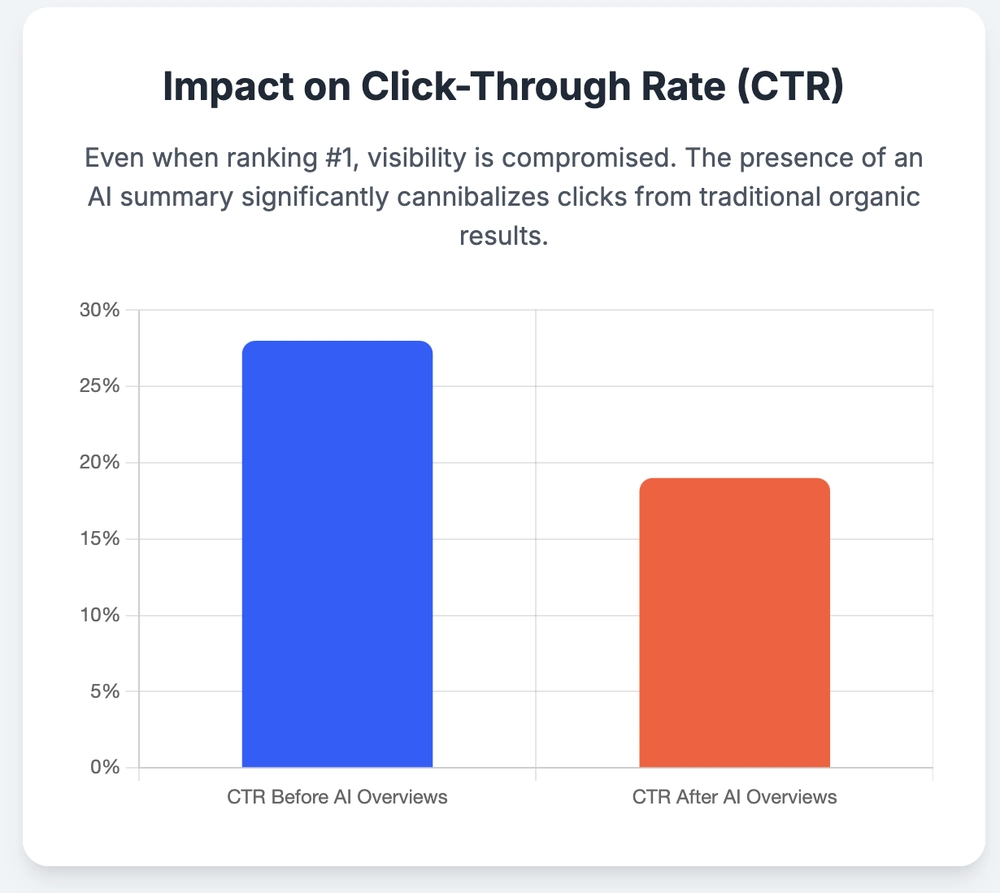
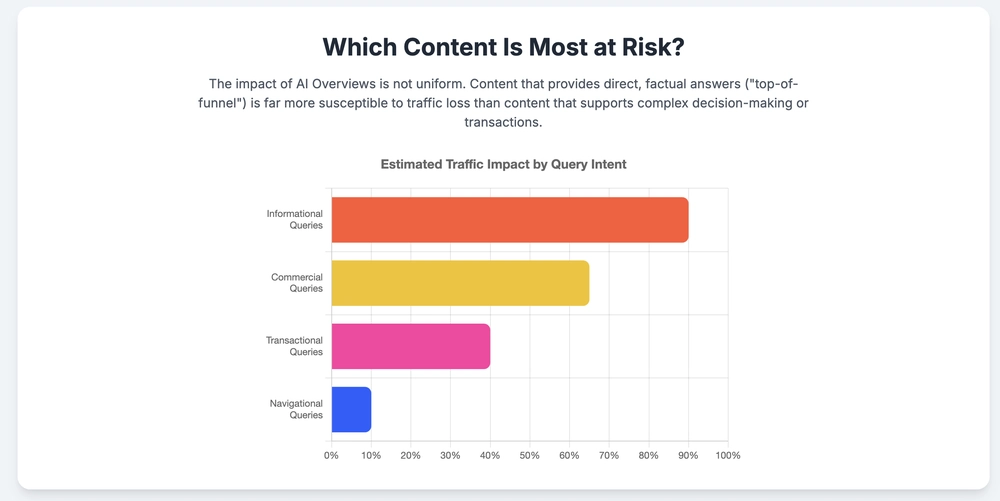
Empirical data from the initial rollouts confirms the immediate risks. Third-party studies report a demonstrable decline in organic click-through rates (CTRs) for pages that previously occupied top-ranking positions. For instance, a GrowthSRC Media analysis found that the CTR for Google’s top-ranking search result dropped by 32%, from 28% to 19%, following the expansion of AI Overviews.4 This trend is not uniform, as it disproportionately impacts informational, top-of-the-funnel content, while commercial and transactional queries are also showing increasing, though still limited, effects.5
Survival and long-term growth in this new environment require a fundamental strategic pivot. The new measure of success is not high-volume traffic but high-quality visibility and brand authority. The objective is to evolve from a website that simply receives a click to a trusted brand that is cited and endorsed by Google’s AI. This report provides a detailed analysis of the documented impact, supported by quantitative data, and offers a comprehensive, multi-faceted playbook for a strategic shift. It outlines how content creators can leverage core SEO principles, evolve their content strategy for AI readability, and diversify their digital presence to build a resilient, future-proof business model.
II. The New Search Landscape: Understanding Google’s Generative AI Evolution
The AI-Powered SERP and the Generative Snapshot
Google’s Search Generative Experience (SGE), now officially referred to as AI Overviews, is a pivotal development in search technology. AI Overviews are AI-powered summary boxes that appear at the top of the SERP for queries that Google’s systems determine are eligible for a summary.1 Powered by advanced large language models like PaLM 2 or Gemini, these AI-generated snapshots go beyond traditional keyword matching by understanding the full context and intent of a user’s query, especially for complex or multi-step questions.7
The key components of this new search feature include:
- Generative Snapshot: This is the primary element users see, which synthesizes key insights from multiple high-quality, credible sources on the web. It presents this information in a natural, conversational format, often using bulleted lists, step-by-step instructions, or concise definitions to make the information easy to digest.1
- Interactive Follow-ups: A hallmark of SGE is its conversational interface. Below the initial summary, the system offers related follow-up questions that users can tap to explore new directions without needing to rephrase their original query. This transforms search from a one-off transaction into a fluid dialogue, fostering a more intuitive search journey.7
- Source Attribution: To maintain trust and transparency, AI Overviews cite the web pages from which the information is drawn, often with direct links to the original sources.7 This is intended to promote content credibility and provide publishers with visibility.
The “Answer Engine” Paradigm
The fundamental change SGE introduces is a philosophical shift in Google’s purpose. For over two decades, Google operated as a “search engine,” providing a list of links—the “10 blue links”—that a user would click and sift through to find an answer.1 The user was tasked with doing the work of synthesizing information from multiple sources.
SGE re-imagines Google as an “answer engine”.2 Instead of providing a list of potential resources, it provides a direct, fully composed, and concise answer right at the top of the page.1 This new approach aims to provide more relevant details quickly, effectively cutting down the number of steps a user needs to find what they want.1 Google’s justification is that this creates a better user experience by saving time and effort, particularly for users who do not have the time or energy to click through multiple pages of search results.1
The most significant implication of this shift is the transition from a “link economy” to what can be described as a “citation economy.” In the traditional model, a click was the primary mechanism for transferring value from Google to a website. The entire SEO industry was built on optimizing for that click. With AI Overviews, a new layer of value is introduced: being cited as a source. This moves the competitive battleground from simply ranking at the top to becoming a quotable and authoritative source. A click is a transactional event, whereas a citation represents an endorsement of a brand’s authority and expertise. The long-term implication is that a website’s brand awareness and “mental availability”—the likelihood of being remembered when a user has a related need—become as, if not more, valuable than a single click.12 The core strategic challenge for blog owners is no longer just to capture traffic, but to become an entity that Google’s AI trusts and cites.
III. The Data-Driven Impact: Analyzing the Fallout from Initial Rollouts
The “Zero-Click” Reality and the CTR Collapse
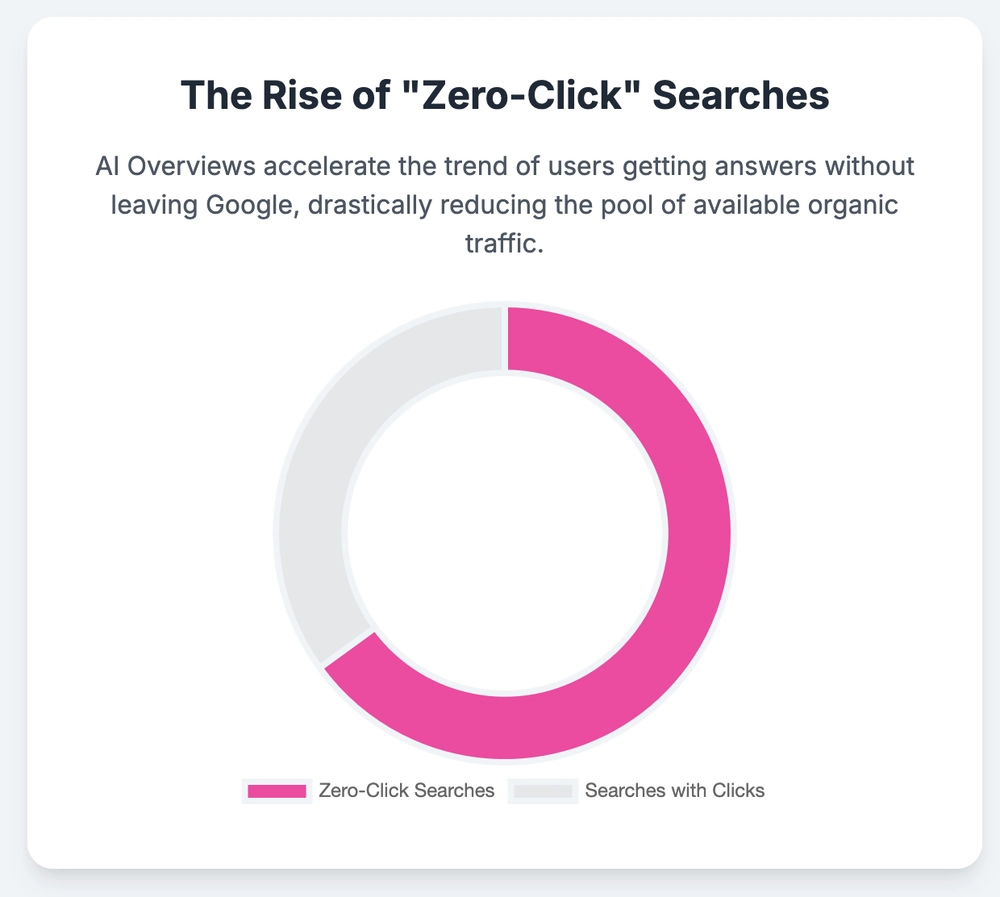
The rollout of AI Overviews, which began as an experimental feature and is now a standard element of the SERP, has significantly altered user behavior. AI Overviews are appearing with increasing frequency, with one study finding that they appeared in 42.5% of search results in Q4 2024, a notable increase from the previous quarter.14 By June 2025, that number had reportedly climbed to 57%.15 This expansion has contributed to a broader trend where a high percentage of searches end without a click-through to a website, with some estimates putting the zero-click rate as high as 69% in 2025.5
For top-ranking organic listings, the presence of an AI Overview has led to a documented decline in click-through rates. This is a critical point for blogs that have historically relied on top-of-the-SERP visibility. The data from various studies highlights this impact:
- Ahrefs analyzed 300,000 keywords and found that the CTR for the first-position organic result dropped by 34.5% when an AI Overview was present.16
- GrowthSRC Media found that the CTR for the top-ranking result declined by 32%, falling from 28% to 19% year-over-year. The second-ranking position experienced an even steeper drop of 39%, with CTRs falling from 20.83% to 12.60%.4
- A major publisher, MailOnline, reported that when an AI Overview was present, its CTRs dropped by 56.1% on desktop and 48.2% on mobile for keywords where it ranked number one.4
While these numbers are sobering, a nuanced view is essential. Another study reported minimal changes in top CTRs, arguing that links within AI Overviews still garner high clicks.17 This suggests that the decline may be more acute for websites that are not featured as a cited source, intensifying the “winner-take-all” dynamic.
Impact by Query Intent and Content Type
The impact of AI Overviews is not uniform across all content and query types. A detailed analysis reveals which content is most vulnerable and where the new opportunities lie.5
- Informational Queries: This is the content most at risk. AI Overviews are overwhelmingly triggered by informational queries, with an estimated 88.1% of queries that trigger a summary being informational in nature.6 This is because the AI is designed to satisfy these “Know” and “Do” intent queries, which are often the top-of-the-funnel content that small blogs use to attract a broad audience.2
- Commercial and Transactional Queries: While AI Overviews have historically appeared less frequently for these queries, their presence is growing.6 The AI may even treat a transactional query more like a commercial query, providing background information rather than a direct link to a store, which could disrupt the user’s journey at a critical point.2
- Branded Queries: This is a noteworthy outlier. Branded keywords are less likely to trigger an AI Overview, and when they do, a study found they can experience a significant CTR boost of up to 18.7%.5 This suggests that for users with strong brand familiarity, the AI overview may serve as a trusted endorsement.
The table below illustrates the varying impact on click-through rates based on query intent 5:
| Query Type | CTR Decline/Boost When AI Overview is Present |
| Informational | -20.0% |
| Commercial | -17.8% |
| Transactional | -15.2% |
| Branded | +18.7% |
Industry and Niche-Specific Effects
The impact is highly dependent on the vertical in which a blog operates. Industries with a high volume of informational content that is easily digestible are most vulnerable. This includes sectors like Science, Health, and People & Society, which have seen a large share growth in AI Overviews.6
The “Your Money, Your Life” (YMYL) industries—such as Finance, Law, and Insurance—initially had lower SGE coverage. This was likely due to the need for high-quality, authoritative information and the higher risk of “hallucinations” or inaccuracies in a summary that could have significant real-world consequences.19 However, even for these sectors, SGE coverage is growing over time, indicating a continuous expansion of the feature’s scope.21
The following table demonstrates the variation in AI Overview coverage across different industries:
| Industry | AI Overview Coverage Rate |
| Health | ~80% |
| Beauty | 94% |
| Finance | 47% |
| Insurance | 8.03% |
| News & Politics | 5.34% |
The paradox of the declining click-through rate is a central theme in this new landscape. While top-level organic CTRs are in a demonstrable decline, this does not necessarily signal a complete traffic apocalypse. One study found that clicks are shifting down the page, with positions 6 through 10 actually seeing a CTR increase of 30.63%.4 This indicates that some users are scrolling past the AI Overview to find the traditional organic results.
Furthermore, the traffic that does click through after seeing an AI Overview is likely to be of significantly higher quality and more likely to convert.10 This is because the AI has already satisfied the low-intent, exploratory searches, and the users who proceed to click are those with genuine interest or a commercial need. A Semrush report supports this view, finding that traffic referred by AI-assisted tools was 4.4 times more likely to convert than traditional search visitors.12 This re-evaluation of traffic quality means that a blog’s strategic focus should shift from raw traffic volume to conversion rates and revenue per visitor.
The intense competition for inclusion in the AI Overview creates a “zero-sum” game of citation. The AI overview typically synthesizes information from a small number of sources, usually 3 to 5.21 This creates an intensely competitive environment where the new battleground is not just for the #1 ranking but for inclusion in that limited set of cited sources. A blog that previously ranked #5 and received some traffic may now be completely invisible if a top-ranking competitor is cited in the AI Overview, as the user may never scroll down to see the traditional links. This is compounded by the fact that Google SGE uses a “new algorithm,” and a website’s traditional SERP ranking does not guarantee a spot as a cited source.21
IV. Strategic Implications: Shifting from Traffic to Value
A Threat to Traditional Monetization
The core business model for many small blogs relies on display advertising and affiliate marketing, both of which are directly tied to traffic and clicks. Display ad revenue is a function of pageviews, and affiliate revenue relies on users clicking through to a product or service page.23 If users are satisfied with the AI Overview, they will bypass the blog, its embedded ads, and its affiliate links, which poses a fundamental threat to the blog’s financial viability.24 This disruption of revenue streams is the primary concern for content creators. The value is created on the publisher’s site but is extracted and presented on Google’s platform, leading to a profound “monetization mismatch.” This is the systemic business model challenge that has led to an “existential crisis” for many publishers.3
The Case for Brand Authority
In an “answer engine” world, a blog’s brand visibility and authority become the primary currency. A core strategic objective is to build a brand with “mental availability,” so that even if a user doesn’t click a link from the search result, they remember the brand when it comes time to make a decision or seek further information.13 Being cited as a trusted source in an AI Overview helps build this brand recognition and credibility.26 This demonstrates to the user that the blog is an authoritative voice on a subject, which can lead to direct, typed-in traffic and branded queries in the future.
The Revaluation of Organic Traffic
The decline in raw organic traffic should not be mistaken for a complete loss of opportunity. As previously discussed, the traffic that remains is pre-qualified and more likely to convert.10 A strategic pivot involves shifting key performance indicators (KPIs) from raw traffic volume to more meaningful metrics such as conversion rates and brand mentions. This necessitates a change in how success is measured, focusing on the quality of visitors rather than the quantity.
V. The New SEO Playbook: Actionable Strategies for Survival and Growth
Foundation First: Mastering Core SEO Principles
Success in the AI-driven search landscape is not about abandoning traditional SEO but about mastering its foundational principles. Google’s AI models are built on existing ranking systems, making a solid SEO foundation a prerequisite for an effective SGE strategy.27
- Optimizing for E-E-A-T: Google’s AI favors content from authoritative sources. This requires a renewed and heavy emphasis on demonstrating Experience, Expertise, Authority, and Trustworthiness.12
- Tactical Steps: To demonstrate these qualities, blogs should add author bios with relevant credentials and professional experience, cite reputable sources and statistics, and showcase real-world experience and unique perspectives.19
- The Technical Core: Technical excellence remains a critical factor for AI readability.
- Structured Data (Schema): Use schema markup to provide AI models with clear context about your content. Essential schema types include $FAQPage$, $HowTo$, and $Article$, which make it easier for the AI to interpret and categorize content for summaries.15
- AI Readability: Focus on clear, concise language and logical content structure. Utilize headings (H1,H2,H3) in chronological order to create a clear outline for AI crawlers.30 Bulleted and numbered lists are highly effective, as they are easily parsed by AI models and appear in a significant percentage of AI Overviews.30
- Multimedia: AI Overviews are multi-modal and can understand more than just text. Blogs should create custom images, videos, and infographics with descriptive alt text to increase the chances of being featured in AI-powered results.19
Evolving Content Strategy for AI & Humans
The content itself must evolve from being keyword-focused to being topic-focused.
- Optimizing for Conversational Queries: The rise of AI search makes it more important than ever to optimize for long-tail, natural-language phrases that reflect how people actually speak and ask questions.28
- Structuring for AI Readability:
- Direct Answer Sections: Place a concise and direct answer to the primary query at the very top of the content, ideally under 50 words.31
- Semantic Chunking: Break down topics into clear, well-structured sub-sections that can be understood in isolation. The “inverted pyramid” writing style, which places the most important information at the beginning of each paragraph, is highly effective for AI systems.12
- Building Topical Authority with Content Clusters: To signal deep expertise to the AI, blogs should adopt a “content cluster” model. This involves creating a main “pillar” page for a broad topic and interlinking it to multiple, detailed sub-topic articles. This strategy demonstrates a comprehensive, in-depth understanding of a subject.28
Beyond the Blog: Diversifying Your Digital Presence
To mitigate the risk of over-reliance on Google, blogs must diversify their audience and presence.
- Owned Audience: Focus on building a direct audience through email lists and brand loyalty. This audience provides a channel of communication that is not dependent on search engine algorithms and fosters a more resilient business model.3
- Social and Other Platforms: Actively participate in relevant communities, such as subreddits and social media, to build a presence and drive qualified traffic that is less susceptible to Google’s changes.5
Ultimately, the most effective strategies for ranking in AI Overviews—focusing on clear structure, natural language, and E-E-A-T—are also the best practices for creating high-quality, genuinely helpful content for human readers.15 This reframes the entire challenge from a purely technical one to a strategic, human-centric one.
VI. Conclusion: The Future is Not a Crisis, but an Opportunity
The traditional search ecosystem that small and medium-sized blogs have relied on for years is irrevocably changed. The documented decline in organic traffic for informational content is a direct result of Google’s new mission to become an “answer engine.” However, this shift is not an existential threat but an opportunity for adaptation and differentiation. The new KPIs for success are brand visibility, authority, and conversion rates, not just raw traffic volume.
For blog owners, the path forward is clear. It requires a strategic pivot that moves beyond a single-minded focus on clicks. By doubling down on authentic expertise, creating genuinely helpful and well-structured content that is both human-first and AI-friendly, and actively building a brand that users trust beyond the search bar, blog owners can not only survive but thrive. The ultimate competitive advantage in the age of the “answer engine” will not be the ability to game an algorithm but the capacity to be the most trusted and authoritative voice in a niche. The landscape is still in a state of continuous evolution, and staying agile and adaptable to future AI advancements will be the only constant.
FAQ
Google’s “AI Mode” refers to its Search Generative Experience (SGE) feature, which generates “AI Overviews” at the top of the search results page. This shifts Google’s purpose from a traditional “10 blue links” search engine to an “answer engine,” aiming to satisfy user queries directly on the page without requiring a click to an external website.
While it may not eliminate it entirely, data shows a significant impact. Third-party studies report a demonstrable decline in organic click-through rates (CTRs) for top-ranking pages, with one analysis finding a drop of up to 32%. This leads to an increase in “zero-click” searches, particularly for informational content.
No. The impact is not uniform. The decline in traffic disproportionately affects informational, top-of-the-funnel content. While commercial and transactional queries are also showing effects, they are generally less impacted at this time.
This concept describes the new reality of SEO. The traditional goal was to get a high volume of clicks. Now, the new measure of success is being visible and cited as an authoritative source within the AI Overview itself. The objective is to become a trusted brand that Google’s AI endorses, not just a link that receives a click.
Survival requires a strategic pivot. Key strategies include:
Creating “AI-readable” content using clear headings, structured data, and bullet points.
Building strong E-E-A-T (Experience, Expertise, Authoritativeness, and Trustworthiness) to be seen as a credible source.
Diversifying traffic sources by focusing on email list building and social media to reduce reliance on Google.
Works cited
- Google SGE: What is it and How Does it Work? – Abstrakt Marketing Group, accessed September 9, 2025, https://www.abstraktmg.com/what-is-google-sge/
- Search Intents & Generative AI – Matthew Edgar, accessed September 9, 2025, https://www.matthewedgar.net/ai-overview-search-intents/
- ‘Existential crisis’: how Google’s shift to AI has upended the online …, accessed September 9, 2025, https://www.theguardian.com/media/2025/sep/06/existential-crisis-google-use-ai-search-upended-web-publishers-models
- Google CTRs Drop 32% For Top Result After AI Overview Rollout, accessed September 9, 2025, https://www.searchenginejournal.com/google-ctrs-drop-32-for-top-result-after-ai-overview-rollout/551730/
- AI search is killing organic traffic – how are you adapting your brand strategy? – Reddit, accessed September 9, 2025, https://www.reddit.com/r/GrowthHacking/comments/1mgf65b/ai_search_is_killing_organic_traffic_how_are_you/
- Semrush Report: AI Overviews’ Impact on Search in 2025, accessed September 9, 2025, https://www.semrush.com/blog/semrush-ai-overviews-study/
- Google SGE: What is Search Generative Experience? – WSI Digital Marketing, accessed September 9, 2025, https://www.wsiworld.com/blog/what-is-sge-search-generative-experience-and-how-can-it-impact-your-business
- en.wikipedia.org, accessed September 9, 2025, https://en.wikipedia.org/wiki/AI_Overviews
- Search Generative Experience (SGE) – What Is It & How to Prepare for It – Innovation Visual, accessed September 9, 2025, https://www.innovationvisual.com/resources-2025/search-generative-experience-sge-what-is-it-how-to-prepare
- What is Search Generative Experience and How Will it Affect Google Search? – Figment Agency, accessed September 9, 2025, https://www.figmentagency.com/what-is-search-generative-experience-and-how-will-it-affect-google-search/
- Google Search Generative Experience (SGE) & SEO – Vital Design, accessed September 9, 2025, https://vitaldesign.com/google-search-generative-experience-seo/
- New AI Search Updates Redefine Website Infrastructure Focuses …, accessed September 9, 2025, https://digimatiq.com/new-ai-search-updates-redefine-website-infrastructure-focuses-future-proof-your-online-visibility-in-the-age-of-generative-search/
- Why Informational Content Still Matters in the AI Search Era – Advanced Web Ranking, accessed September 9, 2025, https://www.advancedwebranking.com/blog/informational-content-still-matters-in-ai-search-era
- Google CTR Study: AI Overviews Rise As Click Rates Decline – Search Engine Journal, accessed September 9, 2025, https://www.searchenginejournal.com/google-ctr-study-ai-overviews-rise-as-click-rates-decline/541465/
- How to Rank in AI Search Results: 9 Effective Strategies – Xponent21, accessed September 9, 2025, https://xponent21.com/insights/optimize-content-rank-in-ai-search-results/
- Google AI Overviews: The Hidden Impact on Click-Through Rates …, accessed September 9, 2025, https://www.adaptworldwide.com/insights/google-ai-overviews-the-hidden-impact-on-click-through-rates
- Google Click-Through Rates (CTRs) by Ranking Position in 2025 – First Page Sage, accessed September 9, 2025, https://firstpagesage.com/reports/google-click-through-rates-ctrs-by-ranking-position/
- Google SGE & SaaS Blog Traffic: What You Need to Know [2025] – The Rank Masters, accessed September 9, 2025, https://www.therankmasters.com/blog/google-sge-saas-blog-traffic-impact
- How Does SGE Affect SEO? (And How to Counter AI Overviews), accessed September 9, 2025, https://www.seo.com/blog/how-does-sge-affect-seo/
- SGE Snippet Research: We Analyzed 100K Keywords … – SE Ranking, accessed September 9, 2025, https://seranking.com/blog/sge-research/
- Google SGE Organic Traffic Impact Divided By Verticals [Data Study], accessed September 9, 2025, https://www.searchenginejournal.com/google-sge-organic-traffic-impact-divided-by-verticals/514800/
- Google SGE: How to Make the Best of AI Overviews – Mailchimp, accessed September 9, 2025, https://mailchimp.com/resources/google-sge-ai-overviews/
- Decoding SGE: Its Role and Impact on Click-Through Rates – Good & Gold, accessed September 9, 2025, https://www.goodandgold.com/post/decoding-sge-its-role-and-impact-on-click-through-rates
- 3 Ways Google’s AI Overview Transforms Product Review Sites, accessed September 9, 2025, https://impact.com/affiliate/googles-new-ai-overview-feature-can-affect-product-review-sites/
- Google’s Search Generative Experience (SGE): How it affects PPC – Lunio, accessed September 9, 2025, https://www.lunio.ai/blog/google-search-generative-experience-ppc
- The future of search: What is SGE? – LoudLocal, accessed September 9, 2025, https://www.loudlocal.co.uk/knowledge-hub-and-blog/generativeai
- How to Build an Effective SGE Strategy for Google’s AI Overviews – SEO.com, accessed September 9, 2025, https://www.seo.com/blog/google-sge-strategy/
- How to Rank in AI Overviews: Actionable Tips That Work, accessed September 9, 2025, https://rankmath.com/blog/ranking-in-ai-overviews/
- What Is Google SGE & What Impact Does It Make On SEO – Nvent Marketing, accessed September 9, 2025, https://nventmarketing.com/what-is-google-sge-what-impact-does-it-make-on-seo/
- Six Generative AI Optimization Tips From Our … – Blue Compass, accessed September 9, 2025, https://www.bluecompass.com/blog/best-practices-to-optimize-your-website-for-googles-sge
- How to Rank in AI Overviews – TheeDigital, accessed September 9, 2025, https://www.theedigital.com/blog/how-to-rank-in-ai-overviews
- AI Search Content Optimization: The Complete Guide (2025) – Beeby Clark+Meyler, accessed September 9, 2025, https://www.beebyclarkmeyler.com/what-we-think/guide-to-content-optimzation-for-ai-search
- SGE and the impact on SEO: What you should know! – Contentoo, accessed September 9, 2025, https://www.contentoo.com/blog/sge-and-the-impact-on-seo-what-you-should-know
- Adapt Your SEO Strategy for Google SGE: Simple Tips for 2024 – Boost Media Group, accessed September 9, 2025, https://boostmediagroup.com/the-future-of-seo-preparing-your-business-for-search-generative-experience-sge/
- Long-Term Growth in the AI Era: Why Content Marketing Outlasts Ads and Social Media, accessed September 9, 2025, https://stupiddope.com/2025/09/long-term-growth-in-the-ai-era-why-content-marketing-outlasts-ads-and-social-media/
 Is Stewart Butterfield a Billionaire?
 Bridging the Digital Divide: Empowering Businesses With Cutting-Edge Tech Insights
 Maximizing Value in CS2 Skin Trading
 Insights and Innovations: Oil Trading in a Crypto Era
 The Power of Positive Reviews: Maximizing the Benefits for Your Business
 The power of a customized domain name for a business
 The Essential Role of Document Translation in a Globalized World
 Crafting an Effective Knowledge Base Content Strategy for Your Business
 Why Are Investors So Interested in Social Casino Startups? A 2025 Market Guide
 Google Gambling SEO 2025: YMYL/E-E-A-T, Indexing & Compliance for US/UK iGaming
 Why Customer Psychology Responds Strongly To Rewards
 What is GEO? The Ultimate Guide to Generative Engine Optimization vs. SEO