
Parlay Calculator
Our free parlay calculator makes it easy to determine your potential payout in seconds. Just enter the betting odds for each leg of your parlay to instantly see your total winnings:
Parlay Calculator
Calculate your potential payout from a parlay bet.
Your Parlay
Total Odds
0.00
Potential Payout
$0.00
Message
The Parlay Paradox: An In-Depth Analysis of Wager Mechanics, Strategic Value, and Long-Term Profitability
The Foundational Framework of Parlay Betting
Defining the Parlay: A Single Wager, Multiple Outcomes
A parlay, also known as an accumulator, combo bet, or multi, is a singular wager that links together two or more individual wagers into one unified ticket.1 This betting vehicle stands in stark contrast to placing a series of individual bets, as its fundamental structure consolidates risk and reward into a single outcome. The individual wagers that constitute a parlay are referred to as “legs” or “selections”.1
The central and most crucial rule governing parlay betting is its all-or-nothing nature. For a parlay to be deemed successful and for a bettor to receive a payout, every single leg included on the ticket must win.3 If even one of the selections results in a loss, the entire bet is lost, and the original stake is forfeited, regardless of the outcomes of the other legs.1 This stringent requirement is the very mechanism that makes the bet so challenging to win but also so appealing from a payout perspective. This dual-edged nature of the “all-or-nothing” rule is the source of the bet’s excitement and its statistical danger. The compounded risk to the bettor is directly correlated with the compounding advantage for the bookmaker, a financial reality that will be explored in greater detail in a subsequent section.
The primary allure of parlay betting is the prospect of a substantially larger payout compared to wagering on each selection individually.3 This is achieved through the compounding of odds across each leg, a mathematical process that can transform a modest stake into a considerable sum.4 This high-risk, high-reward proposition allows bettors to “bet a little, win a lot” 6, creating a powerful psychological draw.

The Anatomy of a Parlay Bet
A parlay bet requires a minimum of two legs to be considered a parlay wager.6 There is no theoretical upper limit to the number of legs a bettor can add, with some sportsbooks allowing parlays with 20 or more selections.9 The naming convention for a parlay ticket is straightforward, with a three-leg parlay referred to as a “3-Bet parlay,” and a twelve-leg parlay as a “12-Bet parlay,” and so on.6
A defining characteristic of the modern parlay is the diversity of selections that can be combined. A bettor is not restricted to a single type of wager; they can mix and match various bet types, including moneylines, point spreads, totals (Over/Under), props, and futures.1 Furthermore, the legs do not need to be confined to a single game or even a single sport.3 This versatility allows bettors to create a bespoke ticket based on their knowledge of different leagues, which can be particularly popular on days with a full slate of games, such as an NFL Sunday.3 While the bettor controls the selections on the ticket, the odds themselves are automatically generated by the sportsbook.6 This process, which calculates the cumulative odds based on the selections, is where the sportsbook’s built-in advantage is covertly applied, as the system ensures that the compounding house edge is baked into the final payout regardless of the bettor’s perceived strategic choices.
In the event that one of the legs in a parlay results in a “push,” or a tie, that selection is simply removed from the parlay ticket.2 The parlay remains active, but the odds and potential payout are recalculated as if the pushed leg was never included.6 This adjustment reduces the potential winnings but keeps the bet alive, a critical difference from a losing leg which would result in the immediate loss of the entire wager.
The Psychological and Financial Appeal
Parlay betting has surged in popularity among both casual and serious bettors, largely because it offers the tantalizing chance to turn a small wager into a big payday.6 This financial appeal is rooted in the high-risk, high-reward nature of the bet.5 The multiplication of odds across multiple outcomes offers a significantly higher payout than placing each wager separately.4 For a bettor who enjoys the thrill of a longshot, the parlay provides an unparalleled level of excitement.
Beyond the financial motivation, parlays also provide an added layer of psychological engagement and excitement.3 By placing a parlay, a bettor becomes invested in the outcomes of multiple games or events at once, which can make a day of watching sports far more engaging.3 This form of enhanced entertainment is a key driver of the wager’s popularity, particularly during major sporting events like the Super Bowl or the NCAA Tournament.3 The perception of control over one’s own selections, combined with the dream of a life-changing payout, creates a powerful feedback loop that drives the widespread adoption of this betting format.
The Mathematics of Parlay Payouts
Manual Payout Calculation: The Compounding Principle
The calculation of a parlay payout is based on a straightforward, yet deceptive, compounding principle.12 To determine the potential winnings, the odds of each individual leg are multiplied together. This combined odds value is then multiplied by the original stake amount to yield the total payout.12 This process is deceptively simple, as it masks the compounding statistical disadvantage that is built into the odds of each selection.
Before multiplication can occur, all odds formats must be converted to their decimal equivalent. The conversion formulas are as follows:
- Positive American Odds: Decimal Odds = 1 + (American Odds / 100).4 For example, a bet with +300 odds would have a decimal equivalent of
1+(300/100)=4.0. - Negative American Odds: Decimal Odds = 1 + (100 / |American Odds|).4 For example, a bet with -110 odds would have a decimal equivalent of
1+(100/110)≈1.91. - Fractional Odds: Decimal Odds = (Numerator / Denominator) + 1.13 For example, a bet with 6/5 odds would have a decimal equivalent of
(6/5)+1=2.2.
Let us consider a three-leg parlay with a $100 stake, with the following odds:
- Leg 1: Golden State Warriors at -110 odds
- Leg 2: Chicago Bulls at +145 odds
- Leg 3: Houston Rockets at +200 odds
First, the odds must be converted to decimals:
- Leg 1: 1+(100/110)≈1.91
- Leg 2: 1+(145/100)=2.45
- Leg 3: 1+(200/100)=3.00
Next, the decimal odds are multiplied together:
- Combined Odds = 1.91×2.45×3.00≈14.04
Finally, the total payout is calculated by multiplying the combined odds by the stake:
- Total Payout = 14.04×$100=$1,404
The simplicity of this calculation is a powerful psychological tool that distracts from a critical fact: the multiplication of odds also multiplies the sportsbook’s inherent advantage, or “vig,” on each leg. This compounding disadvantage is a central component of the financial model that makes parlays so lucrative for sportsbooks.
The Modern Necessity: Parlay Calculators
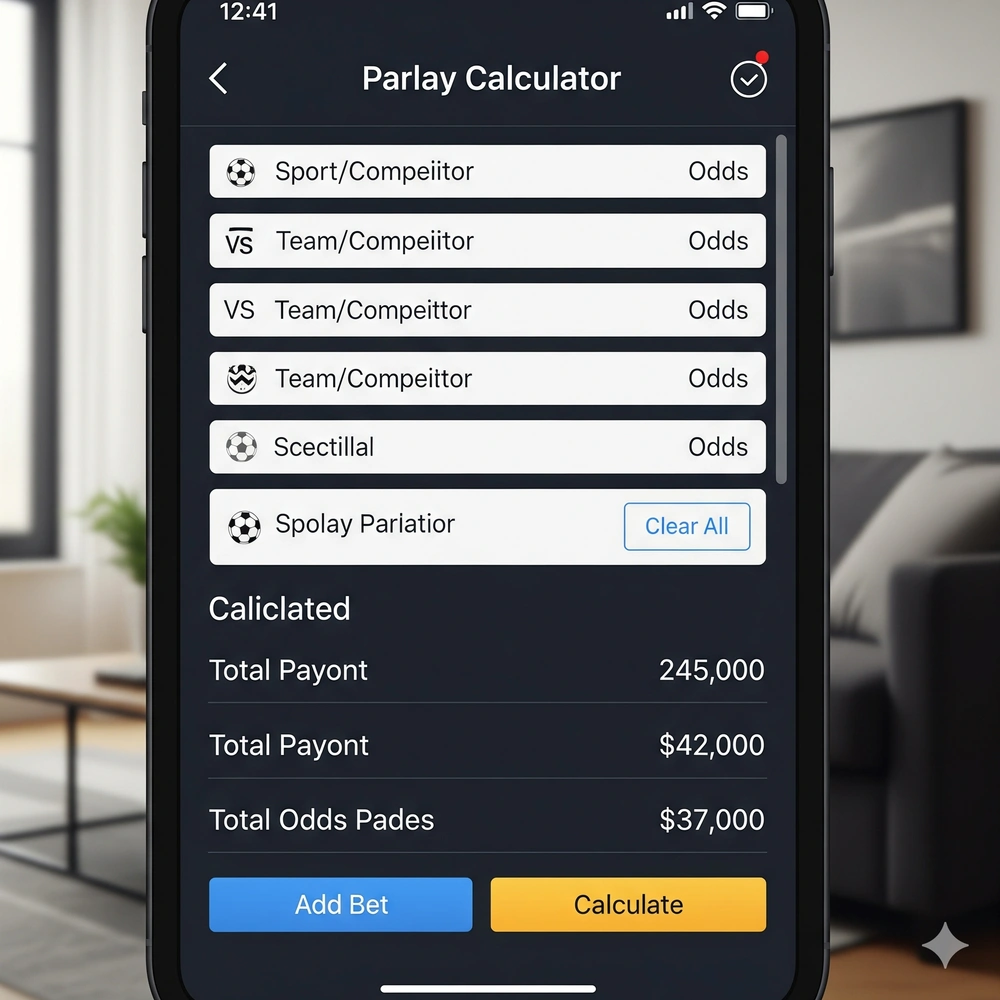
The process of manual calculation, while straightforward, can be time-consuming and prone to human error. To address this, free online parlay calculators have become an essential tool for bettors.9 These tools automate the entire process, instantly combining the individual odds of each leg to calculate the total parlay odds, potential payout, and net profit.9
The primary advantages of using a parlay calculator are efficiency and accuracy. A bettor can rapidly test various combinations of bets and stakes to see how the odds and potential payouts are affected.9 This provides immediate feedback and allows for quick comparison of different betting strategies without the need for manual conversions and calculations.9 It also significantly minimizes the risk of mathematical mistakes that could lead to an incorrect assessment of the potential payout. However, it is worth noting that a disclaimer often accompanies these tools, as final payouts may vary slightly due to minor rounding differences or the specific methodologies employed by individual sportsbooks.13 The calculator serves as a reliable guide for evaluation, but the final odds are determined by the sportsbook itself.
Parlay Payouts by Number of Legs
This table illustrates the theoretical payout for a parlay with a $100 stake, with all legs priced at standard -110 odds (or 1.91 in decimal format).
| Number of Legs | American Odds | Total Payout on $100 Stake |
| 2 | +264 | $364.46 |
| 3 | +596 | $695.79 |
| 4 | +1228 | $1,328.60 |
| 5 | +2436 | $2,536.00 |
| 6 | +4742 | $4,842.00 |
| 7 | +9145 | $9,245.00 |
| 8 | +17534 | $17,634.00 |
Note: Payouts may vary slightly due to rounding.
A Typology of Parlay Structures
Parlay betting extends beyond the traditional multi-game, multi-sport format. Sportsbooks have introduced a variety of parlay types that cater to different risk profiles and betting strategies, each with its own set of rules and considerations. This diversification of the product line serves a strategic business purpose: it gives the illusion of catering to different types of bettors while still leveraging the high-margin nature of the parlay wager.
Same-Game Parlays (SGPs)
A same-game parlay (SGP) is a distinct type of parlay where every leg of the bet is selected from a single game or contest.3 For instance, a bettor might combine a moneyline wager, the Over/Under point total, and a specific player prop, all from the same game.4 SGPs have become increasingly popular, especially during high-profile events like the Super Bowl or NBA Finals.4
Within the realm of SGPs, a crucial distinction exists between correlated and uncorrelated legs. Correlated legs are those where the outcome of one bet directly influences the probability of another.4 For example, betting on a quarterback to exceed a high passing yards total and a key wide receiver to exceed their receiving yards total in the same game are correlated outcomes.4 Because the success of one leg makes the success of the other more likely, sportsbooks are acutely aware of the risk this poses to their financial model. Consequently, they may limit the ability to place such bets or offer significantly reduced odds to account for the correlation.10 In contrast, uncorrelated legs are those where the outcomes are independent of each other.4 An example would be parlaying a team’s win with the coin toss outcome or the time of the first score. These types of SGPs are more likely to have odds that are similar to a standard parlay, as the outcomes do not directly affect one another.4
Teaser Parlays
A teaser parlay, or simply a “teaser,” is a unique type of parlay that allows the bettor to adjust the point spreads of a game in their favor in exchange for reduced odds.10 This means a bettor can “buy” points to make their selections more likely to win. For example, a bettor could change a -7 point spread to a -1 point spread. The trade-off is that they must include a minimum number of selections in their teaser and accept a lower potential payout.10 While a teaser might seem to reduce the risk by offering a more favorable spread, the reduced odds often mean the mathematical disadvantage is still present, albeit in a different form.
Round Robin Bets
A round robin is not a single parlay but rather a group of smaller, interconnected parlays created from a larger set of selections.6 For instance, if a bettor selects four teams, they could structure a round robin that creates all possible two-team parlays from those four selections. The key advantage of a round robin is that it mitigates the all-or-nothing risk of a traditional parlay. The bettor can still receive a payout even if one or more of their original selections lose, as long as the remaining teams form at least one successful smaller parlay.6 This structure offers a middle ground between the full risk of a traditional parlay and the lower reward of placing individual bets.
Advanced Parlay Betting Strategies
For the sophisticated bettor, parlays are not merely a vehicle for entertainment or chasing longshots. They can, in rare instances, be used as a strategic tool to capitalize on market inefficiencies and capitalize on a genuine statistical edge. These advanced strategies are a constant cat-and-mouse game between professional bettors and bookmakers, as sportsbooks actively work to eliminate or price out such opportunities.
The Correlated Parlay: A “Virtual Goldmine”
The most profitable and sought-after parlay strategy is the correlated parlay.14 This strategy involves combining wagers where the outcome of one bet is directly or logically linked to the outcome of another.14 A successful outcome on one leg makes the success of the other legs highly probable, creating a powerful statistical advantage for the bettor.14
Classic examples of correlated parlays include:
- Football Blowout: Betting on a team to cover a massive point spread (e.g., -23) and also taking the “over” on the game total.14 The rationale is that for a team to win by such a large margin, they must score a significant number of points, which would naturally drive the total score over the set number.
- Hockey Domination: Wagering on a hockey team to win by a margin of at least two goals (a -1.5 puck line) and also betting the “over”.14 If a team scores enough to win by two or more goals, it is highly likely that the game’s total score will exceed the set number.
This strategy has been referred to as the “holy grail” of sports betting because, if a sportsbook allows them, they are a “virtual goldmine”.14 However, sportsbooks are well aware of these correlated outcomes and have largely restricted or priced them out of existence.10 The odds on any correlated parlay that a book does offer are significantly reduced to account for the increased probability of success, effectively eliminating the bettor’s advantage.10
Capitalizing on Weak Lines
Another theoretical strategy involves using parlays to increase exposure to a “weak” or mispriced line.14 A weak line occurs when a sportsbook’s odds are significantly different from the market consensus. For example, if the broader market has a team as a -5 point favorite, but a specific book posts them as a -7 point favorite, the Kansas City +7 bet becomes a massive opportunity.14
A savvy bettor would ideally place the maximum possible wager on the weak line as a straight bet. However, if the funds or risk tolerance are limited, a parlay can be used to leverage the edge from the weak line by combining it with another bet.14 The statistical advantage gained from the mispriced line is intended to more than compensate for the house edge that is normally present in a parlay, turning an otherwise unfavorable wager into a profitable one.14 While less common with online sportsbooks due to their sophisticated algorithms, this strategy demonstrates that parlays are not always a “sucker bet” and can, in theory, be a tool for a mathematically-inclined bettor.
Betting on Favorites vs. Underdogs
Two of the most popular parlay strategies among casual bettors involve selecting either heavy favorites or underdogs. A parlay built exclusively with heavy favorites (e.g., -150 to -350 odds) aims for a “consistent, modest return” by stacking high-probability outcomes.16 Historical data supports this, showing that NFL favorites, particularly those with odds of -115 or shorter, win at a high rate (66.6% over a six-season period).16 The intent is to increase the payout by bundling several likely winners together, though the payout will be much smaller than a longshot parlay.
Conversely, a parlay composed of underdogs offers the “largest possible payouts”.16 By combining selections with high odds (e.g., +200, +300), a bettor can achieve a massive potential return.16 While the probability of success is extremely low, the high payouts mean that hitting just one large underdog parlay can offset multiple losses and result in an overall profit.16 This strategy is often employed by bettors who enjoy the high-risk, high-reward nature of the bet and understand they are placing a series of longshots with the hope of a single, transformative win.
The Financial Reality: True Odds, House Edge, and Expected Value
The Fundamental Discrepancy: Parlay vs. True Odds
The most critical aspect of parlay betting for an informed bettor to understand is the significant discrepancy between the odds provided by the sportsbook and the true mathematical odds of a parlay winning.2 Parlay odds are presented as a tantalizingly high number, but they are consistently “below the ‘true’ odds”.2 This is the core of the financial reality of the wager.
To illustrate, consider a two-team parlay where each leg has a 50% chance of winning, a situation common with point spreads at -110 odds. The true probability of both selections winning is 0.5×0.5=0.25, or 25%. The true odds of this outcome should be 3:1 (or +300), meaning a $100 wager should return $400.2 However, a sportsbook will typically only pay out at 2.64:1 (or +264), resulting in a $364 payout on a $100 bet.2 This difference between what the payout should be and what the bookmaker offers is where the house edge is found and how they generate immense profit.
The Compounding House Edge (The “Vig” Problem)
The discrepancy between true odds and sportsbook odds is not a static number; it escalates dramatically with each leg added to the parlay.8 This is because the house edge, or “vig,” from each individual bet is multiplied, compounding the statistical disadvantage for the bettor.8 For a single bet at standard -110 odds, the house edge is approximately 4.54%.8
However, the house edge on a parlay grows at an exponential rate, transforming the bet from a small disadvantage to a significant one. The following table, compiled from market data, illustrates this compounding effect:
True Odds vs. Sportsbook Odds & Compounding House Edge
This table compares the true odds of winning a parlay with each leg at -110 against the odds typically offered by a sportsbook, highlighting the increasing house edge.
| Number of Legs (at -110) | True Odds (50% per leg) | Sportsbook Odds (Payout) | House Edge |
| 2 | +300 | +264 | 8.88% |
| 3 | +700 | +596 | 13.02% |
| 4 | +1500 | +1228 | 16.97% |
| 5 | +3100 | +2436 | 21.88% |
| 6 | +6500 | +4742 | 25.00% |
| 7 | +12900 | +9145 | 29.58% |
| 8 | +25700 | +17534 | 31.07% |
Data adapted from market reports.8
From a financial perspective, a parlay is not a simple transaction; it is an unfavorable financial instrument. The house is not merely taking a commission; it is compounding its advantage against the bettor in a way that is financially destructive over the long run. The high potential payout is the “principal,” and the escalating, compounded house edge is the “interest” paid to the bookmaker, making it a “reverse interest loan” for the bettor.
The Illusion of Near Misses
One of the most powerful psychological tools employed by sportsbooks is the emotional trap of the “near miss”.7 Bettors often fall into the mindset of being “just one game away from winning that parlay”.7 This narrative, which is heavily promoted by advertising campaigns, creates an illusion of being close to a major win, encouraging repeat wagering even when the mathematical reality is starkly different.7 The following table, based on the same -110 odds per leg, illustrates how dramatically the probability of winning decreases as more legs are added.
Parlay Win Probability vs. Number of Legs
This table demonstrates the rapid decline in the probability of a parlay winning as more legs are added, with each leg assumed to have an implied probability of 50%.
| Number of Legs (at -110) | Implied Probability of Winning Parlay |
| 2 | 25.0% |
| 3 | 12.5% |
| 4 | 6.3% |
| 5 | 3.1% |
| 6 | 1.6% |
| 7 | 0.8% |
| 8 | 0.4% |
Data adapted from market reports.7
The stark contrast between the high probability of losing and the low probability of winning is hidden behind the emotional thrill of the near miss, which serves as a powerful psychological reinforcement for the bettor and a profitable mechanism for the bookmaker.
Situational Profitability
While parlays are, for the most part, mathematically unfavorable, there are rare exceptions where a parlay can make financial sense. According to some analyses, a parlay may be considered a viable option if a bettor has a significant statistical advantage on each individual leg, such as a “legitimate 4-5% lean to one side of the implied probability”.7 In such a scenario, the bettor’s edge is so large that it can overcome the compounded house vig.7 Another instance where a parlay can be favorable is when a sportsbook offers a significant odds booster (e.g., a 2x odds booster) that temporarily mitigates the house’s advantage.7
A select few platforms, such as those operating on a peer-to-peer, “zero-vig” model, also offer a theoretical path to a more favorable parlay.8 By eliminating the house’s margin, these platforms allow a user to calculate and potentially build a parlay with a lower overall house edge than what is typically offered by traditional sportsbooks, though native parlay betting may not be offered.8 This highlights that the fundamental problem with parlays is not the concept itself, but how traditional sportsbooks price them to maximize their own profitability.
Market Dynamics: How Bookmakers Profit from Parlays
The Parlay as a Revenue Engine
Despite their mathematical unprofitability for the bettor, parlays are an incredibly popular and highly effective revenue driver for sportsbooks.17 Market data provides a clear picture of this reality. In one month, parlays accounted for a staggering 72.5% of sportsbook gross revenue.8 The hold rate on parlays is astronomically higher than on other types of wagers. In New Jersey, the house win rate on parlays was 16%, nearly triple the 5.3% rate for all other sporting events.17 Data from other states, such as Louisiana, shows that parlays are responsible for nearly half of all sports betting revenue.17 This compelling data makes it clear that the parlay is the primary driver of profitability for the modern sports betting industry.
Marketing and Psychological Engineering
The immense profitability of parlays for the sportsbooks is no accident; it is the direct result of a strategic feedback loop. The mathematical unprofitability of the parlay for the bettor is precisely what makes it so lucrative for the sportsbook. This high margin allows betting companies to spend massive amounts on aggressive marketing campaigns featuring A-list celebrities, which in turn draws more casual bettors to this highly profitable product.17 The advertising is often designed to create a sense of “Fear of Missing Out” (FoMO), with messaging that implies the customer “has already made a parlay on this game”.17
This sophisticated psychological engineering focuses on the emotional appeal of the high payout and the thrill of the wager, while simultaneously obscuring the underlying statistical reality. The gambler’s fallacy of being “one game away” from a big win is actively exploited to encourage continued, unprofitable betting.7 This model reveals a fundamental disconnect between the perception of the parlay as a fun, accessible bet and its reality as a financially engineered instrument designed for maximum house profitability.
Recommendations for the Informed Bettor
Based on the quantitative and strategic analysis of parlay betting, a series of conclusions and actionable recommendations can be made for the informed bettor.
The central paradox of the parlay is that it is both an incredibly exciting and an overwhelmingly unfavorable wager. The promise of massive payouts is real, but the statistical probability of success is low, and the financial cost in the form of a compounding house edge is substantial. For this reason, a parlay should be viewed not as a primary strategy for long-term profit, but rather as a form of entertainment with a known, quantifiable cost.
To engage with parlays in a mindful and disciplined way, a bettor can adhere to the following guidelines:
- Mindful Risk-Taking: A bettor should stick to parlays with a limited number of legs, ideally two or three.8 This approach offers a better balance between the potential for a larger payout and a more manageable level of risk. As the data shows, the house edge increases dramatically with each added leg, making larger parlays increasingly difficult to win and financially disadvantageous.
- Utilize Tools for Due Diligence: The availability of free parlay calculators should be leveraged as an essential tool.8 Before placing any parlay bet, a bettor should use a calculator to evaluate the combined odds, the implied probability of winning, and the potential payout.8 This practice introduces a data-driven layer to the decision-making process, moving it from one based on emotion to one based on numbers.
- Focus on High-Value Opportunities: The only truly profitable parlay strategies are those that exploit market inefficiencies or correlations that the sportsbook has failed to account for.14 A bettor who can identify a weak line or a legitimate statistical edge on each individual leg of a parlay is in a rare position to turn the bet into a profitable endeavor.5 These opportunities are rare and difficult to find, but they are the only scenarios in which the parlay overcomes its inherent financial disadvantage.
Leo Falsafi is a digital marketing veteran and senior journalist at Virlan.co, where he covers the intersection of digital marketing, gaming, and breaking US trending news. With nearly two decades of hands-on experience in SEO and digital strategy, Leo has consulted for and scaled hundreds of companies. His deep industry roots allow him to deliver sharp, fact-checked insights and analysis on the trends shaping today's digital landscape.