
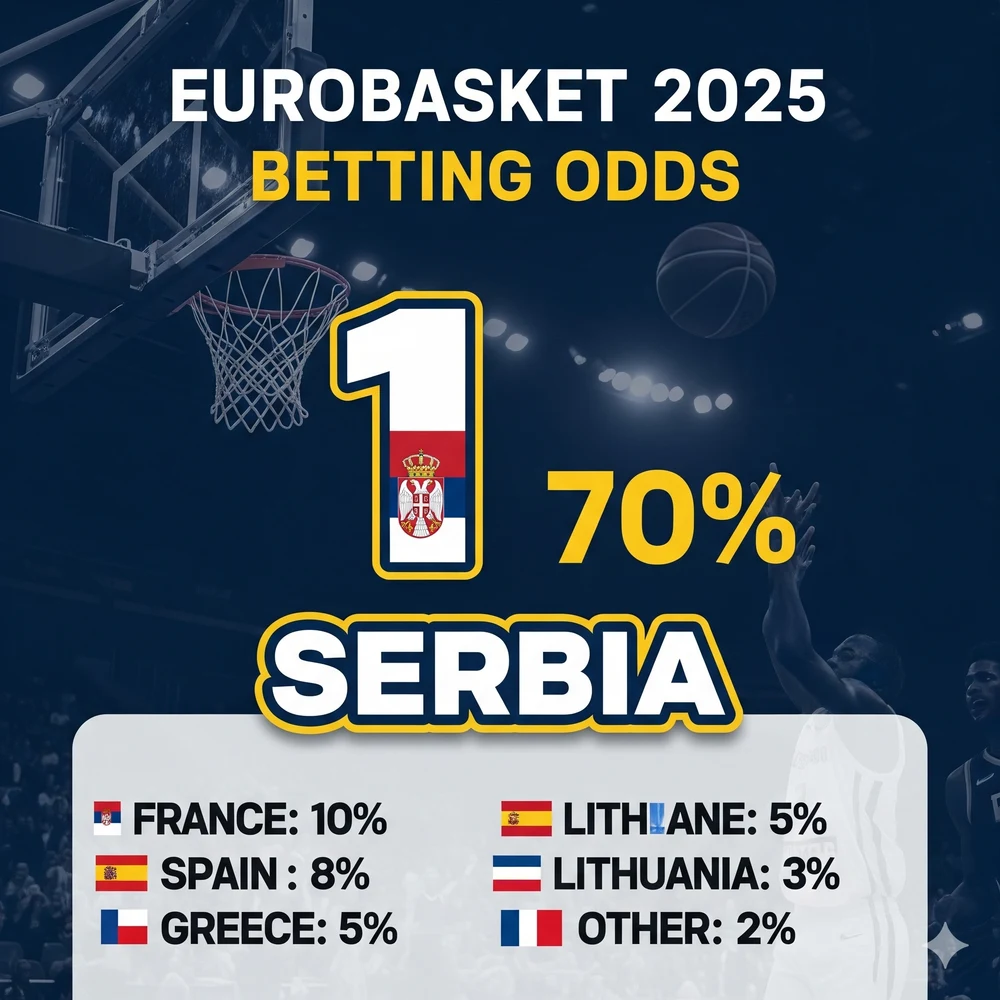
EuroBasket 2025 Betting Odds: Looking to bet on the tournament winner? Our analysis of sportsbook odds and media polls shows a unified consensus: Serbia is the clear favorite. Find out why!
EuroBasket 2025: A Strategic Analysis and Predictive Framework
This report provides a detailed, data-driven analysis of the EuroBasket 2025 tournament. It is designed for a sophisticated audience seeking a comprehensive understanding of the competitive landscape, key strategic narratives, and a refined predictive model. The insights presented go beyond surface-level observations to identify second- and third-order implications that will likely shape the tournament’s outcome.
The Tournament Landscape
This year’s EuroBasket is positioned as a litmus test for the modern European basketball landscape. While a select group of perennial powers enters with overwhelming expectations, the tournament is defined by a series of critical, real-time developments. The central narrative has shifted from a simple coronation of a favorite to a complex examination of team resilience, strategic adaptation, and the limitations of individual brilliance.
EuroBasket 2025 is a clash of titans, but the narrative is more complex than a simple coronation. While Serbia, anchored by Nikola Jokic, enters as the clear favorite, the tournament is defined by unexpected challenges—Bogdan Bogdanovic’s injury, France’s radical roster overhaul, and the formidable home-court advantage of Latvia and Finland. The ultimate champion will be the team that best navigates these strategic minefields in the single-elimination phase.
The key themes shaping this event include: Serbia’s test of resilience in the face of a critical injury to its captain and secondary playmaker; Germany’s ability to execute their proven system from the World Cup; France’s reinvention as a young, deep, and unpredictable squad; and the question of whether the individual brilliance of stars like Luka Doncic and Giannis Antetokounmpo can carry their teams to a medal.
Based on an exhaustive analysis, Serbia, despite its recent injury setback, remains the most likely candidate for the gold medal. Their path, however, is not without risk. Germany’s well-structured system makes them the most formidable opponent and a strong finalist. The tournament’s biggest positive surprises will likely be host nations Finland and Latvia, who are well-positioned to leverage their star power and home-court advantage for a deep run. Conversely, Slovenia and Spain, despite their talent, face the highest risk of disappointment due to roster instability and early struggles in the tournament.
The Contender Tier: Dissecting the Favorites
Serbia: The Nikola Jokic System Under Duress
Serbia enters EuroBasket 2025 as the world’s second-ranked team and the undisputed favorite. This confidence is rooted in a remarkable pre-tournament form, with a pristine 7-0 record in tune-up games, all won by at least 10 points. The team is built around the strategic genius of Nikola Jokic, who is also an overwhelming MVP favorite, receiving 72.2% of the media vote. The team’s roster is exceptionally deep, featuring NBA players like Nikola Jovic and Tristan Vukcevic, and EuroLeague veterans like Vasilije Micic and Marko Guduric. Serbia’s dominance in preparation games and its high ranking in EuroBasket power rankings, above even France and Germany, solidify its status. The team’s initial group stage performances, including a 98-54 victory over Estonia and an 84-80 win against Latvia, further underscore their power.
A critical pivot in Serbia’s tournament narrative, however, occurred with the hamstring injury to team captain Bogdan Bogdanovic. He has been officially ruled out for the remainder of the competition and will return to the United States for treatment. While the immediate consequence is the loss of a key offensive contributor who was averaging 9.0 points, 3.5 rebounds, and 4.0 assists , the wider implications are more profound. Bogdanovic’s absence removes a critical layer of offensive flexibility. He was a dynamic ball handler on the wing, capable of creating his own shot off the dribble or working effectively as a secondary playmaker alongside Jokic. His departure forces the team to rely more on a singular, predictable system.
This strategic shift places an immense and potentially unsustainable burden on Nikola Jokic. His 39-point performance against Latvia, a new career high with the national team, illustrates the increased offensive load he is now required to carry. While Jokic is uniquely capable of handling this responsibility, his dual role as the team’s primary scorer and playmaker creates a single point of failure. A well-executed, targeted defensive scheme from a top-tier opponent could exploit this concentrated reliance, and simple physical fatigue over a demanding tournament schedule could also become a factor. The team’s continued success, as demonstrated by their 42-22 advantage in points in the paint against Latvia, will hinge on their ability to dominate inside and for secondary players to fill the playmaking vacuum.
Germany: The Blueprint of World Champions
As the reigning FIBA World Cup champions and the third-ranked team in the world, Germany enters EuroBasket with a proven system and a deep, cohesive roster. The team is positioned as the second favorite by accredited media, receiving 10% of the votes to win the title and 64.6% of votes to finish on the podium. Their strength is rooted in a balanced attack and a high-efficiency offensive scheme, as showcased in their dominant 107-88 victory over Lithuania, which improved their record to 3-0 in Group B.
The German victory over Lithuania was a masterclass in offensive discipline. The team had three different players score over 20 points (Dennis Schroder with 26, Franz Wagner with 24, and Daniel Theis with 23), demonstrating that their offense is not easily neutralized. They set a EuroBasket record with 19 three-pointers in the game and were remarkably efficient, shooting 53% from the field. Furthermore, their ball security was impeccable, as they committed only six turnovers while forcing 18 from Lithuania, resulting in a crucial 25-7 advantage in points off turnovers. This offensive prowess is not merely a product of individual talent; it is a direct result of their team-oriented “Total Basketball” philosophy, which makes them difficult to scout and contain. This systematic approach allows them to absorb key player absences, such as that of David Kramer, without a significant drop in production, and is a key factor that differentiates them from the more star-reliant teams in the tournament.
While Germany’s offensive strength is well-documented, a full picture of their defensive consistency remains to be seen. Although German assistant coach Alan Ibrahimagic has stated the team was able to “stop their offense better” in the second half of the Lithuania game, the research does not provide specific details on their defensive schemes or their bench’s ability to hold up under pressure. This unquantified defensive factor presents a potential vulnerability in a high-stakes, single-elimination context. The ultimate test for Germany will be their ability to neutralize a singular, dominant force, such as Jokic or Antetokounmpo, which would be a far greater challenge than their impressive offensive performances thus far.
France: A New Guard, A New Identity
France, the world’s fourth-ranked team, is a consistent presence in major tournament finals, as evidenced by their Olympic silver medal and appearance in the last EuroBasket final. However, this year they arrive with a significantly reshaped roster that has led to lower expectations. Despite this, they are still considered a top-three favorite by accredited media, receiving 6.2% of the votes to win the title and 52.3% of votes for a podium finish. The team’s composition has undergone a dramatic overhaul, with eight players from the Paris Olympic team absent, including superstars like Victor Wembanyama, Rudy Gobert, and Nicolas Batum.
This dramatic roster shift has forced a fundamental change in France’s identity. The numerous high-profile absences have created an “absence of burden” advantage. The team is no longer weighed down by the heavy expectations of being the clear favorite and can instead play with a freedom and cohesion that their previous star-heavy iterations may have lacked. This approach has been remarkably effective, with France entering the tournament unbeaten in both their qualifiers and summer preparation games. Their collective strength is a powerful weapon, as their bench demonstrated by scoring 78 points in a victory over Slovenia. Young players like Alex Sarr and Zaccharie Risacher have stepped into significant roles, with Sarr, in particular, showing an ability to efficiently score and potentially serve as a breakout star. This collective, rather than individual, focus makes France a dangerous and unpredictable opponent, and a strong candidate for a positive surprise in the tournament.
Greece: The Giannis Factor and the Supporting Cast
Greece’s EuroBasket campaign is inexorably linked to the presence of its superstar, Giannis Antetokounmpo. His individual prowess is undeniable and makes Greece an immediate contender. The Greek national team, captained by Giannis, is projected to finish on the podium by 13.1% of media polls and is considered a potential positive surprise by 4.6% of voters. In their dominant 94-53 victory over Georgia, Giannis was a force, tallying 27 points, 8 rebounds, and 4 assists in just 25 minutes of play. His ability to draw double-teams and create scoring opportunities for his teammates is a foundational element of the Greek offense.
While Giannis’s dominance is a given, the success of the Greek team hinges on the performance of its supporting cast. The team has demonstrated that it is not solely reliant on its superstar. In a comeback victory against Italy, Greece overcame a 10-point deficit with a massive 27-12 quarter, a period in which Giannis sat out, highlighting the team’s ability to find success even without him. Key contributors like Konstantinos Mitoglou and Tyler Dorsey have shown their capacity for efficient scoring, with Mitoglou’s efficiency rating standing at 17.7 and Dorsey at 12.0. Furthermore, veteran point guard Kostas Sloukas is a reliable playmaker, averaging 3.3 assists per game. The presence of Giannis’s brothers on the roster, Thanasis and Kostas, also adds to the team’s collective defensive and physical identity. The synergy between Giannis’s gravity and his teammates’ contributions will determine how far Greece can advance, especially in a group that features other former champions like Spain and Italy.
The “Dangerous Outsiders”: Dark Horses and Underdogs
Latvia: Home-Court Advantage and the Porziņģis Effect
Latvia, ranked 9th in the world, is being touted as a potential “dark horse” contender. Their elevated status is primarily due to two factors: the significant home-court advantage and the return of NBA star Kristaps Porzingis. As co-hosts, Latvia will play the entire group stage and the knockout phase in their capital city, Riga. This eliminates the physical and mental fatigue of travel and provides a significant morale boost from playing in front of a home crowd. This strategic advantage cannot be overstated and is a key reason why Latvia is predicted to be a “positive surprise” by 17.7% of accredited media.
Kristaps Porzingis, the 7-foot-3 Atlanta Hawks forward, will serve as the team’s catalyst. He has already impressed in pre-tournament games, showcasing his abilities against fellow NBA stars like Luka Doncic. His presence fundamentally changes the team’s dynamic, adding a dominant force on both ends of the floor. Latvia was a surprise success story at the last World Cup, and with their star player back, they are poised to make a deep run. While they have had some defensive issues in preparation games, allowing over 100 points in two of their three losses, the home crowd and Porzingis’s impact could be enough to overcome these vulnerabilities and propel them to a podium finish, as predicted by 21.5% of the media.
Finland: Riding a Wave of Momentum
Finland enters EuroBasket as a “rising team” and is the leading candidate for the “biggest surprise” award, receiving 23.1% of media votes. Their momentum is a direct result of their excellent form and the singular brilliance of their star player, Lauri Markkanen. The team was one of only three to remain undefeated in warm-up games and will also benefit from playing their group stage games at home in Tampere, Finland.
Lauri Markkanen is described as the “alpha and omega” of the Finnish team, a player who elevates his teammates and whose contribution directly determines the team’s results. He has been dominating in preparation games, and the team’s system is built around his strengths. The offensive versatility of the team, even in Markkanen’s absence, is a testament to the system put in place by coach Lassi Tuovi, who has served as an assistant for 12 years before taking over as head coach. The team also features key contributors like Mikael Jantunen, who provides EuroLeague-level support in the paint and from beyond the arc, and veteran shooter Sasu Salin, who can have “shooting explosions capable of ‘killing’ the opponent”. The combination of a top-tier NBA talent, a disciplined system, and a loud home crowd makes Finland a genuine threat to upset established powers and secure a spot in the knockout stage.
Group Stage: A Predictive Breakdown
The group stage will be crucial for determining the knockout bracket matchups. A single loss can significantly impact a team’s path to the finals, as a lower seed will face a higher-seeded opponent in the Round of 16.
- Group A (Riga, Latvia): The clear favorite is Serbia, despite the injury to Bogdan Bogdanovic. Latvia, with their home-court advantage and the return of Kristaps Porzingis, should secure a spot in the top three. The final qualifying spot will likely be a battle between Turkey, who started the tournament strong with a dominant victory over Latvia, and Czechia.
- Predicted Qualifiers: 1. Serbia, 2. Turkey, 3. Latvia, 4. Czechia.
- Group B (Tampere, Finland): This is arguably the most competitive group, with Germany (reigning world champions), Lithuania (a traditional power), and Finland (a rising team with home-court advantage) vying for the top spots. Germany and Finland have started the tournament with a perfect 3-0 record, showcasing their strength and cohesion. Lithuania will have to fight to secure a top-three seed, while Sweden is expected to clinch the final qualifying spot.
- Predicted Qualifiers: 1. Germany, 2. Finland, 3. Lithuania, 4. Sweden.
- Group C (Limassol, Cyprus): This group, dubbed the “group of champions,” has already delivered a major upset with Georgia’s victory over defending champion Spain. Greece, with Giannis, and Italy have both looked formidable in the early going. The defending champions, Spain, will have to fight to secure a top seed after their early loss.
- Predicted Qualifiers: 1. Greece, 2. Italy, 3. Spain, 4. Georgia.
- Group D (Katowice, Poland): France’s collective effort has already proven to be a problem for Slovenia, who relies heavily on Luka Doncic. Host Poland has a legitimate shot at a high seed, as they have already impressed with a victory over Slovenia. Israel and Belgium will likely battle for the final qualifying spot, with Israel getting the nod.
- Predicted Qualifiers: 1. France, 2. Poland, 3. Slovenia, 4. Israel.
The Knockout Bracket: Projecting the Final Phase
The Round of 16 matchups are pre-determined based on group standings, with Group A teams facing Group B teams, and Group C teams facing Group D teams. This structure means that a team’s group seeding is critically important, as a lower seed can lead to a more difficult path to the final. For example, a third-place finish for Slovenia would likely pit them against the second-place team from Group C, which could be a strong contender like Italy or Spain, making their path to a medal significantly harder.
The following projected bracket outlines a potential path for the contenders, setting the stage for a fascinating clash of basketball philosophies. Serbia’s dominant, Jokic-centric system will likely meet Germany’s fluid, team-oriented approach, which would be a battle of individual brilliance versus collective cohesion. The tournament’s final phase will be won not just by talent, but by which system can best counteract the other.
Projected Knockout Stage Bracket
| Round of 16 | Quarterfinals | Semifinals | Final |
|---|---|---|---|
| Serbia (A1) | Serbia | Serbia | Serbia |
| vs. Sweden (B4) | vs. Lithuania | vs. France | vs. Germany |
| — | Lithuania | — | Winner |
| Latvia (A3) | vs. Latvia | — | |
| vs. Lithuania (B2) | — | Germany | |
| — | Germany | Germany | — |
| Germany (B1) | vs. Latvia | vs. Finland | |
| vs. Czechia (A4) | — | ||
| — | — | ||
| Greece (C1) | Greece | Greece | |
| vs. Israel (D4) | vs. Italy | vs. Slovenia | |
| — | Italy | — | |
| Spain (C3) | vs. Spain | ||
| vs. Italy (D2) | — | ||
| — | France | France | |
| France (D1) | vs. Poland | vs. Greece | |
| vs. Georgia (C4) | — | ||
| — | Poland | Slovenia | |
| Poland (D2) | vs. Slovenia | ||
| vs. Slovenia (D3) |
Note: This is a predictive model based on the analysis of early tournament performance and pre-tournament data.
Player and Team Performance Predictions
TISSOT MVP and Top Performer Awards
The data from accredited media polls reveals a clear split in predictions for the TISSOT MVP and the statistical leaders. While Nikola Jokic is the overwhelming favorite for the MVP award, receiving 72.2% of the votes, Luka Doncic is the top pick for top scorer (35.2%) and assists leader (30.4%). Giannis Antetokounmpo is a significant contender for all three awards, with 16.0% of votes for top scorer, 10.4% for top rebounder, and 4.2% for the decisive shot.
This distinction is rooted in the strategic context of their respective teams. Luka Doncic’s “Doncic-or-bust” situation means that with a weakened roster and key player absences, he is forced to take on an immense offensive load, making him the most likely player to rack up high scoring and assist numbers. His talent is extraordinary, but his team’s limitations may prevent them from reaching the final. In contrast, Nikola Jokic is expected to lead his team to victory, and in a team-centric tournament, the MVP award often goes to the best player on the championship-winning team. Thus, Jokic’s role as the central fulcrum of the tournament’s best team makes him the primary MVP candidate, even if his individual statistics don’t surpass Doncic’s.
| Award | Predicted Winner | Rationale |
|---|---|---|
| TISSOT Most Valuable Player | Nikola Jokic (Serbia) | As the leader of the tournament favorite, he is the most influential player on the best team. His role has expanded even further with Bogdanovic’s injury. |
| Top Scorer | Luka Doncic (Slovenia) | With a weakened supporting cast and a heavy offensive burden, Doncic will be forced to take on an immense scoring load to keep his team competitive. |
| Top Rebounder | Nikola Jokic (Serbia) | Ranked first in media polls with 58.4% of the votes, his size, strength, and court vision make him a dominant force on the boards. |
| Assists Leader | Luka Doncic (Slovenia) | Doncic’s primary role as his team’s central playmaker, combined with his exceptional passing ability, positions him to lead in assists. |
Biggest Surprise and Disappointment
Accredited media polls suggest that Finland (23.1%) and Latvia (17.7%) are the most likely positive surprises of the tournament, while Spain (26.9%) and Greece (15.4%) are predicted to be the biggest disappointments.
The analysis of the tournament confirms these trends. For both Finland and Latvia, their home-court advantage is a powerful catalyst that can’t be underestimated. For Finland, it’s the sheer dominance of Lauri Markkanen, who is in peak form and leading an undefeated team in warm-up games. For Latvia, it’s the return of Kristaps Porzingis, who provides a star presence to a team that was already a surprise success at the last World Cup. Spain’s potential disappointment is rooted in a “bad summer,” with numerous absences and injuries that have made their roster adjustments difficult. Greece’s risk of disappointment stems from a potential overreliance on Giannis and a supporting cast that could struggle to consistently perform against the deepest teams in the knockout rounds.
External Market Analysis: Media Polls and Betting Odds
A comprehensive review of external data from accredited media polls and sportsbooks reveals a strong consensus on the tournament’s overall narrative. Both media (73.1% to win) and betting odds (Serbia favored) align perfectly in identifying Serbia as the clear tournament favorite. The widespread belief in Serbia’s dominance, anchored by Jokic, is a consistent theme across all sources.
A fascinating strategic nuance emerges when comparing the predictions for the tournament winner with those for individual awards. While both media and bettors see Serbia as the most likely champion, they project Luka Doncic to lead in key statistical categories like scoring and assists. This suggests a sophisticated and nuanced understanding of the competitive landscape: a belief that a star can perform at an elite, record-setting level, but his team’s inherent weaknesses—be it lack of depth, injuries, or a difficult bracket path—will ultimately prevent them from achieving the ultimate prize.
This analysis concludes that the market is valuing both team cohesion and individual brilliance in a complex and strategic manner. For the discerning analyst, this provides a clear framework for identifying not only the most probable tournament winner but also the key players who will define the narrative, regardless of their team’s ultimate outcome. The final champion will be the team that possesses the best combination of these factors, and the evidence points to Serbia as the team most likely to achieve that balance.
Leo Falsafi is a digital marketing veteran and senior journalist at Virlan.co, where he covers the intersection of digital marketing, gaming, and breaking US trending news. With nearly two decades of hands-on experience in SEO and digital strategy, Leo has consulted for and scaled hundreds of companies. His deep industry roots allow him to deliver sharp, fact-checked insights and analysis on the trends shaping today's digital landscape.