
Understanding Moneyline Betting: Mechanics, Market Dynamics, and Strategic Implications
Moneyline betting represents the most fundamental form of sports wagering, centering exclusively on predicting the outright winner of a sporting event. Its inherent simplicity makes it highly accessible to new participants, while its underlying market dynamics offer considerable strategic depth for seasoned bettors.
Moneyline Bets: Guide & Strategy
The core mechanism involves payouts determined by “money line” odds, which employ positive and negative integers to distinctly identify underdogs and favorites, respectively. These odds directly dictate potential returns, with higher payouts associated with riskier underdog selections and comparatively lower returns for favored teams. Although the act of placing a Moneyline bet is straightforward, the odds themselves are influenced by a sophisticated interplay of statistical analysis, prevailing public sentiment, and real-world factors such as team news.
This dynamic market environment implies that while the concept is simple, understanding the forces that shape the odds is crucial for informed wagering. Moneyline betting proves particularly advantageous in sports where draws are uncommon or when opportunities arise to identify undervalued underdog teams, potentially yielding significant returns.

1. Introduction to Moneyline Betting
Moneyline bets are direct wagers placed on the ultimate outcome of a game, specifically focusing on which team or competitor will secure an outright victory.1 This foundational betting type typically presents only two possible outcomes: either the chosen team wins, or it loses.
However, it is noteworthy that certain events, such as combat sports, may occasionally include a third option for a draw.2 This direct approach to wagering on the winner distinguishes Moneyline betting from more intricate betting mechanisms that involve handicaps or total scores.
The defining characteristic of Moneyline betting is its remarkable simplicity. It is widely regarded as the least complicated form of wager because its objective is singularly focused on identifying the winning side.2
This ease of comprehension makes it an exceptionally popular choice, particularly for individuals new to the realm of sports betting.3 The straightforward nature of simply picking a winner serves as an inviting entry point into the broader world of sports wagering.
Despite its apparent simplicity, the underlying processes that govern Moneyline betting odds are considerably complex. While the act of placing a wager is uncomplicated, the determination and adjustment of these odds involve sophisticated algorithms, extensive statistical analysis, and dynamic market forces.6
This creates a compelling contrast: the ease with which one can place a Moneyline bet belies the intricate calculations and market responses that shape the potential payouts.
For casual bettors, the simplicity offers an accessible gateway, but for those seeking to maximize their returns, a deeper understanding of how these odds are derived and whether they truly represent value becomes essential. This duality transforms what appears to be a simple wager into a more nuanced financial decision for those who delve into the market’s intricacies.
Also read: Is Sports Betting Legal in Your State? The 2025 U.S. Legal Landscape Explained
2. Understanding Moneyline Odds: Favorites and Underdogs
Moneyline odds are predominantly presented using the American odds format, which is characterized by the use of positive (+) or negative (-) integers.2 This specific format is widely adopted and prevalent across sportsbooks in the United States.3 Understanding these numerical representations is crucial for interpreting the implied probabilities and potential payouts associated with each team.
A negative number, such as -170 or -400, consistently indicates the favored team or competitor in a match.2 This signifies that the team with negative odds is statistically expected to win the event. The numerical value itself represents the amount of money a bettor must risk in order to achieve a $100 payout. For instance, if a team has a Moneyline of -400, a bettor would need to wager $400 to realize a $100 profit.2 This structure implies that betting on a favored team offers a lower return on investment due to their higher probability of winning.
Conversely, a positive number, such as +150 or +300, denotes the underdog in the contest.2 This indicates that the team with positive odds is considered less likely to win the match. The positive numerical value directly illustrates how much profit a bettor would gain from a successful $100 wager. For example, if an underdog team is listed at +300, a successful $100 bet would yield a $300 profit.2 This higher potential payout compensates for the increased risk associated with betting on a team less likely to win.
The odds, whether positive or negative, directly reflect the implied probability that sportsbooks assign to each side winning.6 A higher positive odd signifies a lower implied probability of that team winning but, consequently, a higher potential profit for the bettor.10
This establishes a fundamental inverse relationship between risk, reward, and implied probability. When the implied probability of an outcome decreases (as is the case with underdogs), the potential profit for a successful wager increases. Conversely, as the implied probability of an outcome rises (for favored teams), the potential profit diminishes.
This principle is not unique to sports betting; it is a core tenet of risk pricing observed across various financial markets. Recognizing this inverse relationship is paramount for bettors to move beyond simply picking a winner and instead evaluate the intrinsic value of a bet based on the perceived probability versus the offered payout.
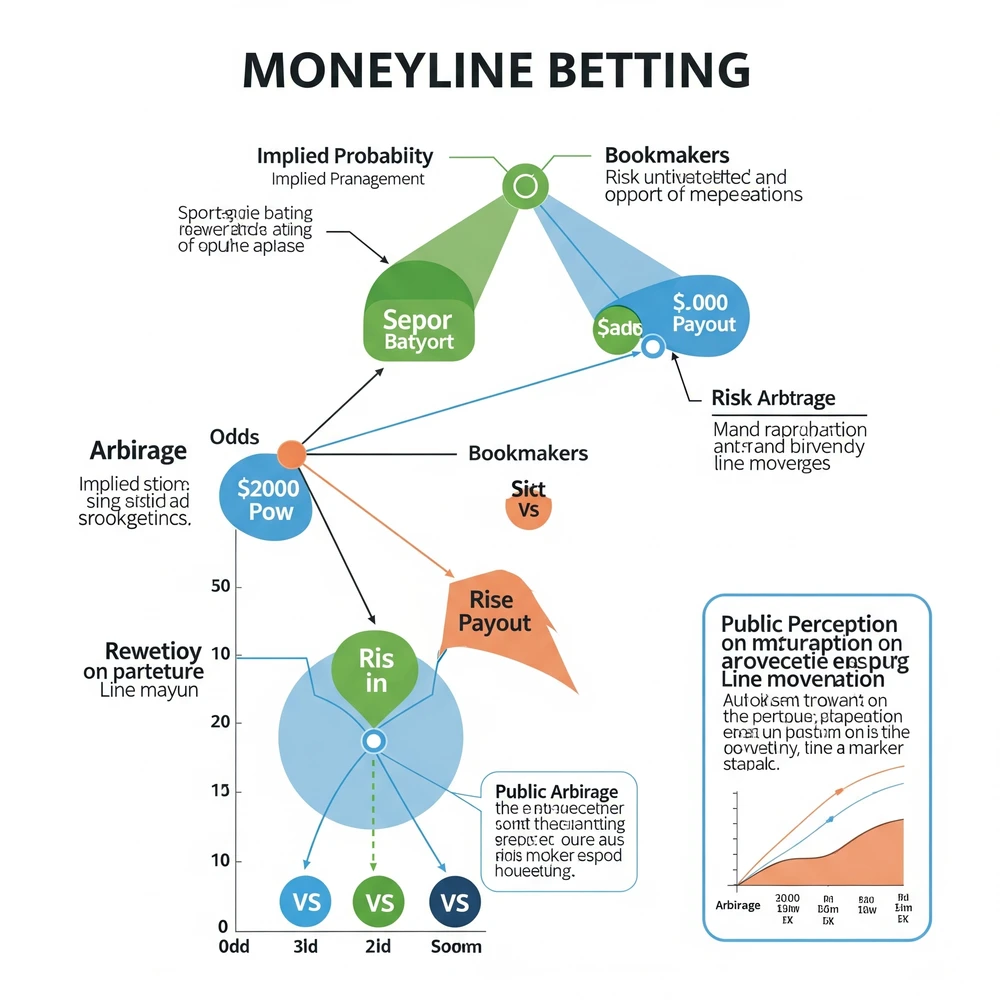
3. Calculating Your Payouts: Practical Examples
Understanding how to calculate potential payouts is essential for any Moneyline bettor. The calculations differ slightly depending on whether one is betting on a favorite (negative odds) or an underdog (positive odds). In all winning scenarios, the original bet amount is returned along with the winnings.8
For bets placed on favorites (negative odds), the negative number (let’s denote it as -X) indicates that a bettor must risk $X to win $100 in profit. For example, if the Moneyline is -400, a successful bet requires risking $400 to gain a $100 profit, resulting in a total payout of $500 ($400 initial risk + $100 profit).2 To calculate the profit for a stake other than $100, one can divide the desired stake by the absolute value of the odds (e.g., $50 / 400 = 0.125) and then multiply by 100 (0.125 * $100 = $12.50 profit).
For bets placed on underdogs (positive odds), the positive number (let’s denote it as +Y) signifies that a $100 bet would yield a $Y profit. For instance, if the Moneyline is +300, a successful $100 bet would result in a $300 profit, leading to a total payout of $400 ($100 initial risk + $300 profit).2 To determine the profit for a different stake, one can divide the odds by 100 (e.g., 300 / 100 = 3) and then multiply this result by the desired stake (3 * $50 = $150 profit).
To illustrate these calculations across various common stake amounts and odds, the following table provides practical examples of potential profits and total payouts:
Table 1: Moneyline Payout Examples
| Odds | Stake Amount | Potential Profit | Total Payout |
| -500 | $10 | $2.00 | $12.00 |
| -500 | $50 | $10.00 | $60.00 |
| -500 | $100 | $20.00 | $120.00 |
| -500 | $500 | $100.00 | $600.00 |
| -200 | $10 | $5.00 | $15.00 |
| -200 | $50 | $25.00 | $75.00 |
| -200 | $100 | $50.00 | $150.00 |
| -200 | $500 | $250.00 | $750.00 |
| -150 | $10 | $6.67 | $16.67 |
| -150 | $50 | $33.33 | $83.33 |
| -150 | $100 | $66.67 | $166.67 |
| -150 | $500 | $333.33 | $833.33 |
| +150 | $10 | $15.00 | $25.00 |
| +150 | $50 | $75.00 | $125.00 |
| +150 | $100 | $150.00 | $250.00 |
| +150 | $500 | $750.00 | $1250.00 |
| +200 | $10 | $20.00 | $30.00 |
| +200 | $50 | $100.00 | $150.00 |
| +200 | $100 | $200.00 | $300.00 |
| +200 | $500 | $1000.00 | $1500.00 |
| +500 | $10 | $50.00 | $60.00 |
| +500 | $50 | $250.00 | $300.00 |
| +500 | $100 | $500.00 | $600.00 |
| +500 | $500 | $2500.00 | $3000.00 |
This table offers a clear visual representation of how different odds and stake amounts translate into tangible profits and total payouts, providing a practical reference for bettors.
Also read: How Crypto is Transforming the World of Sports Betting
4. Moneyline vs. Other Popular Betting Types
To fully contextualize Moneyline betting, it is beneficial to compare it with other prevalent forms of sports wagering. This section will primarily focus on Point Spread betting and provide a brief overview of Over/Under betting.
4.1. Moneyline vs. Point Spread Betting
The fundamental distinction between Moneyline and Point Spread betting lies in their core objectives. Moneyline betting is a straightforward wager solely on the outright winner of a contest, whereas Point Spread betting introduces a handicap designed to equalize the playing field between two teams.3
In Point Spread betting, a specific margin, known as the “spread,” is assigned. This spread is a negative number for the favored team (e.g., -7 points) and a positive number for the underdog (e.g., +7 points).3 For a bet on the favored team to be successful, that team must win by more than the assigned spread (e.g., win by 10 points if favored by 9.5).3
Conversely, for a bet on the underdog to win, the underdog must either win the game outright or lose by a margin smaller than the assigned spread (e.g., win outright or lose by 8 points if receiving 9.5 points).3 A unique scenario in Point Spread betting is a “push,” which occurs if the game’s final score lands precisely on the spread, resulting in the original stake being returned to the bettor.3
The odds and payout structures also differ significantly between these two betting types. In Moneyline betting, the odds are highly variable, directly reflecting the perceived strength difference between the competing teams. This leads to lower payouts for favored teams due to their higher probability of winning and substantially higher payouts for underdogs, compensating for their lower probability.3
Point Spread betting, by contrast, typically features odds closer to -110 for both sides, aiming for similar payouts regardless of which team is chosen, because the handicap effectively balances the perceived strength.3 This -110 figure usually incorporates the bookmaker’s commission, often referred to as “juice” or “vig”.3
Strategically, Moneyline betting is often considered ideal for wagering on underdogs, as it offers the potential for significantly higher payouts, particularly in matches where teams are unevenly matched.3 However, for heavy favorites, Moneyline betting may yield relatively lower profits in the long run.4
Point Spread betting, on the other hand, can offer better potential returns when betting on favorites, as it reduces the required stake for a given payout compared to a heavy Moneyline favorite.3 It also mitigates risk when betting on underdogs, as they do not necessarily need to win outright, only to “cover the spread”.3 This form of betting often necessitates a more in-depth analysis of team performance.4
In terms of typical sports where each is prevalent, Moneyline betting is common in sports like baseball, hockey, and soccer, where game outcomes are less reliant on large margins of victory.4 Point Spread betting, conversely, is most frequently observed in American football and basketball, sports where scoring is generally more predictable and winning by a certain margin is a key factor in the game’s dynamics.3
The following table provides a concise comparison of Moneyline and Point Spread betting:
Table 2: Comparison of Moneyline and Point Spread Betting
| Feature | Moneyline Betting | Point Spread Betting |
| Betting Focus | Outright winner of the game. | Margin of victory or defeat (handicap). |
| Odds Display | Positive (+) for underdogs, negative (-) for favorites (e.g., +150, -200). | Typically around -110 for both sides. |
| How Wager Wins | Chosen team simply wins the game. | Favorite wins by more than the spread; underdog wins outright or loses by less than the spread. |
| Payout Structure | Variable: Lower for favorites, higher for underdogs. | Similar for both sides due to the handicap. |
| Complexity | Simple and straightforward. | More complex, involves a numerical handicap. |
| Strategic Advantage | High reward on underdogs, simplicity. | Better return on favorites, reduced underdog risk, evens the playing field. |
| Common Sports | Baseball, Hockey, Soccer. | American Football, Basketball. |
4.2. Brief Overview of Over/Under Betting
An Over/Under (O/U) bet, also referred to as a “total,” represents a distinct type of wager where a sportsbook establishes a predicted number for a specific statistic within a game.12 Most commonly, this statistic is the combined total score of both teams participating in the event. Bettors then place their wagers on whether the actual number achieved in the game will be higher (“over”) or lower (“under”) than this predetermined line.12 Unlike Moneyline betting, the focus here is not on predicting the winning team but rather on the collective performance metric.
The mechanics of an Over/Under bet are straightforward: bettors simply choose if the final statistic will exceed or fall short of the set line.12 A “push” scenario occurs if the actual number precisely matches the predicted line, in which case all wagers are refunded to the bettors.13
While the combined total score is the most frequent application, Over/Under bets can extend to various other statistical categories. Examples include the total number of yards or attempts in American football, assists or turnovers in basketball, or home runs and RBIs in baseball.13 This highlights the versatility of this betting type beyond just game scores.
The differing focuses of Moneyline, Point Spread, and Over/Under betting reveal divergent betting philosophies. Moneyline betting is exclusively concerned with the outright winner.1 Point Spread betting introduces a handicap to the winning outcome.3 Over/Under betting, however, shifts the entire focus to performance metrics that are independent of which team ultimately wins or loses.12
This fundamental difference means that each betting type caters to a distinct analytical approach and risk appetite. A bettor might excel at predicting which team will win, or how close a game will be, or whether a game will be high-scoring. This segmentation suggests that successful bettors often align their wagering strategy with their specific predictive strengths, choosing the betting market that best suits their analytical capabilities.
Also read: Esports Betting Tips and Strategies
5. Factors Influencing Moneyline Odds
Moneyline odds are not static figures; they are dynamic reflections of perceived probabilities, constantly influenced by a complex array of factors that sportsbooks diligently monitor and adjust for.
The initial setting of betting lines by sportsbooks relies heavily on a sophisticated blend of statistical analysis and complex algorithms.6 These advanced models integrate a vast amount of quantitative data, including historical team performance, individual player statistics, head-to-head matchups, and other relevant metrics.13 This data-driven foundation forms the bedrock upon which the initial odds are established, representing the sportsbook’s objective assessment of each team’s likelihood of winning.
Beyond the initial algorithmic assessment, Moneyline odds are significantly impacted by public sentiment and overall market demand. Market sentiment refers to the collective opinion and betting patterns of the public, which are often swayed by media narratives, recent game outcomes, and inherent biases.7
This can lead to “public overreactions”: when a team or player garners excessive hype due to a string of successes or a compelling storyline, a large influx of public money can cause their odds to shorten, potentially moving them away from their true statistical probability.14 Conversely, teams perceived as struggling might see their odds inflated beyond their actual chances.14
Sportsbooks actively adjust odds based on betting volume to manage and balance their liability, ensuring they maintain profitability regardless of the game’s outcome.7 This means that heavy betting on one side will typically cause those odds to decrease, while simultaneously increasing the odds for the opposing side.7 A critical distinction exists between “sharp money” (professional traders and high-stakes bettors) and general public betting. Sharp money, driven by deep statistical analysis and specialized knowledge, influences odds far more significantly than the collective wagers of casual bettors.7 Bookmakers closely monitor and react to large movements of sharp money, adjusting their odds to protect their margins.7
External factors and breaking team news also play a crucial role in influencing Moneyline odds. The absence of key players due to injuries or suspensions can dramatically alter a team’s prospects and lead to significant shifts in the odds.7
Environmental conditions, such as rain, strong winds, or extreme temperatures, can impact gameplay, particularly in outdoor sports, necessitating corresponding adjustments to the odds.7 Furthermore, managerial changes, especially the arrival of a new coach with a proven track record, can boost a team’s perceived chances of winning, leading to shorter odds as the market anticipates improved performance.7 These real-world variables provide new information that requires rapid and continuous odds adjustments.
It is important to recognize that the odds displayed by sportsbooks never perfectly reflect the true probability of an event.8 A profit margin, commonly known as “vig” or “over-round,” is always factored into the odds by the bookmaker.6
This inherent edge ensures that the payout to a successful bettor is always slightly less than what they would receive if the odds represented the exact, fair chances of the outcome.8 For example, if a bettor were to wager on both outcomes in a two-sided event, they might risk $104.76 to receive $100 back, with the $4.76 difference representing the bookmaker’s built-in profit.8 This structural advantage is fundamental to the sportsbook’s business model.
The continuous adjustment of odds based on statistical models, public betting patterns, team news, and the influence of sophisticated bettors illustrates that the betting market functions as a highly dynamic information aggregator. It constantly processes and incorporates all available data—be it quantitative analysis, market sentiment, or real-world events—into the price of the odds.
This real-time information processing means that for a bettor to gain an advantage, they must either possess superior information (e.g., knowledge of an injury before it is widely known) or employ more robust analytical models that can identify mispricings before the market fully integrates the information. This also implies that any “inefficiencies” in the market are typically transient opportunities, exploitable only by those who can react swiftly or analyze more effectively.
Furthermore, the influence of public sentiment highlights the role of behavioral biases in shaping odds. Public bettors frequently make decisions influenced by emotions, recent successes, or popular narratives rather than purely objective analysis.14
This emotional decision-making can lead to predictable patterns of mispricing in the market. For instance, a team on a winning streak might become “overhyped,” leading to their odds being artificially shortened due to excessive public backing.14 This creates opportunities for analytical bettors who can “fade the public” – that is, bet against the popular consensus – and identify “overvalued favorites and undervalued underdogs”.14 Such strategic approaches leverage the market’s temporary irrationalities, transforming behavioral economics principles into potential wagering advantages.
6. Strategic Applications and Common Sports
Moneyline betting, despite its simplicity, offers specific scenarios where its application can be particularly advantageous for bettors.
One of the most notable advantages of Moneyline betting arises when wagering on underdogs. If a bettor’s analysis suggests that an underdog team has a legitimate and strong chance of winning outright, Moneyline betting can offer significantly higher payouts due to the positive odds associated with these less-favored teams.3
This potential for a substantial return makes it an attractive option in what are perceived as uneven matches, where betting on the underdog can yield a much greater profit compared to betting on the favorite.5 For bettors who prioritize a straightforward wager without the complexities of handicaps or total scores, Moneyline remains the simplest and most accessible choice.3 Additionally, in sports where ties are either rare or result in a refund of the wager, Moneyline bets simplify the outcome to a clear win or loss, removing ambiguity.5
Moneyline is widely considered the most popular type of sports bet overall, largely due to its inherent simplicity.5 It is especially common and advantageous in sports where the outcome is less dependent on a large margin of victory.4 For example, in
baseball, games are frequently decided by a small number of runs, making the outright winner the most natural and primary focus for wagering.4 Similarly,
hockey games can be low-scoring affairs, where the emphasis is squarely on which team secures the victory, rather than the goal differential.4
Soccer matches also frequently conclude with minimal goal differences or even draws, making Moneyline betting (which often includes an option for a draw) a natural and fitting choice for the sport.4
The suitability of a betting market is often dictated by the inherent scoring dynamics of the sport itself. For instance, Moneyline betting thrives in sports like baseball, hockey, and soccer because their outcomes are less about a large winning margin and more about simply securing the victory.4
Conversely, Point Spread betting is more prevalent in sports like American football and basketball, where scoring is more predictable, and winning by a specific margin is a key aspect of the game’s strategy and outcome.4 This illustrates a direct causal relationship: the intrinsic nature of a sport’s scoring and outcome variability influences which betting market is most appropriate and widely adopted.
A sophisticated bettor understands this alignment, tailoring their betting strategy to the specific characteristics of the sport, thereby leveraging the betting instrument that best reflects the game‘s typical flow and results.
7. Conclusion: Simplicity, Risk, and Responsible Betting
Moneyline betting distinguishes itself in the sports wagering landscape through its fundamental simplicity, allowing bettors to focus exclusively on predicting the outright winner of an event. Its intuitive odds format, which clearly delineates favorites from underdogs, effectively communicates the inherent risk and potential reward associated with each selection.
Despite its straightforward nature, Moneyline betting, like all forms of gambling, carries inherent financial risks. A critical aspect to understand is the bookmaker’s profit margin, often referred to as “vig” or “over-round,” which is consistently factored into the odds.2 This structural element ensures a negative expected return for the bettor over the long term, meaning the bookmaker consistently maintains an advantage.2
This is not merely a “con” but the fundamental economic model upon which the betting industry operates; the house must have an edge to remain profitable. This perspective underscores that consistent long-term profitability for an individual bettor is statistically challenging due to this built-in structural advantage. It reinforces the importance of viewing betting as a form of entertainment rather than a reliable source of income, unless one possesses a significant analytical edge to exploit temporary market inefficiencies.
While simple to grasp, successful Moneyline betting benefits significantly from a comprehensive understanding of the complex factors that influence odds. These factors include rigorous statistical analysis, the dynamic influence of market sentiment, and real-world events such as team injuries or managerial changes. Identifying undervalued opportunities, particularly among underdog teams, can indeed offer higher returns, but this potential reward is always accompanied by a proportionally greater risk.
The burgeoning landscape of legal sports betting further amplifies the importance of informed decision-making and responsible gambling practices. The 2018 U.S. Supreme Court decision paved the way for states to legalize sports betting, a trend that has led to its legality in 38 states and Washington, D.C. as of September 2024.2
This widespread legalization signifies a rapidly expanding industry and increased accessibility for the public. Such growth, while creating economic opportunities for states and operators, also presents new regulatory challenges and potential societal impacts, including the increased prevalence of problem gambling.
Given these inherent risks and the expanding accessibility of betting, it is paramount to engage in gambling responsibly. Resources such as the National Council on Problem Gambling (available at 1-800-GAMBLER or 1800gamblerchat.org) are readily available to provide support for individuals who may be experiencing gambling-related difficulties.2
Leo Falsafi is a digital marketing veteran and senior journalist at Virlan.co, where he covers the intersection of digital marketing, gaming, and breaking US trending news. With nearly two decades of hands-on experience in SEO and digital strategy, Leo has consulted for and scaled hundreds of companies. His deep industry roots allow him to deliver sharp, fact-checked insights and analysis on the trends shaping today's digital landscape.