For over a decade, ranking the “best states for business” was a predictable math equation: subtract taxes, add logistics, and measure the permitting speed. But in 2026, the equation has fundamentally changed. The strategic case for artificial intelligence has been won, and businesses are shifting from debate to execution.
Today, the most competitive states aren’t just offering cheap land and tax incentives — they are building the infrastructure, talent pipelines, and regulatory frameworks required to power an AI-driven economy.
Based on the latest 2026 research, here is how the US states stack up when it comes to doing business in the age of AI.
1. The Traditional Heavyweights vs. The AI Contenders
If you look purely at traditional business metrics, the Southeast still dominates. According to Area Development’s latest Top States for Doing Business survey, Georgia claimed the No. 1 spot for the 12th consecutive year, followed closely by South Carolina, Texas, North Carolina, and Ohio.
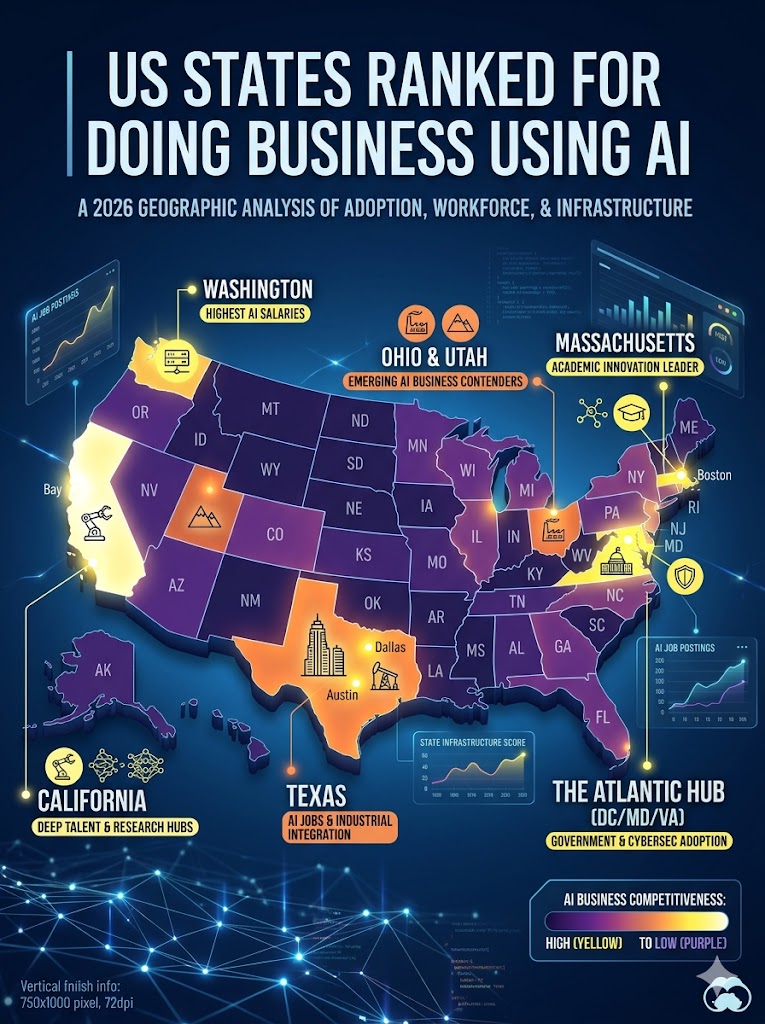
However, when you overlay AI readiness onto these traditional business hubs, the map shifts. States like Texas and Ohio are effectively bridging the gap between old-school industrial strength and next-generation tech.
- Ohio ranks as a top 5 state for doing business overall and is leveraging its massive industrial base (over 700,000 manufacturing jobs) to drive robotics and AI integration. Institutions like the University of Cincinnati are actively investing in experiential upskilling to shorten the adoption curve for digital technologies.
- Texas not only dominates in real estate and site availability but is experiencing explosive growth in AI roles across its energy, healthcare, and financial sectors.
2. Who is Actually Using AI? (The Adoption Leaders)
Having a pro-business environment is one thing; actual operational integration is another. According to Q1 2026 data from Visual Capitalist, AI adoption is spreading rapidly beyond traditional coastal tech hubs.
Here are the jurisdictions leading the nation in the share of their working-age population using AI:
- Washington, D.C.: 40.3%
- Maryland: 36.3% (bolstered by defense contractors and cybersecurity firms)
- Utah: 35.7% (a prime example of a fast-growing, younger workforce accelerating tech adoption)
- Texas: 35.3%
Key insight: University and research communities act as massive accelerators. For example, Williamsburg, Virginia, recorded the highest localized AI adoption rate in America at 73.2%. Similarly, North Carolina is emerging as a major corporate AI hub, ranking 9th nationally, with over 22% of its businesses currently utilizing AI for operational tasks (per a 2026 LendingTree report).
3. The State AI Readiness Index: Who is Building the Infrastructure?
To understand long-term viability, researchers at the Rutgers Policy Lab recently developed the State AI Readiness Index, which evaluates states across four pillars: government policy, AI workforce, data quality, and infrastructure.
- The Top 10 (High Readiness): States like California, Massachusetts, and New Jersey lead the pack. They have comprehensive, statewide AI visions, well-funded research hubs, and deep talent pipelines. Massachusetts benefits from heavyweights like MIT and Harvard, while California relies on the gravitational pull of Silicon Valley.
- The Middle 30 (Medium Readiness): States like Texas, Illinois, and North Carolina fall here. They boast strong private-sector AI innovation (e.g., in Austin and Chicago) but currently lack cohesive, centralized statewide AI governance strategies.
- The Bottom 10 (Low Readiness): States such as West Virginia, New Mexico, and South Carolina struggle with limited AI-specific policies, a lack of specialized education programs, and unequal broadband/cloud infrastructure.
4. The Talent War: Where the AI Workforce is Going
For businesses relying on AI, talent acquisition is the single biggest bottleneck. A 2026 analysis by Research.com highlights where AI degree graduates are heading to build their careers:
- Job Availability: California, Texas, and New York lead the nation in entry-level AI jobs. California demands software and cloud engineers; Texas seeks interdisciplinary skills for healthcare and fintech; New York focuses on enterprise business analytics.
- Compensation vs. Cost of Living: Washington and California offer the highest salaries, with roles like Computer and Information Research Scientists pushing past the mid-$170,000s. However, growing hubs like Texas and Massachusetts (offering mean salaries between $120,000–$140,000) are highly competitive when adjusting for the cost of living.
The Bottom Line
The 2026 data reveals a clear divide. The states that will win the next decade of business are those combining traditional business fundamentals (like fast permitting and robust logistics) with aggressive investments in AI infrastructure and talent. Right now, Texas and California represent the two different ends of that winning spectrum, while states like Ohio, Utah, and North Carolina are proving that the AI boom is no longer strictly a coastal phenomenon.
Author & Outlet Report: This article quotes research and rankings from Area Development, Visual Capitalist, Research.com, LendingTree (via WCNC), and the Rutgers Policy Lab’s State AI Readiness Index (authored by Ojobo Agbo Eje, Michael Akinwumi, Itzhak Yanovitzky, and Kristoffer Shields).

Leo Falsafi is a digital marketing veteran and senior journalist at Virlan.co, where he covers the intersection of digital marketing, gaming, and breaking US trending news. With nearly two decades of hands-on experience in SEO and digital strategy, Leo has consulted for and scaled hundreds of companies. His deep industry roots allow him to deliver sharp, fact-checked insights and analysis on the trends shaping today’s digital landscape.