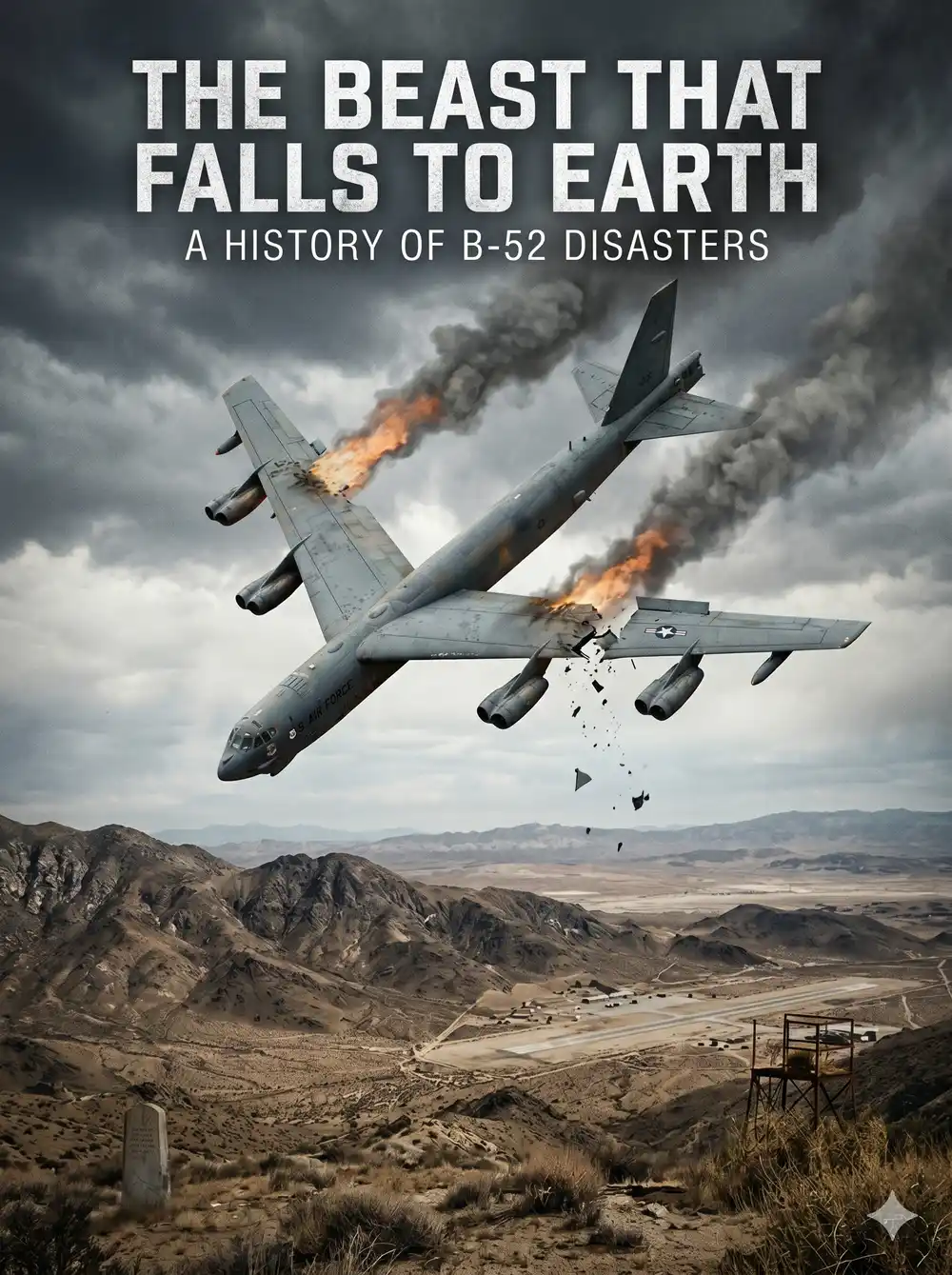
On June 15, 2026, the aviation world was jolted by breaking news out of California: a B-52 bomber crashed shortly after takeoff at a military base, leaving eight personnel presumed dead. While federal authorities and the military are just beginning to comb through the wreckage, the incident serves as a grim, real-time reminder of the immense risks associated with operating the longest-serving combat aircraft in aviation history.
The Boeing B-52 Stratofortress—affectionately (and accurately) nicknamed the “BUFF” (Big Ugly Fat F*cker)—first took to the skies in 1952. Originally developed by the U.S. Strategic Air Command (SAC) to deliver atomic bombs to the Soviet Union, the BUFF was later converted into a flying dump truck for conventional ordnance during Vietnam, and it has remained the backbone of American air superiority ever since. With its eight jet engines and 160-foot wingspan, it is an incredible projection of power.
But a machine that carries up to 70,000 pounds of payload is highly unforgiving of mechanical failures, adverse weather, and human arrogance. From dropped nuclear weapons to fatal airshow stunts, the history of B-52 crashes is a harrowing chronicle of Cold War paranoia, environmental disasters, and catastrophic leadership failures.
Here are the most infamous B-52 crashes that altered military history.
1. The Goldsboro “Broken Arrow” (January 24, 1961)
During the height of the Cold War, a B-52G bomber broke apart mid-air over rural Wayne County, North Carolina. As the fuselage disintegrated, the aircraft dropped its payload: two Mark 39 thermonuclear bombs, each with a yield hundreds of times more powerful than the bomb dropped on Hiroshima.
One of the bombs parachuted to the ground, its firing mechanisms engaging one by one as it descended. Only a single, simple low-voltage switch prevented the bomb from detonating and turning North Carolina into a nuclear wasteland. The government heavily misled the public about the risk of radioactivity and the armament state of the bombs to prevent mass panic, establishing a playbook of secrecy that would define “Broken Arrow” (nuclear accident) protocols for decades.
2. Radioactive Snow in Palomares (1966)
In 1966, a routine mid-air refueling maneuver went disastrously wrong over Palomares, Spain. A B-52 collided with its KC-135 tanker, destroying both aircraft and killing seven airmen.
The bomber was carrying four hydrogen bombs. While none of them yielded a nuclear explosion, two of the bombs hit the ground hard enough that their conventional explosives detonated, fracturing the cores and spreading highly radioactive plutonium dust over the Spanish farming village. The U.S. military quietly dispatched 1,388 personnel—mostly low-ranking cooks, grocery clerks, and band members with little to no hazardous material training—to scrape up the radioactive dirt, sparking decades of mass litigation over veteran disability and toxic exposure.
3. The “Lost Bomb” of Thule, Greenland (January 21, 1968)
In one of the most heavily scrutinized crashes of the 20th century, a B-52 was crippled by a severe cabin fire after a crew member placed seat cushions too close to a hot air duct. The crew abandoned the aircraft over the Arctic ice near Thule Air Base in Greenland.
The bomber crashed through the sea ice, shattering its four hydrogen bombs and contaminating the frozen landscape with plutonium. While the official stance of both the U.S. and Danish governments has always been that all four weapons were destroyed, declassified documents and BBC investigations later revealed frantic searches by a submersible (Star III) and widespread rumors of a “missing bomb” abandoned at the bottom of the sea. The cleanup workers faced immense health concerns, cementing the Thule crash as a haunting case study in Arctic environmental disaster.
4. Czar 52 and the Arrogance of “Bud” Holland (June 24, 1994)
While the Cold War crashes were often blamed on mechanical failure or experimental operational tempos, the crash of “Czar 52” was purely a failure of human leadership.
Lt. Col. Arthur “Bud” Holland was a B-52 instructor pilot stationed at Fairchild Air Force Base in Washington. For years, Holland flew like a rogue pilot, treating the massive bomber like a fighter jet—flagrantly violating pitch and bank limits, and illegally flying at treetop levels over crowds. Despite junior officers being terrified to fly with him, his command structure willfully ignored his dangerous behavior.
On June 24, 1994, while practicing for an airshow, Holland attempted a tight 360-degree turn around the control tower at an altitude of just 250 feet. The massive aircraft banked past 90 degrees, lost its lift, stalled, and clipped a power line before exploding into the ground. All four field-grade officers on board, including copilot Lt. Col. Mark McGeehan, were killed instantly. Today, the “Czar 52” crash is universally taught in military academies and corporate boardrooms as the textbook definition of toxic command climates and failed leadership.
The Legacy of the BUFF
As we await further details on the tragic June 2026 crash in California, we are reminded that the B-52 is more than just an airplane. It is a flying fortress carrying the weight of 70 years of American history. It is a marvel of engineering that has “cheated death” countless times, yet remains tragically bound to the unforgiving laws of gravity and human error.
Sources & Authors Report: This article synthesizes breaking updates from LiveNOW from FOX and Fire Engineering, historical features by Michael T. Klare (Arms Control Today), and academic/historical case studies by S. O’Brien, T. Kern, M. Mitchell, S.L. Wagner, and the Danish Institute for International Studies.

Leo Falsafi is a digital marketing veteran and senior journalist at Virlan.co, where he covers the intersection of digital marketing, gaming, and breaking US trending news. With nearly two decades of hands-on experience in SEO and digital strategy, Leo has consulted for and scaled hundreds of companies. His deep industry roots allow him to deliver sharp, fact-checked insights and analysis on the trends shaping today’s digital landscape.