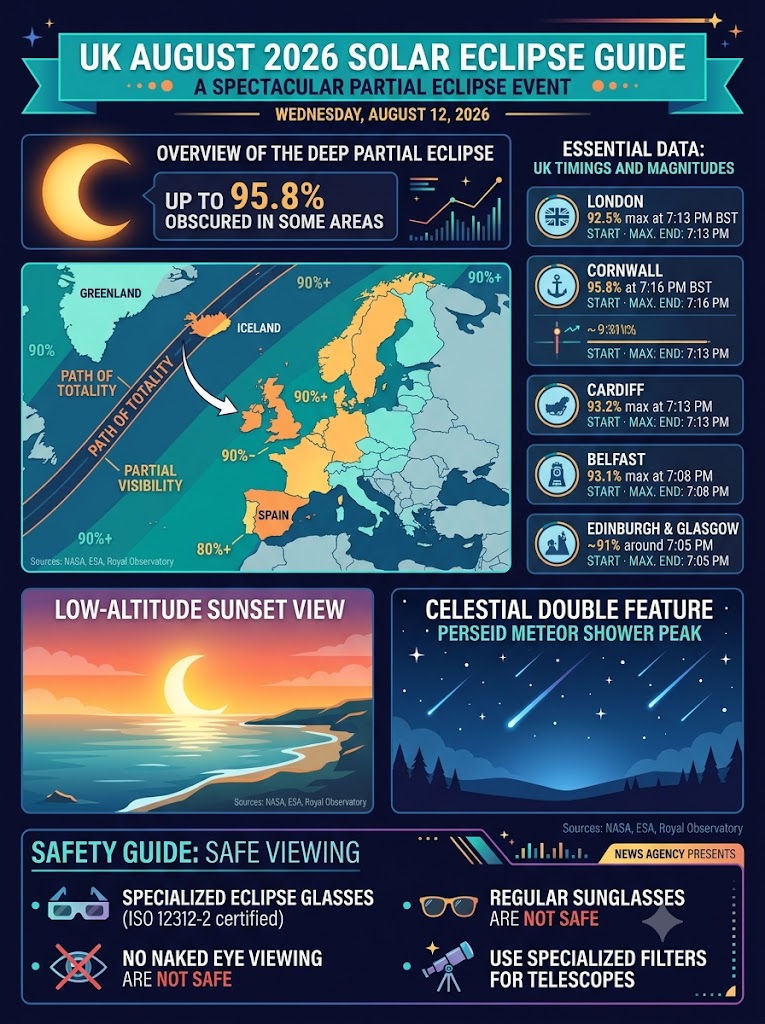
In the late afternoon of Wednesday, August 12, 2026, the sky over Europe will undergo a profound transformation. As the sun begins its descent toward the western horizon, the moon will sweep across its face, plunging select regions of the continent into darkness and offering the United Kingdom its most spectacular astronomical event in decades.
While the elusive “path of totality” will trace a narrow arc through Greenland, western Iceland, and northern Spain, the UK is perfectly positioned to witness a deeply dramatic partial eclipse. According to data from the Royal Observatory Greenwich, mainland Britain will see upwards of 90 percent of the sun obscured, creating an eerie, twilight-like atmosphere during the evening rush hour.
The 2026 Path of Totality: Where Day Turns to Night
To understand the magnitude of the August 2026 solar eclipse, you have to look at its geographic footprint. NASA and the European Space Agency (ESA) have mapped a counter-clockwise trajectory for the shadow. Totality begins over the remote Arctic Ocean, sweeps across eastern Greenland and western Iceland, and finally barrels through northern Spain and the northeastern tip of Portugal right before sunset.
For those stationed along the center line in Iceland or the North Atlantic, the total phase will last up to 2 minutes and 18 seconds. However, chasing totality requires significant travel and navigating potentially fickle coastal cloud cover.
For millions in the UK, staying home still guarantees a front-row seat to an exceptionally deep partial eclipse. Because the moon will cover the sun from right to left, observers will see a distinct, frown-shaped crescent with its horns pointing downward.
UK Eclipse Timings and Magnitudes
The precise experience depends entirely on your latitude and longitude. The further south and west you travel in the British Isles, the more pronounced the darkness will be.
Here is a breakdown of what to expect during the event’s maximum phase, based on timing data from the Royal Observatory Greenwich and Time and Date:
- London: The partial eclipse begins at 6:17 p.m. BST. Maximum obscuration hits at 7:13 p.m. (92.5% coverage), before concluding at 8:06 p.m.
- Cornwall (Land’s End): This southwestern outpost will boast some of the most dramatic views in the country, experiencing an impressive 95.8% coverage peaking around 7:16 p.m.
- Cardiff: Skywatchers in Wales will see 93.2% of the sun hidden at maximum eclipse (7:13 p.m.).
- Belfast: Reaching its peak at 7:08 p.m., the Northern Irish capital will experience 93.1% coverage.
- Edinburgh & Glasgow: Both Scottish cities will see roughly 91% coverage just after 7:05 p.m.
Even at the absolute northern extremity of the UK, the SaxaVord Spaceport on Unst in the Shetland Islands will still witness a remarkable 87.9% obscuration.
A Sunset Silhouette and a Celestial Double Feature
What elevates the August 2026 event beyond a standard partial eclipse is its low altitude. Unlike midday eclipses, this phenomenon will unfold as the sun sits roughly 10 to 15 degrees above the western horizon. Skywatchers will be treated to the surreal optical illusion of a giant “bite” being taken out of the setting sun. Photographers are already scouting elevated vantage points, coastal cliffs, and western-facing parks to capture the crescent sun sinking into the landscape.
Furthermore, August 12 delivers a remarkable astronomical coincidence. Just hours after the solar eclipse concludes, darkness will usher in the annual peak of the Perseid meteor shower. As Earth plows through the debris trail left by Comet Swift-Tuttle, observers in areas with low light pollution could see dozens of shooting stars per hour, making it a once-in-a-generation double spectacle.
Will the UK see a total solar eclipse in 2026?
No. The UK sits just a few hundred miles outside the path of totality. However, the entire country will experience a very deep partial eclipse ranging from 87% to nearly 96% obscuration. Astronomers note that you will have to wait until the year 2090 for a true total solar eclipse to be visible from mainland Britain.
Is it safe to look at the partial eclipse?
Absolutely not with the naked eye. Because the eclipse is strictly partial in the UK, there is no period where the sun is entirely covered. Staring directly at the crescent sun can cause permanent retinal damage. You must use specialized solar eclipse glasses stamped with the “ISO 12312-2” safety certification. Regular sunglasses, no matter how dark, do not offer adequate UV protection.
Sources Quoted: NASA; European Space Agency (ESA); Royal Observatory Greenwich; BBC Sky at Night Magazine; Time and Date.

Leo Falsafi is a digital marketing veteran and senior journalist at Virlan.co, where he covers the intersection of digital marketing, gaming, and breaking US trending news. With nearly two decades of hands-on experience in SEO and digital strategy, Leo has consulted for and scaled hundreds of companies. His deep industry roots allow him to deliver sharp, fact-checked insights and analysis on the trends shaping today’s digital landscape.