The 178 MPH Ride That Ended in Tragedy
On July 10, 2026, 35-year-old Lewis Baker of Tadmarton, Milton Keynes, stood before Aylesbury Crown Court to answer for what seasoned crash investigators are calling the most reckless motorcycle riding they have encountered in decades.
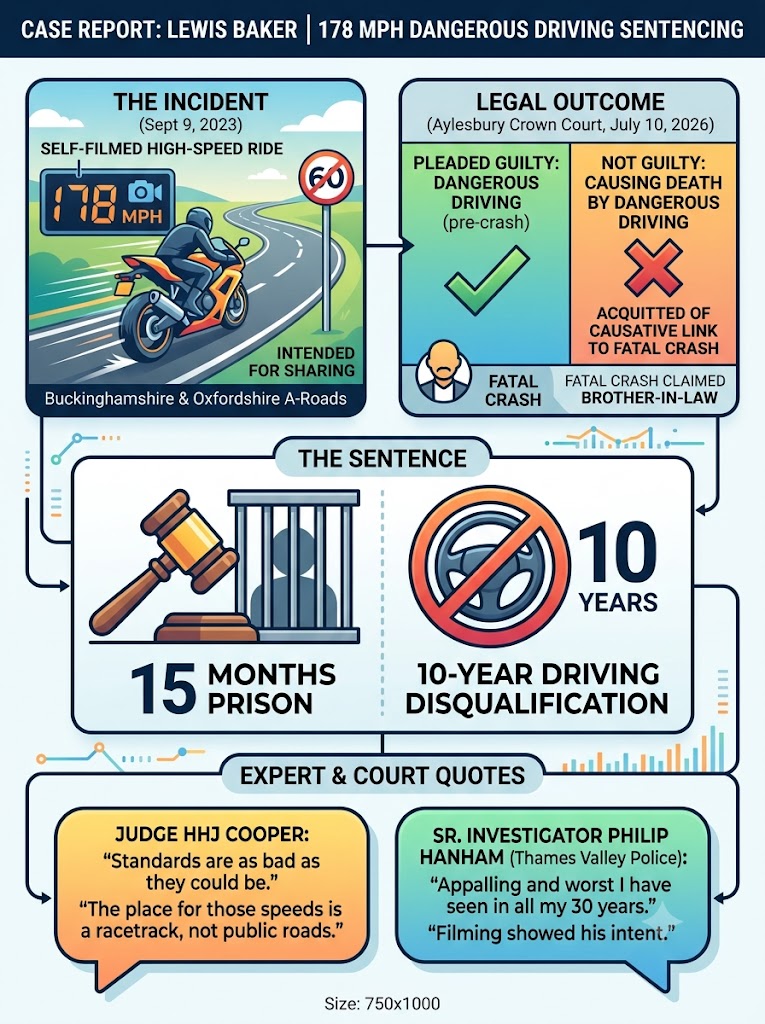
The courtroom proceedings brought a complicated conclusion to a devastating incident from September 9, 2023. On that day, Baker drove his motorcycle across public A-roads in Buckinghamshire and Oxfordshire at staggering speeds, reportedly hitting 178 mph shortly before a catastrophic collision. The crash ultimately claimed the life of Baker’s brother-in-law.
Despite the tragic outcome, the jury’s verdict drew a sharp legal distinction. Baker was found not guilty of causing death by dangerous driving. He did, however, plead guilty to one count of dangerous driving for his actions leading up to the crash.
Aylesbury Crown Court: “As Bad As It Could Be”
During sentencing, the court reviewed footage recorded by Baker himself. The prosecution revealed that Baker had intentionally filmed his ride, capturing his speedometer maintaining sustained speeds over 130 mph and occasionally breaching the 160 mph mark before peaking at 178 mph. The stated intent behind the recording was to share the footage with others.
Baker, addressing his own behavior, admitted to the court that he had driven like a “menace.”
Presiding Judge HHJ Cooper handed down a 15-month prison sentence alongside a severe 10-year driving disqualification. In his closing remarks, Cooper characterized Baker’s riding standards as “as bad as it could be,” emphasizing that public highways are entirely unequipped for such extremes. “The place for driving at those very high speeds,” the judge noted, “was a racetrack, not the public roads.”
Police Perspective on the Sentencing
Thames Valley Police offered a grim assessment of the evidence collected. Senior Investigator Philip Hanham of the Serious Collision Investigation Unit did not mince words when discussing the digital footprint Baker left behind.
“Dangerous riding puts lives at risk and can have the most devastating consequences,” Hanham stated. “Baker’s riding was appalling and is the worst I have seen on a motorbike in all my 30 years as a police officer and investigator. On the day of this appalling riding, Baker was filming his dangerous riding with the intention of sharing with others. This showed his intent to ride in the dangerous manner that he was rightly sentenced for today.”
The Lewis Baker Verdict
For those tracking the legal boundaries of vehicular homicide versus dangerous driving convictions in the UK, the specifics of this case highlight several critical legal thresholds:
- The Verdict Distinction: A guilty plea for dangerous driving does not automatically equate to liability for a subsequent fatality, as evidenced by Baker’s acquittal on the charge of causing death by dangerous driving.
- The Sentence: Baker received a 15-month custodial sentence and a 10-year ban from driving.
- The Evidence: Self-recorded video footage intended for social sharing served as the primary evidence of the defendant’s prolonged, excessive speeding on Buckinghamshire and Oxfordshire A-roads.
Why was Lewis Baker found not guilty of causing death by dangerous driving?
In UK law, securing a conviction for causing death by dangerous driving requires the prosecution to prove beyond a reasonable doubt that the specific standard of the defendant’s driving was the direct, causative factor of the death. While Baker admitted to driving at highly dangerous speeds, the jury concluded that the specific legal burden linking his driving to his brother-in-law’s fatal crash was not met, leading to his acquittal on that specific charge.
What is the standard sentence for dangerous driving in the UK?
Under UK guidelines, dangerous driving (without causing death or serious injury) carries a maximum penalty of two years in prison, an unlimited fine, and a mandatory minimum driving disqualification of 12 months. Baker’s 15-month sentence and exceptionally long 10-year ban reflect the extreme, sustained nature of his speeding—which reached 178 mph—and the multiple breaches of the law committed during the ride.
Sources Quoted: Information, quotes, and case specifics were extracted directly from primary press statements published by Thames Valley Police (July 10, 2026), the Oxford Mail, and breaking news updates from BBC World News.

Leo Falsafi is a digital marketing veteran and senior journalist at Virlan.co, where he covers the intersection of digital marketing, gaming, and breaking US trending news. With nearly two decades of hands-on experience in SEO and digital strategy, Leo has consulted for and scaled hundreds of companies. His deep industry roots allow him to deliver sharp, fact-checked insights and analysis on the trends shaping today’s digital landscape.